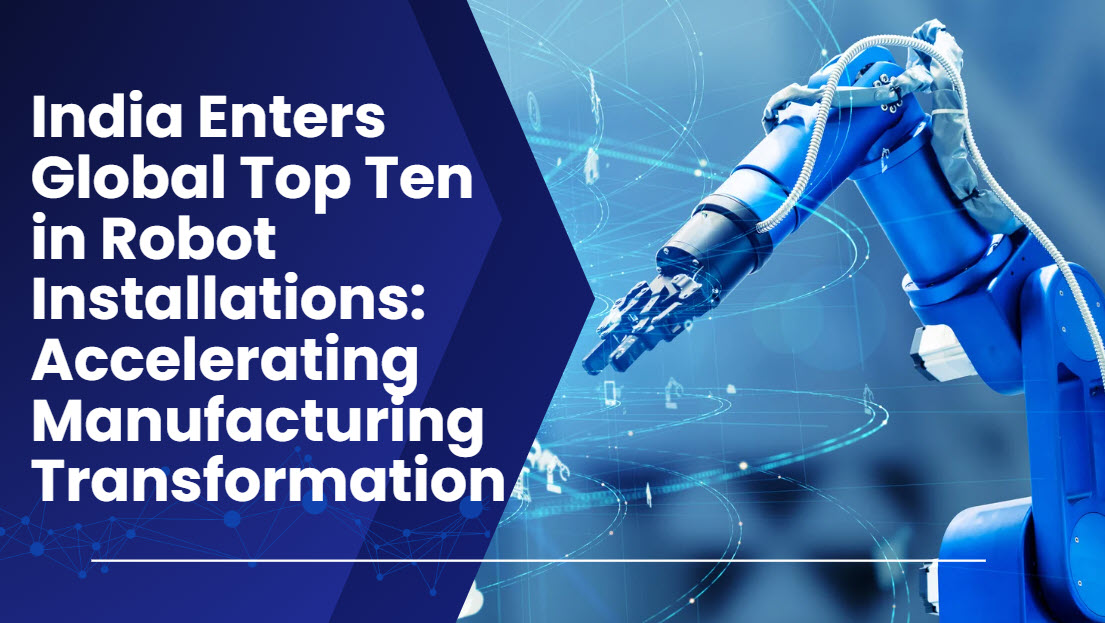
India has reached a significant milestone in its industrial automation journey—emerging as one of the top global markets for industrial robot installations, according to the latest report by the International Federation of Robotics. This achievement highlights the country’s accelerating shift toward smart manufacturing, Industry 4.0, and global competitiveness.
India’s Rise in Global Robot Installations
The World Robotics 2025 report reveals that India installed approximately 9,100 industrial robots in 2024, marking a steady growth of about 7% compared to the previous year.
This growth has propelled India to the 6th position globally in annual robot installations, placing it firmly within the top ten robot markets worldwide.
This is a remarkable progression considering:
- India ranked 7th in 2023 with 8,510 units installed
- The country has steadily climbed the global rankings in recent years
In terms of total operational robots, India now has over 52,000 industrial robots in use, ranking around 10th globally.
Global Context: A Booming Robotics Market
Globally, industrial robot adoption continues to surge. The IFR report states that over 542,000 robots were installed worldwide in 2024, more than double the number a decade ago.
Asia dominates this growth:
- 74% of global robot installations are in Asia
- China alone accounts for 54% of global demand
Within this landscape, India stands out as one of the fastest-growing emerging markets, indicating strong long-term potential.
Key Drivers Behind India’s Growth
1. Automotive Industry Leading the Way
The automotive sector remains the largest driver of robot adoption in India, accounting for approximately 45% of total installations.
Applications include:
- Spot welding
- Assembly automation
- Painting and material handling
With the rise of EV manufacturing, automation demand is expected to grow even further.
2. Expansion into New Industries
While automotive dominates, other sectors are rapidly adopting robotics:
- Electronics and semiconductor manufacturing
- Metal fabrication and machining
- Chemicals and pharmaceuticals
This diversification indicates that robotics is no longer limited to large OEMs.
3. Push for Industry 4.0 and Digital Manufacturing
Indian manufacturers are increasingly investing in:
- Smart factories
- Digital twins
- Automation and robotics
Government initiatives such as Make in India and Production Linked Incentive (PLI) schemes are also accelerating adoption.
4. Labor and Productivity Factors
Rising labor costs in organized manufacturing and the need for consistent quality are pushing companies toward automation.
Robots help:
- Improve productivity
- Reduce errors
- Ensure repeatability
The Opportunity: High Growth Potential Ahead
Despite entering the top ten, India still has significant room for growth.
One of the most telling metrics is robot density (robots per 10,000 workers):
- India: ~5–7
- Global average: 162
- South Korea: 1,000+
This gap highlights a massive opportunity for expansion.
India is expected to:
- Cross 10,000+ annual installations soon
- Potentially double adoption by the end of the decade
Challenges to Address
While growth is strong, several challenges remain:
- Low robot density compared to global leaders
- High initial investment for SMEs
- Skill gaps in robotics programming and integration
- Limited awareness in smaller manufacturing units
Addressing these challenges will be critical to sustaining momentum.
Impact on Indian Manufacturing
India’s entry into the global top ten for robot installations signals a major shift:
1. Increased Global Competitiveness
Automation enables Indian manufacturers to meet international quality standards and compete globally.
2. Faster Production & Scalability
Robots allow companies to scale production efficiently while maintaining consistency.
3. Improved Quality & Precision
Automation reduces defects and improves repeatability in manufacturing processes.
4. Attraction of Global Investments
A strong automation ecosystem makes India more attractive for global manufacturing investments.
India’s rise into the global top tier of robot installations is a clear indicator of its transformation into a modern manufacturing hub. With strong growth in industrial automation, increasing adoption across sectors, and supportive government policies, the country is well-positioned to become a major force in global manufacturing.
However, the journey is just beginning. Bridging the gap in robot density, expanding adoption among MSMEs, and building a skilled workforce will be key to unlocking India’s full potential.
Download International Federation of Robotics Report 2025 – https://ifr.org/ifr-press-releases/global-robot-demand-in-factories-doubles-over-10-years