Home Blog Page 11

CIMdata to Bring its PLM Certificate Program to Paris, France from Jun 8-12

0

ANN ARBOR, MI, USA, Mar 18, 2026 – CIMdata, Inc., the leading global strategic consulting and research firm focused on PLM (Product Lifecycle Management) and its digital transformation, announces the offering of its industry-standard PLM Certificate Program in Paris (La Defense), France, from 8-12 June.

This intensive, week-long program is designed to equip PLM professionals with the actionable strategic frameworks and high-level knowledge they need to formulate and execute effective PLM strategies. Participants gain expertise in addressing common challenges while taking a deep dive into advanced topics—including the practical application of AI, IoT, and Digital Twins—through guided discussion and structured problem-solving sessions.

The program is assessment-based and delivers a personalized classroom experience, comprehensive individual and team-based exercises, and rigorous achievement evaluations. CIMdata experts, with decades of hands-on, industry-recognized expertise, guide participants through this five-day program. Upon successful completion of the program and assessments, participants receive the prestigious Certificate of PLM Leadership.

CIMdata’s Edge in PLM Education

With over forty years of industry leadership, CIMdata has a proven record of guiding industrial companies in developing and executing top-tier PLM strategies and tactics. Whether you’re starting a new PLM journey or are already working on implementing PLM, this program supports all levels of expertise.

“As digital transformation initiatives become more complex and urgent, the need for high-impact PLM education has never been greater,” said Cheryl Peck, CIMdata’s Chief Marketing Officer. “With our decades of experience and deep industry insight, CIMdata is uniquely positioned to help PLM professionals overcome evolving challenges and succeed.”

Along with the 5-day Standard PLM Certificate program, CIMdata offers a one-day Executive Short Course, a two-day PLM Fundamentals for Solution Providers Short Course, and a three-day Core PLM Certificate program.

Certificate Program March26 Structure

For more information on CIMdata’s PLM Certificate Program and short courses, visit our website at https://www.cimdata.com/en/education/plm-certificate-program.

About CIMdata

CIMdata, a global strategic management consulting firm, provides services designed to maximize an enterprise’s ability to design, deliver, and support innovative products and services. For more than forty years, CIMdata has provided industrial organizations, providers of digital technologies and services, and investment firms with world-class insight, expertise, and best-practice methods on a broad set of product lifecycle management (PLM) topics and the digital transformation they enable. CIMdata also offers research, subscription services, publications, and education through certificate programs and international conferences. To learn more, visit www.CIMdata.com or email info@CIMdata.com.

Invitation
Siemens sd17

DMG MORI Launches DMF 600|11 Travelling Column Machine with DMF Working Area of 6 Meter Travel

0
Dmf 600

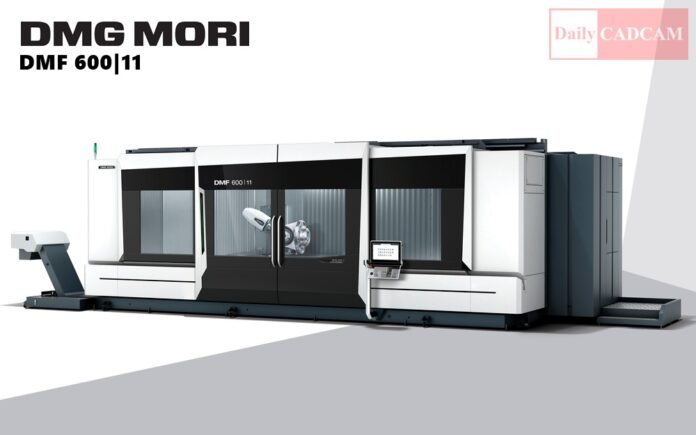
TOKYO, Japan, Mar 18, 2026 – DMG MORI’s DMF moving column machines stand for maximum efficiency in the 5-axis precision machining of long structural components and other complex workpieces. With the new DMF 600|11, the series is expanding to include a model for XXL machining. Components measuring up to 6,000 x 1,100 x 1,050 mm and weighing up to 12,000 kg can be accommodated in the machining compartment. An optional partition wall divides this into two areas measuring 3,600 x 1,100 x 1,050 mm. Independent configurations with an A axis or C axis are possible in each area. The rotary tables can be loaded with up to 2,000 kg and enable 5-axis machining of workpieces with a diameter of up to 1,400 mm and a height of 1,050 mm. The version with a partition wall allows a second job to be set up during the main processing time. In times of increasing component diversity and single-part production, for example in the semiconductor or die & mold sectors, this ensures high flexibility and optimal utilization of the DMF 600|11.

Precise and powerful machining for every application

The DMF 600|11 achieves high accuracy and surface quality thanks to its highly stable design. The cast machine bed, three linear guides on the X-axis—which are located outside the machining compartment—and a symmetrical structure ensure a consistently rigid construction across the entire machining compartment. Extensive cooling measures in the spindle, the drives, the B axis, and the ball screws ensure long-term thermal stability. The available spindles address different applications. 

speedMASTER spindles with speeds ranging from 15,000 rpm to 20,000 rpm are used for precision milling, while powerMASTER spindles with a torque of up to 430 Nm enable heavy-duty machining of demanding materials. As standard, the DMF 600|11 achieves rapid traverse speeds of 42 m/min and acceleration of 4 m/s² in all axes. The optionally available Dynamic Package increases these values to 80 m/min in the X-axis and 60 m/min in the Y- and Z-axes, as well as acceleration of 6 m/s².

Up to 300 tools and optimized tool changer

The tool magazine of the DMF 600|11 offers space for 40 ISO40 tools up to 400 mm in length (ISO50: 450 mm / HSK100: 540 mm) as standard. The magazine can be expanded in the background to up to 300 tool positions, which minimizes setup times when there is a high degree of component variation. As with the smaller sister models, tool changes in the DMF 600|11 are also carried out behind the table, thus ruling out collisions.

Future-proof manufacturing with process integration and automation

In the 5-axis version, the DMF 600|11 offers everything you need for efficient complete machining of demanding workpieces. The possibilities range from a milling-turning table to the process integration of gear cutting, grinding, fine drilling, and deep hole drilling. Machining in a single clamping frees up capacity on other machines, reduces throughput times, and ensures consistent quality. An automation interface further increases the productivity of the DMF 600|11. Here, for example, the MATRIS system implements autonomous manufacturing processes around the clock. Driverless transport systems from the AMR series also supply the machine with material and tools. This type of automated manufacturing increases productivity and reduces the workload for skilled workers, who can then concentrate on preparing new orders and quality control.

About DMG MORI

DMG MORI is a worldwide leading manufacturer of high-precision machine tools and sustainable technologies that are at the heart of global value chains. In the “Global One Company” more than 12,000 employees are in direct contact with over 100,000 customers from 57 industries. DMG MORI is globally present in 88 countries with 16 production plants, 113 sales and service locations.

Integrated automation and end-to-end digitization solutions expand the core business with lathes and milling machines, ultrasonic, lasertec and additive manufacturing. The entire manufacturing know-how from more than 152 years flows into technology excellence for the focus industries Aerospace, Automotive, Die & Mold, Medical and Semiconductor. Customer-oriented services accompany the entire life cycle of a machine tool – including training, repair, maintenance and spare parts service. The strategic fit of automation, digitization and sustainability fits perfectly with DMG MORI’s vision and mission statement: We empower our customers in manufacturing and digitization! We want to be the most attractive machine tool manufacturer worldwide with digital and sustainable products!

Siemens Launches Fuse EDA AI Agent for Automation across Semiconductor, 3D IC and PCB System Workflows

0
EDA SIEMENS
  • Fuse EDA AI Agent autonomously orchestrates multi-agent workflows across Siemens’ complete electronic design automation (EDA) portfolio, from design conception through manufacturing sign-off, increasing engineering efficiency and design quality
  • Builds on top of the Fuse EDA AI system, which provides an advanced retrieval-augmented generation (RAG) framework, multimodal EDA data support, secure agentic orchestration with Model Context Protocol (MCP) and Agent Skills support, along with an open framework for third-party integration
  • Supports NVIDIA Agent Toolkit, Nemotron models and NVIDIA AI infrastructure for enhanced tool calling and reasoning capabilities

March 16, 2026. Plano, Texas, USA: Siemens today announced the Fuse™ EDA AI Agent system, a purpose-built domain-scoped autonomous AI agent that plans and orchestrates multi-tool and multi-agent complex semiconductor, 3D IC and printed circuit board (PCB) system workflows that span across design, verification and manufacturing sign-off. Supporting NVIDIA Agent Toolkit, advanced Nemotron models and NVIDIA AI infrastructure, the Fuse EDA AI Agent manages workflows across Siemens’ comprehensive EDA portfolio, delivering automation that significantly accelerates engineering productivity and achieves higher-quality designs.

“Fuse EDA AI Agent represents the next evolution of our Fuse EDA AI system, moving from in-tool AI capabilities to autonomous, end-to-end workflow orchestration,” said Amit Gupta, chief AI strategy officer, senior vice president and general manager, Siemens EDA, Siemens Digital Industries Software. “We are delivering intelligent automation across the complete EDA lifecycle, enabling our customers to dramatically reduce design cycles while maintaining the highest quality standards. Our open architecture allows customers to integrate their own workflows and models, providing the flexibility required for enterprise-scale AI deployment. This positions the industry to maintain a competitive advantage in an increasingly complex semiconductor and PCB system landscape.”

Fuse EDA AI Agent builds upon Siemens’ Fuse™ EDA AI system, which features a sophisticated RAG pipeline, a multimodal EDA-specific data lake, specialized parsers for EDA file formats, customizable access controls, support for multiple AI models and an open approach for third-party integrations.

Comprehensive coverage across the semiconductor and PCB system workflow

The Fuse EDA AI Agent delivers end-to-end domain-scoped automation by planning, orchestrating and executing processes across the full design lifecycle. In the front-end design and verification stages, Fuse Agent supports the automation of architectural exploration, design planning, and register-transfer level (RTL) coding with Siemens’ Catapult™ software. For digital verification, Fuse Agent assists with testbench generation, debugging and more through integration with the newly launched Questa One Agentic Toolkit.

As designs move to physical implementation, the Fuse Agent assists with place-and-route, timing closure, and power optimization through direct integration with Siemens’ Aprisa™ software. Fuse Agent accelerates custom design and verification with Siemens’ Solido™ software, along with hardware-assisted verification with the Veloce™ hardware-assisted verification and validation system. Fuse Agent also accelerates physical verification sign-off by automating design rule check (DRC) violation analysis and resolution through integration with industry-leading Calibre® software. For 3D IC, it drives power/ground load optimization and automated creation of signal path plan clustering in Innovator3D IC™ software. For PCB systems, it aids layout, signal integrity and other analyses in Xpedition™ software and Hyperlynx™ software. Additionally, it supports the manufacturing readiness workflow through Tessent™ software for design-for-test (DFT) workflows and integration with Calibre optical proximity correction (OPC) products.

Key capabilities of the Fuse EDA AI Agent

Standard AI tools struggle with semiconductor and PCB system design because they lack the proprietary domain knowledge needed to interpret dense, physics-based EDA data. Generic agentic AI platforms may also introduce IP risk considerations, including the possibility of inadequate access controls across folders and documents, as well as the potential for sensitive design data to be inadvertently exposed through native internet or cloud resource usage. Finally, the sheer density of modern tool chains quickly overwhelms generic models, leading to context saturation and hallucinations. Fuse EDA AI Agent addresses these challenges by providing:

  • Domain-specific expertise: While generic agentic solutions struggle with EDA workflows, Fuse EDA AI Agent delivers intelligent automation based on Siemens’ deep understanding of semiconductor and PCB system workflows and specialized tool relationships. It orchestrates multi-tool and multi-agent EDA workflows while preventing errors through built-in validation and domain-specific guardrails. Fuse Agent supports Agent Skills, enabling executable playbooks that accurately complete complex, multi-step tasks across EDA workflows by integrating domain-specific knowledge. This empowers designers to seamlessly customize these playbooks to meet their specific requirements.
  • Scalable AgentOps and MCP architecture: Fuse EDA AI Agent performs dynamic tool discovery and orchestration across MCP-connected EDA tools, uses hierarchical planning with a supervisor agent and worker agents, and includes autonomous recovery loops. This enables seamless integration with Siemens’ EDA tools and third-party tools, providing a true multi-vendor tool solution. This approach mitigates context-window saturation across multiple MCP uses and streamlines the designer-agent experience.
  • Enterprise infrastructure and data orchestration: Fuse EDA AI Agent is built for high-performance in EDA environments as it optimizes resource allocation across existing scheduling frameworks and high-performance computing (HPC) clusters while maintaining enterprise-scale workflow reliability. Centralized data handling enables teams to leverage existing infrastructure and gain cross-workflow insights within air-gapped compute environments.
  • Embedded security and governance: There is native support for role-based access controls, audit trails and human checkpoints thatenable trustworthy automation in secure EDA environments, thereby safeguarding sensitive design IP from external exposure.

“Seamless orchestration across complex EDA environments is crucial as the industry continues to advance semiconductor technologies. Samsung is pleased to introduce Siemens’ Fuse as a key enabler for cutting-edge design strategies within our agentic semiconductor workflows,” said Jung Yun Choi, executive vice president of Memory Design Technology, Samsung Electronics. “With its purpose-built architecture and interoperable framework, Fuse is expected to accelerate our move beyond traditional automation, enhancing engineering productivity and design excellence.”

Collaboration with NVIDIA

Siemens and NVIDIA are deepening their strategic partnership to advance the next generation of autonomous and long-running agents for semiconductor and PCB system design. By collaborating with NVIDIA, Siemens enables the offloading of specialized and time-intensive processes to autonomous agents, so that organizations can achieve a new level of operational expertise and capabilities previously impossible. At the core of this partnership is Fuse EDA AI Agent, which seamlessly supports NVIDIA GPUs and Nemotron models optimized for reasoning and tool-calling reliability, enhancing RAG accuracy across multimodal data and ensuring dependable execution of complex EDA workflows. NVIDIA Nemotron models provide high precision and increased throughput for agentic EDA tool calls, achieving frontier-model parity while significantly reducing token cost.

Looking ahead, Siemens plans to enhance Fuse Agent’s capabilities with NVIDIA’s expanding enterprise-grade agentic AI stack, including NVIDIA NemoClaw, an open source stack that simplifies running OpenClaw always-on assistants, more safely, with a single command. As part of the NVIDIA Agent Toolkit, it installs the NVIDIA OpenShell runtime – a secure environment for running autonomous agents and open source models like NVIDIA Nemotron. This cements Fuse EDA AI Agent and Fuse EDA AI system as an industrial-grade solution for autonomous EDA automation.

“Together with Siemens, we are charting the next era of agentic AI, where long-running agents can safely operate engineering tools and coordinate complex tasks,” said Kari Briski, vice president of generative AI, NVIDIA. “By combining Siemens Fuse Agent with NVIDIA agentic AI technologies, we’re laying the foundation for agents that can plan, act, and adapt across design workflows.” NVIDIA uses the Siemens Fuse EDA solution in its chip development. The collaboration accelerates the industry’s move beyond traditional automation toward intelligent, domain-aware autonomous agents.

NVIDIA uses Siemens’ Fuse EDA solution in its chip development. The collaboration accelerates the industry’s move beyond traditional automation toward intelligent, domain-aware autonomous agents.

Availability

Fuse EDA AI Agent debuts today at NVIDIA GTC 2026, an industry-leading AI conference taking place March 16–19 in San Jose, California. ​Attendees can visit Siemens’ booth for Fuse EDA AI demonstrations. To learn more about Siemens’ Fuse EDA AI Agent, visit https://www.siemens.com/en-us/products/fuse-eda-ai-system/agent/

Siemens Digital Industries Software helps organizations of all sizes digitally transform using software, hardware and services from the Siemens Xcelerator business platform. Siemens’ software and the comprehensive digital twin enable companies to optimize their design, engineering and manufacturing processes to turn today’s ideas into the sustainable products of the future. From chips to entire systems, from product to process, across all industries. Siemens Digital Industries Software – Accelerating transformation.

Siemens Digital Industries (DI) empowers companies of all sizes within the process and discrete manufacturing industries to accelerate their digital and sustainability transformation across the entire value chain. Siemens’ cutting-edge automation and software portfolio revolutionizes the design, realization and optimization of products and production. And with Siemens Xcelerator – the open digital business platform – this process is made even easier, faster, and scalable. Together with our partners and ecosystem, Siemens Digital Industries enables customers to become a sustainable Digital Enterprise. Siemens Digital Industries has a workforce of around 70,000 people worldwide.

Siemens AG (Berlin and Munich) is a leading technology company focused on industry, infrastructure, mobility, and healthcare. The company’s purpose is to create technology to transform the everyday, for everyone. By combining the real and the digital worlds, Siemens empowers customers to accelerate their digital and sustainability transformations, making factories more efficient, cities more livable, and transportation more sustainable. A leader in industrial AI, Siemens leverages its deep domain know-how to apply AI – including generative AI – to real-world applications, making AI accessible and impactful for customers across diverse industries. Siemens also owns a majority stake in the publicly listed company Siemens Healthineers, a leading global medical technology provider pioneering breakthroughs in healthcare. For everyone. Everywhere. Sustainably.

In fiscal 2025, which ended on September 30, 2025, the Siemens Group generated revenue of €78.9 billion and net income of €10.4 billion. As of September 30, 2025, the company employed around 318,000 people worldwide on the basis of continuing operations. Further information is available on the Internet at www.siemens.com.

Note: A list of relevant Siemens trademarks can be found here. Other trademarks belong to their respective owners.

This document contains statements related to our future business and financial performance and future events or developments involving Siemens that may constitute forward-looking statements. These statements may be identified by words such as “expects,” “looks forward to,” “anticipates,” “intends,” “plans,” “believes,” “seeks,” “estimates,”

OpenBOM and AMC Bridge Strengthen Long-Term Collaboration for Digital Continuity and Multi-CAD Integration

0
Openboum

Waltham, MA—In today’s manufacturing landscape, where engineering teams are increasingly distributed and products are growing more complex, achieving digital continuity across the product lifecycle has become a critical business priority. Organizations strive to connect design, engineering, and supply chain data into a unified digital thread, reducing manual handoffs, eliminating data silos, and enabling faster, more informed decision-making.

Recognizing these challenges, OpenBOM, a cloud-native digital thread platform, has been at the forefront of helping manufacturers modernize product data management and collaboration. To support this vision, OpenBOM has been partnering with AMC Bridge, a global software development consultancy specializing in engineering software integration.

Together, the companies deliver robust, scalable, and high-performance integrations that strengthen the digital thread and support real-time collaboration across the manufacturing ecosystem.

Empowering the Connected Manufacturing Ecosystem

The relationship between OpenBOM and AMC Bridge is built on a shared commitment to helping manufacturers and engineering organizations modernize their product data management processes.

OpenBOM’s cloud-native platform provides intuitive tools for managing bills of materials (BOMs), engineering change orders, and supplier information—empowering distributed teams to collaborate effectively. To extend and enhance these capabilities, OpenBOM collaborates with AMC Bridge, whose technical expertise spans integrations for SOLIDWORKS®, Onshape®, Altium Designer®, Autodesk Inventor®, Autodesk Fusion®, PTC Creo®, and other leading engineering solutions.

This collaboration ensures manufacturers can operate efficiently across hybrid environments, connecting desktop CAD tools with modern cloud platforms while maintaining data accuracy, performance, and reliability.

“Our partnership with OpenBOM exemplifies how combining domain expertise and technical excellence can drive innovation across the manufacturing ecosystem,” said Igor Tsinman, President of AMC Bridge“By enabling seamless integrations between CAD and enterprise systems, we help OpenBOM deliver on its mission of unifying product data across the digital thread.”

Demonstrating Collaboration at Autodesk University 2025

The strength of this long-term relationship was highlighted at Autodesk University 2025 in Nashville, where OpenBOM and AMC Bridge jointly presented at the Autodesk Platform Services (APS) booth. The session showcased how AMC Bridge supports OpenBOM integrations powered by APS, bridging CAD, PLM, BOM, and enterprise systems through hybrid-cloud architectures and modern API connectivity.

The live presentation highlighted how AMC Bridge’s integration expertise powers OpenBOM’s ability to synchronize product data in real time, creating a continuous digital workflow that connects design environments with operational and manufacturing processes, ensuring accuracy, traceability, and immediate data availability across teams.

“At OpenBOM, we’ve been using AMC Bridge to provide integration with our core platform. It helps us in many ways—their core development experience, strong knowledge of the CAD industry, multi-CAD and mixed-CAD environments, agile and, importantly, rapid product development. AMC Bridge has become a valuable partner in our business,” emphasized Oleg Shilovitsky, CEO of OpenBOM.

Advancing Digital Transformation Through Integration

Through the ongoing cooperation, OpenBOM and AMC Bridge deliver advanced interoperability solutions that accelerate digital transformation for global manufacturing clients. By combining OpenBOM’s leadership in cloud-based product data management with AMC Bridge’s experience in connecting major CAD and PLM systems, the teams address the evolving needs of engineering organizations.

The joint efforts focus on four key areas:

  • Engineering‑grade integrations of any complexity, connecting leading CAD, PLM, PDM, ERP, and supply chain systems with the cloud‑native OpenBOM platform for BOM/xBOM management, product data control, and a continuous digital thread.
  • Enterprise-level quality, performance, and stability, ensuring every integration is robust, scalable, thoroughly tested, and ready for production use.
  • Intuitive, user-centered UI/UX, designing clear, efficient workflows that reduce friction and enable engineers to focus on design rather than tool management.
  • Rapid issue resolution and long-term support, providing responsive troubleshooting and continuous improvement, even for rare or highly specific customer scenarios.

Together, these capabilities enable organizations to transition from fragmented, manual workflows to unified digital processes that increase traceability, reduce engineering cycle time, and improve collaboration.

A Partnership Built for the Future

As industry demands become more complex and interconnected, OpenBOM continues to drive innovation in digital product lifecycle management, with AMC Bridge providing trusted technical expertise to help realize that vision.

Through this long-standing collaboration, OpenBOM expands and enhances its platform capabilities, empowering customers to:

  • Integrate design, production, and supply chain systems through modern APIs and cloud technologies.
  • Accelerate product development cycles with connected, real-time data flows.
  • Support hybrid environments that blend on-premises and cloud systems.
  • Improve decision-making and collaboration across distributed engineering teams.
  • Incorporate AI‑driven automation and insights within OpenBOM to streamline workflows and boost performance, automating routine tasks, reducing manual rework, and surfacing actionable insights at the moment of need.

This partnership reflects a shared vision for next-generation digital transformation, helping manufacturers build resilient, scalable, and future-ready engineering ecosystems.

About OpenBOM

OpenBOM is a global multi-tenant digital thread SaaS platform that manages product lifecycle and connects manufacturers and their supply chain networks. OpenBOM’s modern SaaS real-time collaboration and data management technology allows the creation and management of CAD files, Parts, Bills of Materials, Vendors, and Purchases across networks of engineers, supply chain managers, and contract manufacturers. OpenBOM enables people to share and collaborate online information from the initial design through all stages of engineering, manufacturing, and supply chain. OpenBOM is headquartered in Boston, MA. For more information, visit openbom.com.

About AMC Bridge

AMC Bridge is a global software development consultancy serving engineering, manufacturing, and construction industries. Since 1999, we have enabled digital transformation for our clients by creating custom software solutions that eliminate data silos, connect complex applications, unlock internal innovation, and democratize cutting-edge technologies. AMC Bridge’s software development experts use extensive experience with APIs of the majority of engineering software solutions and platforms, as well as in-depth knowledge of computational geometry, 3D visualization, and other advanced technologies to solve our clients’ critical business needs. For more information, visit amcbridge.com.

CADSoftTools Unveils Latest ABViewer 16.1 Update

0

Our team continues to improve ABViewer to make working with CAD files easier and more efficient. In version 16.1, we expanded G-code generation capabilities, upgraded editing tools, and improved import and conversion features, along with overall performance.

What’s new in ABViewer 16.1:

  • 2D improvements:
    • Improved import of DWG, DXF, and SVG formats.
    • Improved export to DWG and DXF formats.
  • 3D improvements:
    • Improved import of the SLDPRT and SLDASM formats.
    • Optimized the minimum dimension calculation algorithm.
  • Improved PDF to DWG/DXF conversion.
  • Improved G-code generation:
    • Added support for generating G-code compatible with electrical discharge machines (EDM).
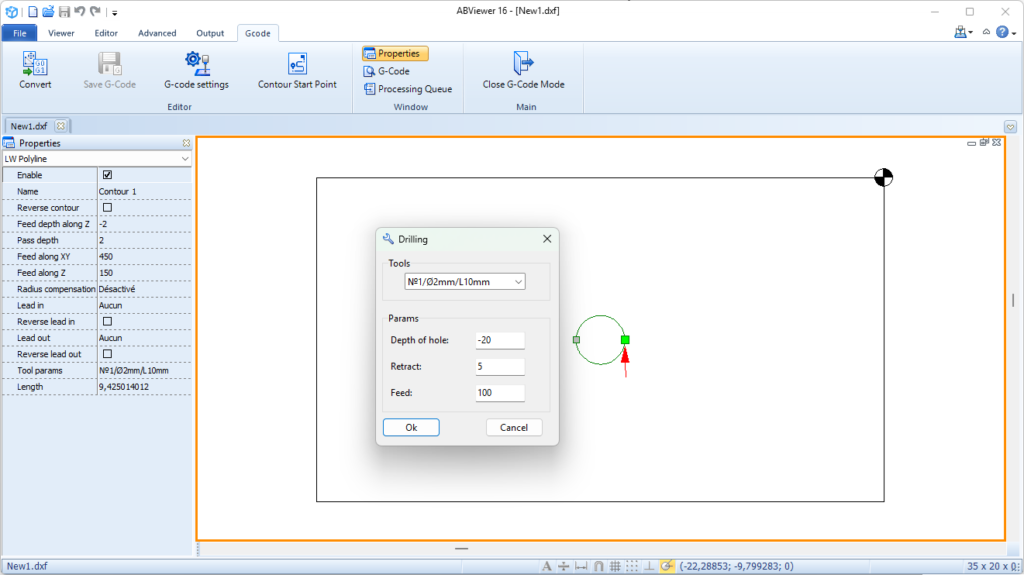
    • Added support for G80–G84 drilling commands (select a circle, right-click and choose Create hole).
G code drilling
  • Added a setting to define the contour starting point at any location (G-code settings -> Advanced -> Contour start point snap -> Nearest points).
  • Improved the user interface.
  • Improved Editor mode:
    • Added new modes to create circles and arcs: 2-Point Circle3-Point Circle3-Point ArcStart-Center-End ArcCenter-Start-End Arc.
New arcs modes
    • Improved the Offset tool. It is now possible to apply it to open contours.
  • Accelerated XML API performance.
  • Bug fixes and performance improvements.

Download the latest version of ABViewer and try it out right now. It is free for 30 days.

If you have a license for ABViewer 16, you will receive ABViewer 16.1 free of charge. If you are using an older version, you can upgrade at a special price at https://cadsofttools.com/products/abviewer/lifetime-license-upgrade/. Contact us at info@cadsofttools.com, and we will be happy to answer your questions and assist with the upgrade.

For more details – Visit – CADSoftTools 

From Alerts to Action: IoT and MOM in Automotive Manufacturing

0
Mom26

The automotive industry is undergoing a rapid digital transformation driven by electrification, mass customization, and increasing pressure for efficiency and quality. In this evolving landscape, the convergence of the Industrial Internet of Things (IoT) and Manufacturing Operations Management (MOM) is proving to be a game changer.

For manufacturing engineers, the real value lies not just in collecting data—but in acting on it.


Understanding the Foundations

IoT in Manufacturing connects machines, sensors, and devices to capture real-time shop floor data—machine health, cycle times, environmental conditions, and more.

MOM (Manufacturing Operations Management) manages and optimizes production operations, including MES, quality, scheduling, and performance tracking.

Individually powerful, together they enable a truly intelligent factory.


The Simplest Way to Understand It

IoT is the “Alert,” but MOM is the “Action.”

In many factories today, IoT systems are already in place. Machines are connected. Dashboards exist. Alerts are generated.

A light blinks. A screen turns red.

But then… nothing happens.

Someone needs to:

  • Inform a supervisor
  • Call a technician
  • Diagnose the issue
  • Search for documentation

This delay is exactly where productivity and profit are lost.


From Alerts to Action: The Real Transformation

When IoT is integrated with MOM, the response becomes automated and intelligent.

Instead of just highlighting a problem:

  • The system identifies the issue
  • Triggers a workflow
  • Notifies the right team
  • Provides actionable instructions

For example:
If a machine shows abnormal vibration, the system doesn’t just raise an alert—it automatically generates a maintenance task, assigns it to the technician, and provides recommended actions before a breakdown occurs.

It’s like upgrading from a smoke alarm that only beeps to a sprinkler system that actually puts out the fire.


Real-World Automotive Examples

BMW – Smart Factory with MOM Integration

BMW has implemented IoT-enabled production systems combined with MOM platforms to create highly connected factories. Sensors across assembly lines monitor equipment and process conditions in real time, while MOM systems orchestrate production workflows, quality checks, and maintenance actions.

Impact:

  • Faster response to production deviations
  • Improved quality consistency
  • Reduced downtime through predictive maintenance

Tesla – Data-Driven Manufacturing

Tesla’s manufacturing strategy relies heavily on connected machines and real-time analytics. IoT data is continuously analyzed and fed into operational systems to optimize production and detect issues early.

While Tesla uses proprietary systems, the principle mirrors IoT + MOM integration:

  • Real-time alerts trigger immediate corrective actions
  • Continuous optimization of production processes
  • Rapid scaling of manufacturing operations

Siemens Opcenter (MOM Platform)

Siemens Opcenter is a leading MOM solution widely used in automotive manufacturing.

When integrated with IoT platforms (like MindSphere or shop floor sensors), Opcenter enables:

  • Real-time production visibility
  • Automated quality checks and traceability
  • Predictive maintenance workflows
  • Closed-loop manufacturing execution

Example Use Case:
A machine deviation detected via IoT automatically triggers a workflow in Opcenter, assigns a corrective task, and logs the issue for traceability—ensuring compliance and faster resolution.

Visit for more details on Opcenter – https://www.siemens.com/en-us/products/opcenter


Dassault Systèmes DELMIA Apriso

DELMIA Apriso is another powerful MOM platform used by global automotive OEMs and suppliers.

With IoT integration, DELMIA Apriso enables:

  • Global production visibility across plants
  • Real-time synchronization between shop floor and enterprise systems
  • Automated responses to machine and process events

Automotive Impact:

  • Standardized operations across multiple plants
  • Faster issue resolution through automated workflows
  • Improved compliance and traceability

Visit – https://discover.3ds.com/mom-software-optimize-your-manufacturing-operations?_gl=1loxvhj_upMQ.._gs*MQ..&gclid=Cj0KCQjwmunNBhDbARIsAOndKpnIV9BbR2A3oKcGz0BtJiHCl19FwfbuRjOzOU82CHvHkQqVsA8tpToaAhBXEALw_wcB&gbraid=0AAAAADqOeJSL_5EmqSpDtWyEcjcbKJsDu


Why This Matters for Automotive Manufacturing

In automotive production, where downtime, defects, and delays directly impact cost and delivery timelines, this integration delivers:

  • ✔️ Reduced unplanned downtime
  • ✔️ Faster issue resolution
  • ✔️ Improved product quality
  • ✔️ Higher production efficiency
  • ✔️ Better asset utilization

The Digital Spine Approach

The real goal is not just digitization—it’s connected execution.

The Going Digital® Bottom Line:
Don’t just invest in IoT to “see” more problems. Use a Digital Spine to fix them faster.

If your data:

  • Doesn’t trigger action
  • Doesn’t automate workflows
  • Doesn’t improve response time

Then it’s not delivering value—it’s just an expensive visibility tool.


IoT and MOM are not just complementary—they are interdependent.

IoT tells you what is happening.
MOM ensures something is done about it.

For automotive manufacturers, this combination is the key to moving from reactive operations to proactive, intelligent manufacturing.

Because in the end, data without action is just noise—and action driven by data is where real value begins.

Thank you,

NVIDIA and Global Industrial Software Giants Bring Design, Engineering and Manufacturing Into the AI Era

0
Industrial software giants (1)

News Summary:

  • Cadence, Dassault Systèmes, Siemens and Synopsys are building NVIDIA-powered AI agents to plan, optimize and verify complex chip and system workflows.
  • FANUC, HD Hyundai, Honda, JLR, KION, Mercedes-Benz, MediaTek, PepsiCo, Samsung, SK hynix and TSMC are using NVIDIA CUDA-X and GPU-accelerated industrial software and tools to accelerate industrial design, engineering and manufacturing.
  • Amazon Web Services (AWS), Google Cloud, Microsoft Azure and Oracle Cloud Infrastructure (OCI) are delivering NVIDIA GPU-accelerated software for running computational design and engineering at production scale, while leading manufacturers Dell Technologies, HPE and Supermicro ship NVIDIA-accelerated systems for on-premises and hybrid deployments.

GTC—NVIDIA today announced it is working with global industrial software leaders Cadence, Dassault Systèmes, PTC, Siemens and Synopsys to bring NVIDIA CUDA-X™, NVIDIA Omniverse™ and GPU-accelerated industrial software and tools to FANUC, HD Hyundai, Honda, JLR, KION, Mercedes-Benz, MediaTek, PepsiCo, Samsung, SK hynix and TSMC to accelerate design, engineering and manufacturing. These software leaders are also introducing NVIDIA-powered agentic solutions to prepare their customers for the next phase of the AI era.

These solutions are running on NVIDIA AI infrastructure across leading cloud service providers Amazon Web Services (AWS), Google Cloud, Microsoft Azure and Oracle Cloud Infrastructure (OCI) and original equipment manufacturers Dell, HPE and Supermicro for accelerated design and simulation.

“The dawn of a new industrial revolution has arrived, where physical AI and autonomous AI agents are fundamentally reinventing how the world designs, engineers and manufactures,” said Jensen Huang, founder and CEO of NVIDIA. “Uniting our global ecosystem of software giants, cloud providers and OEMs, NVIDIA is delivering a full-stack accelerated computing platform that empowers every industry to turn this vision into reality at a scale and speed never before possible.”

Leading Industrial Software Giants Build Agents to Accelerate Design and Engineering
Industrial engineering is entering an agentic inflection point, as long-running AI agents can now streamline and orchestrate complex industrial design, engineering and manufacturing workflows.

Cadence, Dassault Systèmes, Siemens and Synopsys are accelerating these workflows by bringing agentic AI into their platforms, using the NVIDIA NeMo™ platform, NVIDIA Nemotron™ open models, NVIDIA CUDA‑X libraries and NVIDIA accelerated computing to power autonomous design agents for complex chip and system workflows:

  • Cadence’s ChipStack AI SuperAgent combines accelerated electronic design automation (EDA) software with agentic orchestration for the design and verification of semiconductors, including design and testbench coding, test-plan creation and debugging.
  • Dassault Systèmes is building role-based AI agents called Virtual Companions on its 3DEXPERIENCE agentic platform to manage workflows across its entire portfolio of industrial software
  • Siemens’ Fuse EDA AI Agent autonomously orchestrates multiple agents across the entire semiconductor and printed circuit board workflow, from design conception to manufacturing sign-off.
  • Synopsys is building its AgentEngineer multi-agent framework for semiconductor and systems design.
     

Accelerating Automotive Innovation With GPU‑Powered Simulation
To accelerate next-generation vehicle design, NVIDIA is partnering with Siemens and Synopsys to deliver GPU-accelerated tools for computational fluid dynamics (CFD) and electromagnetics. These solutions replace weekslong CPU simulations with high-fidelity virtual testing, enabling faster iteration and reduced time to market.

Honda is using Synopsys’ Ansys Fluent, accelerated by the NVIDIA Grace Blackwell platform, to run aerodynamic simulations 34x faster than using CPUs, contributing to shorter development cycles.

JLR and Mercedes-Benz are harnessing Siemens’ Simcenter STAR-CCM+ software on NVIDIA-accelerated infrastructure to transform engineering workflows. JLR runs the platform on AWS to enhance vehicle aerodynamics.

Dassault Systemès’ SIMULIA Abaqus and PowerFlow, accelerated by NVIDIA AI infrastructure, are used to support Rivian’s vehicle simulation testing.

Revolutionizing Aerospace Design Through High‑Fidelity Virtual Testing
Aerospace engineering demands some of the most complex CFD simulations, such as simulating aircrafts during takeoff. With NVIDIA‑accelerated solvers from Cadence, organizations can run high‑fidelity simulations at scale, enabling previously impractical workflows and unlocking new designs for space exploration.​

Ascendance is using Cadence Fidelity on NVIDIA GPUs on Oracle Cloud to simulate hybrid electric propulsion and vertical takeoff and landing aircraft scenarios, enabling same-day full aerodynamic simulation campaigns that are not possible with large CPU-based high-performance computing.

Accelerating the Global Energy Transition
Energy leaders are adopting GPU-accelerated CFD workflows on NVIDIA AI infrastructure across cloud and on-premises environments to cut simulation turnaround times, boost throughput and overcome the limits of CPU-only computing — accelerating gas turbine innovation for cleaner energy solutions.

Solar Turbines is harnessing Cadence Fidelity on Dell infrastructure to complete 360-degree, billion-cell combustor simulations in just 14 hours.

Argonne uses Cadence Fidelity on the Polaris supercomputer, built by HPE and accelerated by NVIDIA A100 GPUs, to enable high‑fidelity combustion simulations for advanced energy and propulsion research.

Accelerated Computing Fuels the Next Era of Semiconductor Innovation
As semiconductor design enters the trillion-transistor era beyond Moore’s law, CPU-based workflows can no longer keep pace — driving industry leaders to adopt NVIDIA-accelerated tools from Cadence, Siemens and Synopsys to advance electronic design automation.

Samsung and SK hynix are using Cadence Pegasus, Synopsys PrimeSim and Siemens’ Calibre software on NVIDIA-accelerated Dell PowerEdge servers and HPE systems to streamline high-volume computational lithography and physical verification, accelerating DRAM and flash memory production.

Astera Labs uses Synopsys PrimeSim B200 GPU-accelerated EC2 on AWS to speed chip design by 3.5x over CPU-only systems, accelerating validation and time to market for next-generation connectivity solutions. MediaTek is accelerating Cadence Spectre by 6x, with the power of NVIDIA H100 GPUs, to build its AI future with an on-premises AI factory powered by NVIDIA.

TSMC is using Synopsys tools on HPE and Supermicro systems to accelerate critical workloads for advanced manufacturing.

Micron is accelerating next‑generation high-bandwidth memory development by expanding its collaboration with Cadence, adopting NVIDIA GPU‑accelerated design tools and integrating agentic AI to boost efficiency across its complex memory design workflows.

Transforming Manufacturing and Logistics Through Industrial Digital Twins
NVIDIA and its industrial ecosystem partners are accelerating the digitalization of product lines, factories, warehouses and shipyards, using high-fidelity industrial digital twins to connect virtual planning with real-world execution.

Siemens’ newly launched Digital Twin Composer leverages NVIDIA Omniverse libraries to enable companies like Foxconn, HD Hyundai, PepsiCo and KION to build industrial metaverse environments at scale, empowering organizations to apply industrial AI, simulation and real-time physical data to make decisions virtually, at speed and at scale.

Krones is using Ansys Fluent on Microsoft Azure to power physics-accurate, AI-driven digital twins with NVIDIA Omniverse, CUDA-X and GPU-accelerated simulation to cut bottling-line simulation times from hours to minutes.

PTC is announcing a new robotics design-to-simulation workflow from its cloud-native Onshape computer-aided design (CAD) and product data management platform to NVIDIA Isaac Sim™, creating a seamless CAD-to-OpenUSD bridge that will enable engineering teams like FANUC America Corporation and Fauna Robotics to design and validate their robotic systems within physically accurate digital twins.

KION is working with Siemens, NVIDIA and Accenture to advance autonomous warehouse solutions. Using NVIDIA Omniverse and a physical AI-powered digital twin and systems architecture pioneered by Accenture, KION engineers create large-scale, physics-accurate warehouse digital twins to train and test fleets of NVIDIA Jetson™-based autonomous forklifts for GXO, the world’s largest pure-play contract logistics provider.

Watch the GTC keynote from Huang and explore sessions.

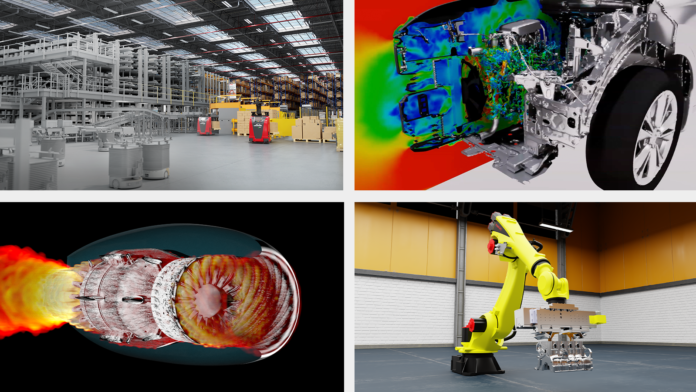
Note: Featured image courtesy of Siemens, KION, Accenture, GXO (top left), Synopsys, Honda (top right), Cadence, Honda R&D (bottom left) and PTC, FANUC (bottom right).

About NVIDIA
NVIDIA (NASDAQ: NVDA) is the world leader in AI and accelerated computing.

Certain statements in this press release including, but not limited to, statements as to: physical AI and autonomous AI agents fundamentally reinventing how the world designs, engineers and manufactures; uniting our global ecosystem of software giants, cloud providers and OEMs, NVIDIA delivering a full-stack accelerated computing platform that empowers every industry to turn this vision into reality at a scale and speed never before possible; the benefits, impact, performance, and availability of NVIDIA’s products, services, and technologies; expectations with respect to NVIDIA’s third party arrangements, including with its collaborators and partners; expectations with respect to technology developments; expectations with respect to AI and related industries; and other statements that are not historical facts are forward-looking statements within the meaning of Section 27A of the Securities Act of 1933, as amended, and Section 21E of the Securities Exchange Act of 1934, as amended, which are subject to the “safe harbor” created by those sections based on management’s beliefs and assumptions and on information currently available to management and are subject to risks and uncertainties that could cause results to be materially different than expectations. Important factors that could cause actual results to differ materially include: global economic and political conditions; NVIDIA’s reliance on third parties to manufacture, assemble, package and test NVIDIA’s products; the impact of technological development and competition; development of new products and technologies or enhancements to NVIDIA’s existing product and technologies; market acceptance of NVIDIA’s products or NVIDIA’s partners’ products; design, manufacturing or software defects; changes in consumer preferences or demands; changes in industry standards and interfaces; unexpected loss of performance of NVIDIA’s products or technologies when integrated into systems; NVIDIA’s ability to realize the potential benefits of business investments or acquisitions; and changes in applicable laws and regulations, as well as other factors detailed from time to time in the most recent reports NVIDIA files with the Securities and Exchange Commission, or SEC, including, but not limited to, its annual report on Form 10-K and quarterly reports on Form 10-Q. Copies of reports filed with the SEC are posted on the company’s website and are available from NVIDIA without charge. These forward-looking statements are not guarantees of future performance and speak only as of the date hereof, and, except as required by law, NVIDIA disclaims any obligation to update these forward-looking statements to reflect future events or circumstances.

© 2026 NVIDIA Corporation. All rights reserved. NVIDIA, the NVIDIA logo, CUDA-X, Nemotron, NVIDIA Isaac Sim, NVIDIA Jetson, NVIDIA NeMo and NVIDIA Omniverse are trademarks and/or registered trademarks of NVIDIA Corporation in the U.S. and other countries. Other company and product names may be trademarks of the respective companies with which they are associated. Features, pricing, availability and specifications are subject to change without notice.

ROBOZE Launches ARGO 500 HYPERSPEED MISSION READY for Aerospace, Defense Manufacturing

0
Argo 500 hyperspeed mr 1

EL SEGUNDO, CA, USA, Mar 18, 2026 – ROBOZE, a manufacturing technology company developing advanced production platforms for mission-critical industries, announced the launch of ARGO 500 HYPERSPEED MISSION READY (MR) — a new industrial additive manufacturing platform designed to produce high-performance polymer and composite parts for aerospace and defense applications where reliability, repeatability, and operational readiness are essential.

As global operations grow more complex and supply chains face increasing disruption, the ability to manufacture critical components quickly and predictably has become a strategic capability. ARGO 500 HYPERSPEED MISSION READY was developed to help aerospace and defense organizations produce advanced parts on demand while maintaining consistent performance in the most demanding operational environments.

“In today’s geopolitical and industrial landscape, technological sovereignty and supply-chain resilience are mission-critical capabilities,” said Alessio Lorusso, founder & CEO of ROBOZE. “ARGO 500 HYPERSPEED MISSION READY enables aerospace and defense organizations to produce advanced components on demand, strengthening operational readiness while reducing dependence on traditional, fragile supply chains.”

The system is designed to produce components using high-performance polymers and advanced composites increasingly used across aerospace and defense platforms to reduce weight, improve durability, and replace traditionally machined metal parts. The product is optimized for industry standard materials such as SABIC’s ULTEM AM9085F resin for cabin interior applications, as well as advanced carbon fiber reinforced materials like ROBOZE’s Carbon PEEK for metal replacement and corrosive environments.

Built on more than a decade of engineering refinement, this platform advances mechanical precision, thermal stability, and advanced programmable logic control (PLC) architecture that define ROBOZE systems. A key innovation is its integrated material conditioning architecture, designed to protect sensitive materials throughout the manufacturing process.

Moisture controlling is critical when working with advanced polymers, as even small variations can affect mechanical performance and part reliability. By integrating material conditioning directly into the platform, ARGO 500 HYPERSPEED MISSION READY simplifies production workflows while delivering the process control required for aerospace and defense manufacturing.

The platform enables a wide range of advanced applications, including high-temperature aerospace ducting, naval and defense structural components, and lightweight parts designed to replace traditionally machined metal components.

For ROBOZE, the launch reflects a broader shift across the aerospace and defense sectors as organizations seek greater supply-chain resilience, faster access to critical components, and great manufacturing independence. Additive manufacturing is rapidly becoming a strategic capability for mission-critical systems.

“As an industry, aerospace and defense constantly pushes the boundaries of innovation” said Scott Sevcik, executive vice president of aerospace & defense at ROBOZE. “But delivering value to the operator in the field requires meeting the highest standards and performing under extreme conditions. ARGO 500 HYPERSPEED MISSION READY was engineered to deliver the repeatability, material control, and reliability required to meet the stringent qualification requirements and perform at the highest levels.”

About ROBOZE

ROBOZE is a manufacturing technology company developing advanced production platforms for mission-critical industries. By combining proprietary hardware, materials science, software and embedded Physical AI, ROBOZE enables the distributed production of high-performance components for aerospace, defense, energy and transportation. Through its global Smart Factory network, Roboze provides certified, repeatable manufacturing solutions where performance, reliability and supply chain resilience are essential. For more information, visit https://www.roboze.com.

Trekomp Expands JETCAM Scandinavia Support to Include Denmark

0

Monaco, Mar 18, 2026 – JETCAM International s.a.r.l. has announced that Trekomp Maskinservice AB will assume responsibility for sales and support of JETCAM CAD/CAM and nesting software in Denmark, succeeding Camtek a.p.s., which has represented JETCAM in Denmark for over 30 years.

Camtek’s Managing Director Peter Johansen is retiring after a successful collaboration spanning decades. Trekomp — with its strong performance in Sweden and Norway — has been appointed to ensure continuity of local service and deepen engagement with Danish sheet metal manufacturing customers.

This strategic change reinforces JETCAM’s commitment to delivering best-in-class nesting and automation solutions across the Scandinavian region. Trekomp will provide dedicated sales, implementation, and support services to help Danish sheet metal manufacturers optimise material use, streamline production workflows, and achieve measurable returns on investment.

Said Martin Bailey, Managing Director of JETCAM International s.a.r.l., “We extend our sincere thanks to Camtek for over 30 years of exceptional service to the Danish market. Their dedication has helped hundreds of companies benefit from JETCAM’s nesting and automation solutions. As Camtek’s MD steps into a well-earned retirement, we are delighted to welcome Trekomp, whose success in Sweden and Norway demonstrates a deep understanding of the Scandinavian sheet metal manufacturing sector and a strong commitment to customer service. We look forward to continuing to support Danish manufacturers with enhanced local expertise.”

“For more than three decades, we have had the privilege of serving Danish manufacturers with JETCAM’s industry-leading software. Our long-standing partnership has been defined by trust, innovation, and a shared commitment to customer success. As I retire, I am proud to pass the torch to Trekomp, confident they will provide excellent continuity and support to our customers.” added Peter Johansen, Managing Director, Camtek a.p.s.

“We are honoured to take on the responsibility for representing JETCAM in Denmark. Building on our strong presence in Sweden and Norway, we look forward to supporting Danish customers with tailored solutions and exceptional service. Our team is committed to helping manufacturers improve efficiency, reduce waste, and leverage the full potential of JETCAM’s software suite.” said Fredrik Trotzig, VD/CEO, Trekomp Maskinservice AB.

Customers with an existing maintenance contract will automatically be transferred to Trekomp Maskinservice, with Camtek happy to provide backup support during the transitional period. Customers out of maintenance can contact Trekomp to request a quote for maintenance renewal, receiving 5% discount if they register for Maintenance AutoRenew.

For more information visit trekomp.se or jetcam.net.

About JETCAM International s.a.r.l.

Founded in 1986, JETCAM develops and distributes its range of CAD, nesting and Industry 4.0/5.0 enhanced automation software for the composite and sheet metal industries. It has been nominated or has won dozens of awards due to its demonstrable return on investment in machine runtime, material utilization, and automation. For more information, visit https://www.jetcam.net.

Bluebeam Announces Unbound 2026 World Tour

0
Unbound26

PASADENA, CA, USA, Mar 18, 2026 – Bluebeam, a leading developer of solutions and services for architecture, engineering, and construction (AEC) professionals, today announced Unbound 2026: World Tour, a new global event series designed to bring AI-powered construction innovation directly to industry professionals in their own cities.  

Unbound 2026: World Tour reimagines the traditional conference experience giving AEC teams practical insights, peer connection and live demonstrations of the latest advancements in Bluebeam, including the newest AI-powered features in Bluebeam Max.  

How AI is Shaping the Next Era of Construction 

As AI rapidly reshapes how the built environment plans, designs and delivers projects, AEC firms are under pressure to move faster, collaborate and reduce risk. Attendees will see firsthand how these advancements – including Bluebeam Max’s rapidly expanding toolset – are being applied in real‑world workflows.  

Each stop on the tour will feature: 

  • Global perspectives from Bluebeam leaders on the future of construction technology 
  • Local insight from engineers, builders and project teams delivering work in the region 
  • Live demonstrations and hands‑on examples of AI‑powered tools transforming everyday workflows 

Unbound 2026: World Tour kicks off in Mumbai (April 24), followed by events in Stockholm (May 27), London (June 18), Cologne (June 23), Singapore (August 13), and Sydney (August 18). 

“AI and automation are accelerating a fundamental shift in how projects are delivered,” said Usman Shuja, CEO of Bluebeam. “With the Unbound 2026: World Tour, we’re bringing this transformation directly to the cities where teams are building the future and showcasing how Bluebeam is making leading-edge innovation accessible to teams everywhere.” 

By combining global expertise with regional perspectives, Unbound 2026: World Tour offers a dynamic forum to bring together emerging AI‑driven construction technologies and real‑world project insights to help shape the next phase of innovation in the built environment. 

For more information and to register, visit unbound.bluebeam.com/worldtour/.

About Bluebeam 

Bluebeam is the leading provider of digital productivity and collaboration solutions for industries that design and build our world. Since 2002, Bluebeam has made desktop, mobile and cloud-based solutions for paperless workflows that improve project communication and streamline processes across the entire project lifecycle. Trusted by over 3 million users in more than 160 countries, Bluebeam’s solutions empower professionals to make their mark, adapt to change, and deliver projects successfully. Headquartered in Pasadena, CA, Bluebeam has offices globally and is part of the Nemetschek Group.