Home Blog Page 20

Kennametal Introduces RKD303R PCD Road Milling Pick for Construction Applications

0

PITTSBURGH, PA, USA, Mar 3, 2026 — Kennametal Inc. announced today the expansion of its comprehensive product line of tooling and wear protection solutions for construction applications with the introduction of the Road King Diamond 303R.

RKD303R

This non-rotating, rugged pick combines the strength and durability of polycrystalline diamond (PCD), delivering maximum road milling performance.

RKD303R features a carbide ring and bolster for abrasion protection in long wear-life applications, with hardfacing on the collar to safeguard the block, reducing downtime for change-outs. Paired with the reliability of our KPF 300-series block systems, RKD303R enhances machine operation and allows for a consistent cutting pattern and cutting depth over the entire tool life.

Customers will see the new RKD303R for the first time this week at CONEXPO 2026 in Las Vegas at Booth C-32742. It will be displayed alongside the entire groundbreaking Road King™ series of road milling picks that are specifically designed to maximize tool life and make change-outs both easy and efficient for milling machine operators. Kennametal’s broad portfolio of products and solutions that combat wear in foundation drilling and trenching will also be on display.

World-class materials science expertise enables Kennametal to deliver products uniquely designed to help customers fight wear and improve operations.

“We listen closely to our customers in the field, and we turn their feedback into production innovation designed to solve tough wear challenges,” said Marcelo Campos, Vice President, Global Earth Cutting Tools. “CONEXPO is an excellent opportunity to further this collaborative process, and we look forward to talking to customers this week about how our solutions can improve their operations.”

To purchase RKD303R (Order #7143179), please contact your sales representative or find an authorized Kennametal distributor online.

About Kennametal

With over 85 years as an industrial technology leader, Kennametal Inc. delivers productivity to customers through materials science, tooling, and wear-resistant solutions. Customers across aerospace and defense, earthworks, energy, general engineering, and transportation turn to Kennametal to help them manufacture with precision and efficiency. Every day approximately 8,100 employees help customers in nearly 100 countries stay competitive. Kennametal generated $2 billion in revenues in fiscal 2025. Learn more at www.kennametal.com. Follow @Kennametal: Instagram, Facebook, LinkedIn, and YouTube.

Invitation
Siemens sd17

Dyndrite Sponsors ASTM ICAM 2026 at Leader Level, Launches $10,000 Student Grant Competition to Accelerate Metal AM Adoption

0

SEATTLE, WA, USA, Mar 3, 2026 – Dyndrite, a provider of next-generation industrial software for additive manufacturing, today announced it will sponsor ASTM’s ICAM 2026 conference at the Leader level. The company is also immediately launching a student competition challenging the next generation of engineers to rethink what is possible in metal additive manufacturing by leveraging the company’s next-generation LPBF Pro software. The winner(s), selected by Dyndrite and announced at ICAM 26, will receive up to $10,000 in grants to continue Laser Powder Bed Fusion (LPBF) research. ICAM 2026 is scheduled for September 28 – October 2, 2026 in Orlando, Florida.

“ICAM brings together the people and organizations that are truly pushing the boundaries of metal additive manufacturing, from industry leaders across multiple sectors to the researchers and young minds shaping what comes next,” said Harshil Goel, Founder and CEO at Dyndrite. “We support ICAM because it sits at the intersection of industrial reality and future innovation. That combination is critical to advancing metal AM from a promising technology to scalable, trusted production.”

This marks the second consecutive year Dyndrite has sponsored the ICAM conference at the highest level. During the event, the company will deliver technical presentations and showcase its LPBF software platform. Several manufacturers are also expected to present innovative use cases demonstrating how Dyndrite is being applied across both research and production environments.

In addition, Dyndrite is introducing a global student competition focused on LPBF research as part of this year’s conference. The challenge invites university students to leverage the Dyndrite LPBF Pro software platform to push beyond today’s constraints by exploring new design freedoms and novel toolpath strategies.

“Metal additive manufacturing will not scale on legacy software, legacy assumptions, or locked-down workflows,” said Steve Walton, Head of Product at Dyndrite. “The next breakthroughs will come from engineers who think algorithmically about manufacturing. This competition is about empowering students to explore that future, and rewarding the most compelling ideas.”

Dyndrite Student Challenge

The Dyndrite Student Competition will award a total of $10,000 in grant funding to winning individuals or teams that demonstrate innovative thinking in LPBF. Open to students within North America, Europe, Japan, Korea, and Singapore, participants are encouraged to think beyond today’s legacy workflows and explore how software-defined manufacturing can unlock performance, scalability, and qualification efficiency.

Investing in Future AM Workforce

ASTM ICAM is widely regarded as the premier technical conference for industrial additive manufacturing, bringing together leaders from aerospace, defense, energy, automotive, academia, and government. By stepping into the Leader sponsorship role, Dyndrite reinforces its commitment to both industrial adoption and the development of the next generation of AM engineers. 

The Dyndrite Student Challenge is an industry-sponsored competition designed and administered by Dyndrite. Student presentations are hosted at ICAM as part of its broader technical program. The competition’s design, evaluation, and awards are managed independently by Dyndrite and do not represent ASTM or ICAM positions.

Students interested in learning more about the Dyndrite Student Competition can click here.

‍Dyndrite 2026 World Tour

LPBF users ready to take control of their additive workflows are invited to join the Dyndrite 2026 You Control the Laser World Tour —a multi-city, hands-on workshop for LPBF and EOS, Nikon SLM, and Renishaw, and Velo3D users, scheduled for September 28, 2026 Experience Dyndrite LPBF Pro in action and learn how to unlock scalability in your metal AM operations. Sign up today  – click here.

About Dyndrite

Dyndrite’s mission is to fundamentally change how geometry is created, transformed, and transmitted on computers. Built on its Accelerated Computation Engine (ACE)—the world’s first GPU-based geometry kernel—Dyndrite’s flagship product, Dyndrite LPBF Pro, delivers unmatched control, performance, scalability, and automation for additive manufacturing engineering applications. Customers across defense, space, energy, medical, and automotive industries gain full control over the additive process, enabling faster, more agile qualification, higher quality, and true production scale. For more information, visit dyndrite.com.

About ASTM ICAM

ASTM ICAM is organized by ASTM International and serves as the leading global forum for advancing additive manufacturing through standards development, research, and industrial collaboration.

Aras Expands InnovatorEdge with New Services for API Management, App Development, Agentic AI

0

ANDOVER, MA, USA, Mar 3, 2026 – Aras, a leading provider of digital thread solutions for product lifecycle management (PLM) and engineering AI, announced new services built on Aras InnovatorEdge (“Edge”) that enable secure, governed access to PLM data and workflows across the value chain while supporting the scalable adoption of agentic AI.

Announced last year, Edge extends Aras Innovator with a set of cloud-delivered governance and API utilities that connect digital threads to external users, developers, applications, and AI resources. Edge delivers controlled, contextualized access to product data wherever it resides while preserving traceability, permissions, and business context.

These new Edge services are designed to simplify and accelerate how Aras Innovator is extended and integrated for new users and cloud resources:

  • Aras InnovatorEdge API Manager (Edge API): A cloud-delivered, low-code service for quickly defining and managing APIs that securely expose Aras Innovator data and digital thread services to external applications or agents.
  • Aras InnovatorEdge App Builder (Edge Builder): A SaaS-based development environment for rapidly building, hosting, and publishing lightweight, task-based apps that natively consume Edge APIs.
  • Aras InnovatorEdge AI (Edge AI): A suite of services for building, deploying, running, and governing agentic workflows and AI services across the Aras Innovator PLM ecosystem.

“We see Aras InnovatorEdge as a natural extension of our longtime strategy of delivering PLM solutions based on an open, extensible digital thread infrastructure,” said Leon Lauritsen, CEO of Aras. “It gives our customers game-changing flexibility as they race to transform PLM and engineering with new modes of collaboration and AI-driven insight without compromising control or context.”

Aras has also introduced several new AI agents built on Edge AI that can be configured and implemented within any Aras Innovator environment.

About Aras

Aras provides a digital thread platform for product lifecycle management and engineering AI. Built on an AI-native, low-code foundation, it enables the rapid delivery of flexible solutions. Aras connects teams across disciplines and functions to critical product data and agentic AI throughout the product lifecycle and extended value chain. Visit aras.com to learn more and follow Aras on LinkedInYouTubeX, and Facebook.

Gamma Technologies Unveils GT Intelligence Studio, Strengthens Leadership Team

0
GAMMA TECHNOLOGIES LOGO

WESTMONT, Ill.–(News Source – BUSINESS WIRE)–Gamma Technologies (GT), the global leader in multi-physics systems simulation platforms, today announced a major milestone in its growth strategy with the launch of GT Intelligence Studio, the company’s next-generation platform designed for enterprises to unlock innovation and creativity with AI-driven engineering. The launch is paired with two key executive appointments—Dan Marsh and Michael Nisenson—who will help lead the company to further accelerate GT’s technical velocity and commercial expansion.

Introducing GT Intelligence Studio: A New Era of Engineering Simulation

GT Intelligence Studio represents a major leap forward in how simulation is performed. By delivering contextual AI assistance directly inside GT-SUITE, engineers can dramatically reduce the time traditionally spent building models and analyzing results, writing automation scripts, as well as navigating complex workflows.

The platform enables engineers to shift their time toward higher value work, unlocking greater creativity, faster iterations, and more confident decision making.

Strategic Executive Appointments Strengthen Growth Trajectory

To support this next stage of company expansion, GT has appointed two proven leaders:

Dan Marsh has been promoted to Vice President of AI Strategy and Enterprise Systems to spearhead product strategy, customer experience and cross-functional alignment around the Intelligence Studio ecosystem and GT’s machine learning solutions. Dan brings deep expertise in enterprise software, platform strategy, and scaling customer-centric SaaS solutions.

Marsh, a 16-year veteran of Gamma Technologies, brings a uniquely blended background in engineering simulation, user experience innovation, and enterprise systems leadership. Throughout his career at GT, he has played a central role in building the foundation on which GT’s AI-first future is emerging.

Michael Nisenson joins as Chief Revenue Officer (CRO) and will head GT’s global go-to-market teams, driving growth in emerging technologies and lead GT into its next era of global expansion, bridging new industries, strengthening enterprise partnerships, and scaling the company’s presence across key international markets.

Nisenson joins GT following an accomplished 15+ year career at ANSYS, where he most recently served as Global Vice President of New & Emerging Technologies, after holding multiple senior leadership roles across North America, strategic accounts, major global markets, and advanced technology portfolios.

Both leaders will play a central role in operationalizing GT’s accelerated growth model.

A Company Focused on Growth and Technical Velocity

Together, the launch of GT Intelligence Studio and these leadership appointments mark a pivotal step in Gamma Technologies’ transformation. The company is investing aggressively in talent, technology, and execution frameworks that support long-term scalability and faster delivery cycles.

“Our strategy is all about velocity—velocity in innovation, in customer impact, and what we bring to the market,” said President and CEO, Dimple Shah. “I am excited about the augmentation of GT-SUITE with GT Intelligence Studio and am confident that under Dan and Michael’s leadership, GT will continue to deliver impactful advancements for the diverse industries we serve.”

About Gamma Technologies | www.gtisoft.com

Gamma Technologies (GT) develops and licenses GT-SUITE, the industry leading multi-physics CAE simulation platform. GT-SUITE offers a comprehensive library of physics-based modeling templates covering fluid flow, thermal systems, mechanics, electrics, magnetics, chemistry, and controls, supporting the full product development cycle from early concept to final validation.

GT-SUITE is used to simulate a broad range of engineering systems across industries, including automotive including transportation and mobility, marine, defense, power and energy, data centers, HVACR, and aerospace. Applications span engines, powertrains, motors, compressors, cooling systems, full vehicle thermal management, acoustics, hydraulics, lubrication, multibody mechanics, and more.

Gamma Technologies has integrated artificial intelligence and machine learning into the simulation workflow—enhancing model creation, enabling automated analysis, and improving engineering productivity across the entire GT-SUITE ecosystem.

Additional information is available at www.gtisoft.com.

News Source: (BUSINESS WIRE)

SPDM (Simulation Process and Data Management): The Backbone of Modern Digital Engineering

0
SPDMMM

A complete guide for engineering leaders and simulation professionals

In today’s manufacturing and engineering landscape, simulation tools are no longer isolated specialist tools — they are mission-critical engines of design innovation. But with the rapid growth of simulation usage across teams and disciplines comes increasing complexity in managing models, data, workflows, and results.

This is where Simulation Process and Data Management (SPDM) becomes essential.


What Is SPDM?

Simulation Process and Data Management (SPDM) is a structured methodology and software capability that helps engineering organizations:

  • Organize and govern simulation models, inputs, and results
  • Capture relationships between simulation data and engineering decisions
  • Automate routine tasks and workflows
  • Enable cross-team collaboration, traceability, and version control

Unlike traditional file-based simulation management — where data lives in folders, spreadsheets, and local drives — SPDM ensures that data and processes are centralized, searchable, secure, and reusable across the engineering enterprise.


Why SPDM Matters in Digital Engineering

Digital engineering is not just about running simulations — it is about connecting simulation into the broader digital thread of product development. SPDM plays a foundational role in this transformation by:

  • Scaling simulation operations beyond small CAE teams
  • Standardizing engineering workflows and governance
  • Connecting simulation to CAD, PLM, and digital twin frameworks
  • Improving collaboration across distributed engineering teams
  • Enabling automation and AI-assisted decision-making
  • Ensuring data traceability and regulatory compliance

For organizations adopting Industry 4.0 and advanced digital engineering strategies, SPDM is no longer optional — it is strategic infrastructure.


Various SPDM / SDM Software Available

Several leading engineering software providers offer SPDM or SDM (Simulation Data Management) solutions:

SCALE.sdm – by SCALE GmbH

A modern SPDM platform that links simulation models, loads, materials, solver settings, and results in a governed environment focused on traceability, collaboration, automation, reporting, and AI-assisted insights.

VOLTA – by ESTECO Engineering

The digital engineering platform for simulation process and data management (SPDM) and multidisciplinary design optimization (MDO).

Teamcenter – by Siemens

A leading PLM platform with integrated simulation process and data management capabilities designed to connect CAE workflows with enterprise product data.

3DEXPERIENCE Platform – by Dassault Systèmes

Provides simulation lifecycle management alongside design, systems engineering, and manufacturing on a unified digital platform.

Ansys Minerva – by Ansys

Focused specifically on simulation data governance and workflow automation in high-throughput CAE environments.

MSC SimManager

A web-based SPDM environment that centralizes simulation projects, workflows, and collaboration across distributed teams.

Cadence – BETA CAE – SPDRM Software

Each of these tools targets different engineering needs, integration levels, and scalability requirements — from PLM-driven ecosystems to simulation-centric governance platforms.


What Are the Benefits of SPDM?

Adopting SPDM delivers measurable advantages for engineering and product development teams:

Increased Engineering Productivity

Automation reduces manual effort and repetitive tasks, allowing engineers to focus on innovation and optimization.

Faster Time to Market

Standardized and reusable workflows accelerate validation cycles and design iterations.

Better Data-Driven Decisions

Centralized and validated simulation data improves confidence in design decisions and reduces risk.

Reduced Rework

Version control and traceability prevent errors caused by outdated models or mismanaged data.

Improved Collaboration

Engineering teams across locations and disciplines can securely share and reuse simulation assets.

Improved ROI on Simulation Investments

Structured management maximizes the value of CAE tools, HPC infrastructure, and engineering expertise.


What’s the Best Way to Get Started with SPDM?

Implementing SPDM is both a technical and organizational initiative. A structured approach ensures long-term success.

1. Assess Current Simulation Maturity

Evaluate how simulation data is stored, shared, and validated today. Identify inefficiencies and duplication of effort.

2. Identify High-Impact Use Cases

Start with a pilot area such as structural analysis, CFD, crash simulation, or multi-physics workflows where automation can deliver measurable value.

3. Define and Standardize Processes

Document best practices and approval workflows before automating them.

4. Integrate with Existing Systems

Ensure connectivity with CAD, PLM, and enterprise systems to maintain digital continuity.

5. Focus on Change Management

Train teams and secure leadership support to drive adoption and cultural alignment.

6. Scale Gradually

Expand SPDM usage across departments once initial ROI is demonstrated.


Final Thoughts for DailyCADCAM Readers

As simulation becomes central to digital twins, AI-driven optimization, and model-based engineering, unmanaged simulation data can become a bottleneck to innovation.

SPDM transforms simulation from a siloed technical activity into a governed, scalable, and enterprise-ready digital asset.

For engineering leaders and CAD/CAE professionals evaluating their next digital investment, the question is no longer whether SPDM is needed — it is how strategically and efficiently it can be implemented.

Thank you,

DailyCADCAM

OPEN MIND Receives TISAX Label for Automotive Information Security

0

WESSLING, Germany, Mar 2, 2026 – OPEN MIND Technologies AG is one of the world’s leading manufacturers of powerful CAD/CAM solutions for machine and controller-independent NC programming. The company has successfully completed a TISAX assessment in accordance with VDA ISA requirements and received the TISAX label.

OpenMind tisax

By receiving the TISAX label, OPEN MIND is strengthening its position as a trusted partner to the automotive industry and sending a clear signal about its commitment to high standards in information security.

TISAX (Trusted Information Security Assessment Exchange) is a cross-industry recognized standard for assessing information security. Developed by the automotive industry to protect sensitive information along the value chain, the assessment is based on the VDA ISA (German Association of the Automotive Industry Information Security Assessment) and creates a uniform basis for the secure exchange of confidential information between companies.

For customers and partners, the TISAX label demonstrates added value and an assurance that OPEN MIND has implemented structured measures to protect sensitive information. The exchange of confidential information is thus based on clearly defined, industry-specific security requirements.

“With the TISAX label we provide to customers and partners, it is additional proof of fundamental layers of security that information security at OPEN MIND is implemented consistently and in accordance with recognized standards,” explains Hagen Rühlich, Senior Project Manager/Consulting at OPEN MIND.

The TISAX assessment was carried out by BSI Group Deutschland GmbH and is valid for three years. The results are available exclusively via the ENX portal. TISAX is a registered trademark and is subject to the ENX Association. With TISAX, the ENX Association supports the joint acceptance of information security audits in the automotive industry on behalf of the VDA. TISAX and TISAX results are not intended for general public.

About OPEN MIND Technologies AG

OPEN MIND Technologies AG develops and sells innovative CAD/CAM solutions that generate optimized NC milling and turning programs for machine tools from digital models.

Manufacturers from a broad range of industries around the globe have decided to go with OPEN MIND products because they enable cost-effective and efficient manufacturing. This leads to models, prototypes, tools, molds, prismatic workpieces, integral components and more, all of impressive quality:

  1. Modeling and prototyping
  2. Tool and mold manufacturing
  3. Production machining
  4. Automotive industry
  5. Aerospace industry
  6. Energy industry
  7. Medical implant manufacturing
  8. Jewelry and watch industry.

OPEN MIND is active in all of the important markets, such as Asia, Europe and North America, with international subsidiaries and a global network of sales partners. OPEN MIND Technologies AG is a man and machine company. For more information, visit http://www.openmind-tech.com.

Divergent, Mach Launch Concept to Flight-Ready Prototype in 71 Days

0
Divergent mach

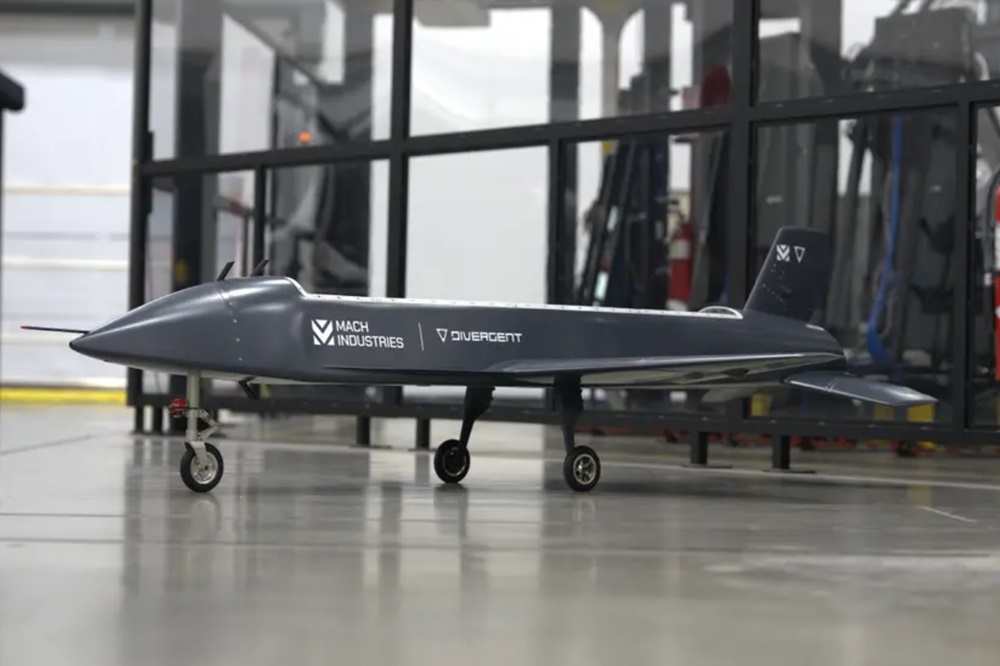
LOS ANGELES, CA, USA, Mar 2, 2026 – Divergent Technologies and Mach Industries announced a partnership to deliver Venom, a prototype flight demonstration aircraft showing hardware development at software speed.

Venom

“This partnership between Mach Industries and Divergent demonstrates a pivotal capability for the nation. By combining Mach’s innovative systems with Divergent’s revolutionary digital manufacturing platform, we’ve moved from concept to a flight-ready prototype in 71 days,” said Alex Lovett, the Principal Deputy Assistant Secretary of War for Mission Capabilities in the Office of the Under Secretary of War for Research and Engineering (OUSW(R&E)). “This isn’t just an impressive metric—it’s a direct enabler of our strategy to achieve affordable mass and support the SECWAR’s ‘Drone Dominance’ vision. ODASW(P&E) is committed to sponsoring collaborations like this that accelerate rapid acquisition and deliver urgent, low-cost munitions to the warfighter.”

Mach Industries established the baseline requirements and architecture leveraging the avionics and simulation from existing, flight-proven tech stacks with a modular, open-systems architecture to accelerate development from concept to flight. Divergent executed the digital design and 3D print of the Venom structure, including wings, fuselage, skins, and control surfaces as monolithic assemblies rather than conventional multi-part builds.

“Going from inception to flight in 71 days is a clear demonstration of what’s possible when Divergent’s Adaptive Production System is utilized from day one. This is what production at the speed of relevance looks like,” said Lukas Czinger, Co-Founder and CEO of Divergent. “Most importantly, Divergent will drive the rapid scale-up of this system, producing thousands of airframes annually. Partnering with Mach has been an immediate win and reflects two mission-aligned, innovative companies executing at maximum pace.”

Enabled by Divergent’s Adaptive Production System (DAPSTM), Divergent collapses traditional multi-hundred-part assemblies into unified additively manufactured structures to accelerate production, achieve superior mass and performance, and dramatically reduce overall part count.

“Over the last 18 months Mach has taken four products from concept to flight test through rapid iteration, and Divergent’s adaptive tech stack has been instrumental in accelerating that iteration,” said Ethan Thornton, Founder and CEO of Mach. “Mach’s selection for a production contract is the first of many opportunities to show not only speed to prototype, but speed to scaled manufacturing.”

By leveraging a common simulation and controls foundation, Mach Industries is able to support high-fidelity prototyping and adaptable iteration across hardware and software. The result: a framework that enabled parallel development, accelerated validation, and achieving concept-to-first-flight in 71 days.

Together, Divergent and Mach Industries are demonstrating a new model for autonomous defense systems, replacing tooling-heavy aerospace processes with a software-defined manufacturing approach that enables rapid iteration, scalable production, and speed to field. With Venom, the companies are showing that advanced manufacturing is not only an efficiency advantage, it is a strategic capability that delivers operational systems at the speed, volume, and performance demanded by modern defense missions.

About Divergent Technologies

Divergent has created the world’s first end-to-end software-hardware production system for industrial digital manufacturing – the Divergent Adaptive Production System (DAPS™) – allowing customers to design, additively manufacture, and automatically assemble complex structures for automotive, aerospace, and defense applications. DAPS transforms the economics, speed, and scalability of defense vehicle manufacturing by optimizing designs, dematerializing structures, and eliminating upfront capex. For more information, visit www.divergent3d.com.

About Mach Industries

Founded in 2023, Mach Industries is a defense manufacturing company headquartered in Huntington Beach, California. The company develops advanced unmanned systems and the manufacturing infrastructure to scale their production. By vertically integrating weapons, propulsion, and manufacturing, Mach delivers the speed, adaptability, and resilience required to preserve military advantage. For more information, visit www.machindustries.com.

Protolabs Introduces ProDesk AI-enabled Platform for Digital Manufacturing from Prototyping to Production

0

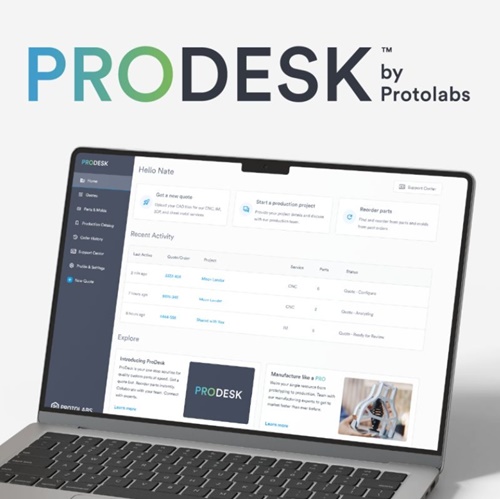
MINNEAPOLIS, MN, USA, Mar 2, 2026 – ProDesk unveiled by Protolabs provides an all-in-one resource that accelerates innovation for product development and procurement teams with real-time, AI-powered quoting with design for manufacturability (DFM) analysis, seamless collaboration across teams, and a suite of tools that support prototyping and production projects.

3429

“To better serve our customers from prototyping to production, ProDesk serves as the ultimate manufacturing resource for innovation,” Protolabs President and CEO Suresh Krishna said. “We are excited to deliver an online experience that elevates Protolabs as a tech-enabled partner for quality parts throughout the entire product life cycle.”

ProDesk features AI-driven DFM analysis across injection molding, CNC machining, and 3D printing services for instant feedback on parts before they reach the production floor. Configurable quotes include material options, secondary operations, and finishes for real-time quotes. Lead times are also configured within the quote, allowing users to tailor quotes depending on turn-time needs and budget.

As customers advance through the product development timeline, ProDesk’s Production Catalog lets users designate parts that are ready for production and simplifies management, organization, and reordering of those parts.

Through each stage of the ordering process, ProDesk is optimized for collaboration. All quotes and orders can be shared across teams to monitor order status and track shipments. The Production Catalog can also be shared with colleagues to instantly view and reorder parts, as well as to access order history, documentation, and part details.

ProDesk’s support center provides a central hub for assistance around orders, documents, billing, and quality documentation. The support center also provides direct communication to Protolabs’ team of applications engineers for design assistance, along with service line-specific guides with DFM information.

The new online platform brings each of these features into an interactive dashboard with real-time updates on recent orders, providing vital information upon login.

“Our goal with ProDesk is to deliver an online environment that modernizes the experience of working with Protolabs,” said Mark Flannery, Protolabs’ Global Product Director for E-commerce. “The nearly 50,000 customers who will access ProDesk this year will now have an industry-leading online experience that will accelerate product development timelines.”

Product developers, engineers, and procurement teams can experience ProDesk online today at protolabs.com.

About Protolabs

Protolabs is the world’s fastest manufacturing service enabling companies across every industry to streamline production of quality parts throughout the entire product life cycle. From custom prototyping to end-use production, we support product developers, engineers, and supply chain teams along every phase of their manufacturing journey. Get started now at protolabs.com.

Siemens Introduces Questa One Agentic AI Toolkit for IC Design, Verification

0

PLANO, TX, USA, Mar 2, 2026 – Siemens announced the Questa One Agentic Toolkit, which brings domain-scoped agentic AI workflows to its Questa One smart verification software portfolio to accelerate creation, verification planning, execution, debugging and closure to achieve trusted RTL sign-off faster while transforming how engineers approach integrated circuit (IC) design and verification tasks.

The verification productivity gap continues to widen as design complexity explodes with 3D ICs, chiplet-based architectures and software-defined systems. The Questa One Agentic Toolkit transforms verification and design from isolated tool interactions into intelligent, domain-scoped multi-step, framework-agnostic workflows powered by agentic AI – autonomous systems operating within the verification domain under customer-defined governance boundaries that can reason, plan and execute complex tasks while maintaining configurable human oversight at critical decision points directly within engineers’ existing environments.

“Questa One sets a new standard for smart verification and the Questa One Agentic Toolkit builds on those connected and data-driven principles with agentic AI workflows that empower our customers to achieve trusted design and verification closure with AI acceleration – while maintaining the human expertise and judgment that builds quality and trust,” said Abhi Kolpekwar, senior vice president and general manager, Digital Verification Technologies, Siemens Digital Industries Software. “We own the engines and we understand verification at the deepest level. It isn’t an afterthought or a wrapper; it’s the EDA industry’s most comprehensive verification solution enhanced with intelligent agentic AI workflows that work the way our customers expect and delivers the results they are demanding.”

Working with Fuse EDA AI system and beyond

The Questa One Agentic Toolkit works seamlessly with the Fuse™ EDA AI system, Siemens’ agentic and generative framework for electronic design automation, providing customers who want a fully integrated Siemens experience with optimized performance and deep integration.

It is Fuse-preferred, with enhanced capabilities when used within the Fuse environment. Recognizing that customer choice is paramount, the framework-agnostic architecture protects existing investments and integrates with other agentic platforms without compromise. Whether teams use existing or emerging frameworks, Questa One agentic workflows adapt to their environment with standardized interfaces that work consistently across platforms.

The Siemens advantage: Engines, integration and openness

These intelligent agentic workflows represent a fundamentally different approach than what’s emerging from startups and point-solution providers. Siemens uniquely combines verification engine expertise with deep AI integration and customer choice through three differentiating pillars:

  • Engine-native intelligence: Siemens creates both the industry-leading Questa One tools and the model context protocols (MCPs) that expose them to agentic frameworks. These workflows, built leveraging NVIDIA Llama Nemotron and NVIDIA NIM, understand verification state in real time and maintain comprehensive awareness and contextual intelligence relationships between designs, testbenches, test plans and specifications. This provides customers with autonomous goal decomposition, adaptive cross-run strategies and persistent expertise building.
  • Coding application and platform agnostic: The solution works with main-stream AI coding applications – including GitHub Copilot, Claude Code, Cursor, Cline and Siemens’ own Fuse – and can be used in CLI mode or IDEs (e.g. VS-Code). While optimized as Fuse-preferred for customers who want a fully integrated experience based on Siemens’ toolset, these workflows remain completely agnostic, adapting to customer workflows rather than forcing adaptation.
  • Scalable, connected, data-driven foundation: By leveraging the connected verification ecosystem that dynamically orchestrates between tools, including Questa One, Tessent™ software for DFT and the Veloce™ CS hardware-assisted verification and validation system, these agentic workflows bring AI-powered capabilities across the entire design and verification landscape.

Intelligent workflows across design and verification

The Questa One Agentic Toolkit launches with the following intelligent agents that demonstrate the potential of agentic AI:

  • The RTL Code Agent generates synthesizable RTL code from natural language descriptions while simultaneously checking for coding violations and suggesting fixes aligned with industry standards, presenting engineers with clean, high-quality RTL for review.
  • The Lint Agent optimally configures lint analysis, reading existing RTL code to check for design errors and coding style violations. Designers then review results and are offered automated AI-powered design fixes or waivers to help to ensure the highest-quality RTL.
  • The CDC Agent optimally configures, then runs clock domain crossing verification on a design. Configuration fine-tuning suggestions are made based on results. This empowers designers to achieve the cleanest asynchronous designs after reviewing the results and enabling automated AI-powered design fixes or waivers.
  • The Verification Planning Agent analyzes design specifications and automatically generates comprehensive verification plans. Engineers review and approve each step while the AI handles structuring sections, creating detailed feature descriptions and defining scenarios and checking strategies.
  • The Debug Agent accelerates root cause analysis by intelligently correlating waveforms, assertions, coverage data and log files. It identifies suspicious signal transitions, suggests potential failure mechanisms and generates targeted debug scenarios for engineer reviews.

These agents leverage the toolkit’s MCPs to work directly with Questa One Verification IQ, Questa One SFV, Questa One Sim and other tools, backed by curated prompt libraries developed by domain experts.

Partner and customer experiences with Questa One Agentic AI

Early adopters are already seeing significant productivity improvements:

“The increasing complexity of modern chip design and verification requires a new generation of intelligent, agentic workflows that can reason through intricate tasks while maintaining the highest levels of precision,” said Tim Costa, general manager of Industrial and Computational Engineering, NVIDIA. “By leveraging NVIDIA NIM and Nemotron reasoning models, Siemens is providing engineers with a powerful, AI-driven foundation to accelerate the development of the world’s most advanced electronic systems.”

“The productivity gains delivered by the Questa One Agentic Toolkit were both immediate and significant,” said Akshay Aggarwal, senior director of Engineering, MediaTek. “Our engineers were able to become proficient within hours, despite limited prior exposure to the tool – completing tasks that typically require days, and mastering workflows that would usually take weeks of training. In combination with MediaTek’s existing advanced in-house verification methodology, the Questa One Agentic Toolkit not only bridged the knowledge gap but fundamentally accelerated our operational processes.”

“Combining AI and verification, Questa One enabled our team to quickly adopt full agentic Formal Property Verification, and auto-fix issues with Lint Agent,” said Shalesh Thusoo, founder and chief executive officer, Tsavorite Scalable Intelligence. “With the Agentic Toolkit, we leverage these capabilities and their productivity gains at the optimal point in our development flow.”

Availability

The Questa One Agentic Toolkit is available now through an early access program. To learn more, visit https://www.siemens.com/questa-one-agentic.

About Siemens Digital Industries Software

Siemens Digital Industries Software helps organizations of all sizes digitally transform using software, hardware and services from the Siemens Xcelerator business platform. Siemens’ software and the comprehensive digital twin enable companies to optimize their design, engineering and manufacturing processes to turn today’s ideas into the sustainable products of the future. From chips to entire systems, from product to process, across all industries. Siemens Digital Industries Software – Accelerating transformation.

About Siemens Digital Industries

Siemens Digital Industries (DI) empowers companies of all sizes within the process and discrete manufacturing industries to accelerate their digital and sustainability transformation across the entire value chain. Siemens’ cutting-edge automation and software portfolio revolutionizes the design, realization and optimization of products and production. And with Siemens Xcelerator – the open digital business platform – this process is made even easier, faster, and scalable. Together with our partners and ecosystem, Siemens Digital Industries enables customers to become a sustainable Digital Enterprise. Siemens Digital Industries has a workforce of around 70,000 people worldwide.

About Siemens AG

Siemens AG (Berlin and Munich) is a leading technology company focused on industry, infrastructure, mobility, and healthcare. The company’s purpose is to create technology to transform the everyday, for everyone. By combining the real and the digital worlds, Siemens empowers customers to accelerate their digital and sustainability transformations, making factories more efficient, cities more livable, and transportation more sustainable. A leader in industrial AI, Siemens leverages its deep domain know-how to apply AI – including generative AI – to real-world applications, making AI accessible and impactful for customers across diverse industries. Siemens also owns a majority stake in the publicly listed company Siemens Healthineers, a leading global medical technology provider pioneering breakthroughs in healthcare. For everyone. Everywhere. Sustainably.

In fiscal 2025, which ended on September 30, 2025, the Siemens Group generated revenue of €78.9 billion and net income of €10.4 billion. As of September 30, 2025, the company employed around 318,000 people worldwide on the basis of continuing operations. Further information is available on the Internet at www.siemens.com.

AMUG Announces Second Keynote Presentation for 2026 Conference

0

ZEELAND, MI, USA, Mar 2, 2026 – The Additive Manufacturing Users Group (AMUG) announced a second keynote presentation for the 2026 AMUG Conference, which will be held in Reno, Nevada, from March 15 – 19, 2026. On Tuesday, March 17, Steve Fournier, leader of the Additive Designs & Manufacturing Center of Excellence at General Atomics Aeronautical Systems, and Scott Sawyer, Director of Programs at Divergent, will share their cross-industry collaboration story and successes.

Fournier and sawyer
Steve Fournier (left), General Atomics Aeronautical Systems, and Scott Sawyer, Director of Programs, Divergent.

Their keynote address, titled “From Hypercars to Defense Drones: How Two Major Industry Innovators Started Their Partnership Journey at AMUG,” will discuss how an automotive and a defense company found transferable additive manufacturing value through their partnership.

Fournier and Sawyer jointly stated, “AMUG has been, and continues to be, a forum where AM users from multiple disciplines and industries come together to share achievements and learning.” They continued, “The question, though, is how effective is knowledge transfer at such an industry event, and what does it amount to in terms of industrial growth, differentiated capabilities, and business revenue pursuits?”

To answer those questions, Fournier and Sawyer will discuss how their respective companies have used the AMUG platform to uncover insights and innovations that apply across industries. Specifically, this keynote will tell the story of how the leading U.S. Defense drone manufacturer, General Atomics Aeronautical Systems, connected with Divergent Technologies following a 2022 AMUG Conference keynote speech by Kevin Czinger, founder of Divergent.

They will share details on how that AMUG-initiated connection led to important and valuable business and product transformations by learning from one another and identifying applicable AM technology that transfers across vastly different product lines. During the discussion, they may showcase hardware that is representative of the products that emerged from their partnership.

Alex Roschli, AMUG’s Director, Education and Conference, said, “Separately, General Atomics and Divergent have been well-recognized for their impressive outcomes when applying additive manufacturing. I am very excited to hear how they have elevated the value of the technology through their partnership.”

Steve Fournier has over 23 years of experience in Silicon Valley R&D, product and business development, engineering project management, and manufacturing, including optical telecom & lasers, semiconductor mechatronic equipment, DoE National Laboratory projects, and DoD aerospace/aviation unmanned aerial systems. For the past 15 years, he has been a driving force in additive manufacturing and advanced production technologies, leading transformative initiatives that fuse innovation with industrial execution. As the leader of the Additive Designs & Manufacturing Center of Excellence at General Atomics Aeronautical Systems, Fournier is shaping the future of aerospace manufacturing and is the strategic force behind the company’s Factory of the Future.

Scott Sawyer serves as Director of Programs at Divergent, overseeing a portfolio of over 25 programs in both the commercial and defense sectors. In his role, Sawyer engages with government and industry customers to bring the Divergent Adaptive Production System (DAPS) to platform designs, enabling modular, affordable, scalable structural solutions. With a background in aerospace engineering, Sawyer has been working to bring additive manufacturing to aircraft platform design and production for over a decade. He has over 15 years of experience in the defense industry supporting DoW programs, previously working at Lockheed Martin, Boeing Defense, and General Atomics Aeronautical Systems.

In addition to Fournier’s and Sawyer’s Tuesday keynote, featured presentations on the AMUG Conference’s main stage will be a panel discussion with industry leaders representing AMUG’s Diamond Sponsors on Monday, March 16, a keynote presentation by Ronen Hadar of The LEGO Group on Thursday, March 19, and the Innovators Showcase on Wednesday, March 18. The keynotes and featured presentations will kickstart each day of the conference and set the tone for nearly 150 presentations, panel discussions, workshops, and hands-on training sessions.

Designed for novice and experienced additive manufacturing users, the AMUG Conference agenda topics range from technology basics to advanced applications to business considerations. Conference details and registration are available at www.amug.com.

About Additive Manufacturing Users Group (AMUG)

The Additive Manufacturing Users Group (AMUG), a 501(c)(6) nonprofit corporation, is a catalyst for its community of members to drive additive manufacturing forward. We are committed to educating and advancing AM applications for industrial purposes. Our annual gatherings provide a platform for in-depth technical presentations, workshops, and hands-on experiences, focusing on processes, technologies, and real-world applications. Join us at www.amug.com to be part of the innovation shaping the future of manufacturing.