Home Blog Page 666

Sandvik, BEAMIT Launch Osprey 2507 Components 3D Printed in Super-Duplex Stainless Steel

0

SANDVIKEN, Sweden, Apr 23, 2021 – Sandvik and part subsidiary BEAMIT Group announce a unique capability to additively manufacture components in super-duplex stainless steel. The components printed in Osprey 2507 metal powder – known and trusted for its excellent corrosion resistance and durability – are near fully dense (>99.9%) and crack-free, even before post processing.


super-duplex


The use of iron-based and highly corrosion resistant materials in additive manufacturing (AM) have seen significant growth in interest during the past few years. This is largely due to the needs of demanding industries such as the offshore- and marine segments – where challenging environments call not only for advanced materials, but for on-demand production of spare parts, to minimize stock while also decreasing material waste.

In terms of withstanding harsh elements, there is one material family that unarguably stands out. Produced and optimized for additive manufacturing in-house by the leading materials experts at Sandvik Additive Manufacturing, Osprey 2507 is a super duplex alloy that has excellent corrosion resistance and outstanding mechanical strength. For decades, Sandvik has been leading the materials evolution for duplex stainless steels – continuously launching new duplex and super duplex materials that, with their improved properties, are an undisputable part of Sandvik’s DNA. Sandvik’s super-duplex stainless steels are already successfully used in highly corrosive environments such as the seawater exposed offshore energy sector, and in demanding chemical processing. Predominantly used in the shape of seamless tubes, plates, and bars, super-duplex steel has proved a challenge in additive manufacturing – up until now.

“By leveraging nearly two centuries of materials expertise and industry leading know-how along the additive value chain, we are proud to say Sandvik is the first to offer 3D printed super duplex components to the market”, says Mikael Schuisky, VP and Business Unit Manager at Sandvik Additive Manufacturing. “While many have tried and failed, we are very pleased to have seen components printed to a standard that doesn’t just meet, but outperform that of several conventionally manufactured counterparts.”

Since 2019, Sandvik owns a significant stake in the BEAMIT Group – Europe’s leading AM service provider that support the most demanding industries with high-end metal components. Adding the capabilities of the BEAMIT Group – including one of the most extensive AM machine parks in the industry – makes for an even stronger offering, specifically for customers looking to produce larger scale components.

“We are very excited to co-launch this potent combination of a superior material and the disruptive benefits of additive manufacturing to the market”, says Michele Antolotti, Engineering and R&D Manager at the BEAMIT Group. “Having already developed print parameters for single-laser machines, we are now progressing to expand our joint offering to include even larger applications. With the profound materials expertise within Sandvik, and BEAMIT Group’s market-leading abilities throughout the additive value chain, we are truly in a unique position to supply the offshore industries with an array of business-critical benefits, in terms of component performance and timely production alike.”

Sandvik already presented an “impeller reinvented” – a lighter, faster, and more efficiently manufactured offshore essential, developed in collaboration with energy giant Equinor and Norwegian Eureka Pumps. Now projects across various marine segments – where super duplex stainless steel is the material of choice – are on-going, all according to Sandvik’s “Plan it, Print it, Perfect it” approach, stating that printing is just one of the seven steps you need to master to succeed with the industrialization of AM.


A lighter, faster, and more efficiently manufactured offshore impeller, developed in collaboration with energy giant Equinor and Norwegian Eureka Pumps.


Johan Wallin, Product Manager for super duplex at Sandvik Additive Manufacturing, comments: “Sandvik has been driving the materials evolution since 1862, with duplex stainless steels – including super duplex and hyper duplex – being one of our flagship material families. By our joint forces with BEAMIT, and by combining the inherited applicational benefits of additive manufacturing with the superior characteristics of Osprey 2507 – we are set up to drive the implementation of AM across a number of industries where the impact of optimized, corrosion resistant components, as well as on-demand production of spare parts is potentially enormous.”

On May 18th, 2021, the next episode of interactive webinar series “Additive By Sandvik: Material Matters” airs. Guided by Sandvik’s leading experts in metal powder and additive manufacturing, the episode offers a deep-dive into the game-changing combination of super duplex stainless steel and 3D printing. Just as in the well-received series launch in December, participants are invited to actively help shape the session agenda through preregistering questions and topics of particular interest. To register and learn more about the event, visit https://www.additive.sandvik/webinar.

About Sandvik Additive Manufacturing

Sandvik Additive Manufacturing has a world-leading position in metal powder with the widest range of AM-alloys on the market. The company has also made sizeable investments into a wide range of AM printing technologies since 2013. Adding 158 years of leading expertise in materials technology, 75 years in post processing methods like metal cutting, sintering and heat treatment, Sandvik has well established and leading competence across the entire AM value chain. In 2019, Sandvik acquired a significant stake in BEAMIT, a leading European-based AM service provider, and in 2020 and 2021, the BEAMIT Group acquired 100% of ZARE in Italy and 3T Additive Manufacturing in the UK, bringing together three leading AM service bureaus in Europe – to create one of the largest independent AM service providers in the world, serving the most demanding industries.

Sandvik AB is a high-tech and global engineering group with approximately 37,000 employees and sales of approximately 86 billion SEK in more than 160 countries (2020). The company was founded in Sweden in 1862 and is listed on the Stockholm stock exchange since 1901. For more information, visit https://www.additive.sandvik or https://www.metalpowder.sandvik/en/.

About BEAMIT Group

BEAMIT Group is one of the most integrated and advanced additive manufacturing service providers in the world to serve the most demanding industries. Based in Fornovo di Taro (Parma, Italy), BEAMIT has been operating in the field of additive manufacturing (AM) with metal powders for 24 years. With 48 (and growing) dedicated additive manufacturing systems distributed in over 6 facilities between Italy and UK today the Group counts over 140 employees.

BEAMIT Group specializes in high-end metal AM components for demanding industries like aerospace, automotive, energy, racing and industrial engineering, and holds many relevant quality certifications, including AS/EN 9100:2018 for aerospace, NADCAP approval (National Aerospace and Defense Contractors Accreditation Program), and IATF Automotive.

In 2019, Sandvik Group acquired a significant stake in BEAMIT, and in 2020, BEAMIT acquired a significant stake in PRES-X, an innovative start-up in the field of special postproduction processes for 3D printing. BEAMIT then acquired 100% of AM service bureau ZARE, hence creating Europe’s largest global additive manufacturing hub with a fully integrated value chain. In 2021 BEAMIT Group has acquired 3T Additive Manufacturing (Newbury, UK). 3T Additive Manufacturing holds some of the highest quality certifications for deliveries to Aerospace and Medical and is an approved supplier for serial production by many leading OEMs across the UK, Europe, US and Japan. For more information, visit https://www.beam-it.eu.
Invitation
Siemens sd17

CIMdata to Host Free Webinar on PLM Status & Trends on May 13

0

ANN ARBOR, MI, USA, Apr 23, 2021 – CIMdata, Inc., the leading global PLM strategic management consulting and research firm, announces an upcoming free educational webinar, “2021: PLM Status & Trends.” The webinar will take place on Thursday, 13 May 2021, at 11:00 a.m. (EDT) and last for one hour.

This webinar will provide insight into the results of CIMdata’s recent global PLM Status & Trends research. The study’s goal was to deepen the global PLM community’s collective understanding of the status, drivers, and preconditions necessary for companies to derive value from their investment in PLM. The topics to be covered include spending trends, the focus of implementations, value perception, and processes that are enabled, to name a few. Additionally, the webinar will share some of the key potential PLM industry disruptors.

This webinar will help attendees:

  1. Understand how PLM is being used.
  2. Understand what processes are being enabled by PLM.
  3. Understand what drivers and preconditions are necessary to derive value from PLM.
  4. Understand where executives perceive value in PLM.
  5. Understand the main focus areas of leading companies.

According to Peter Bilello, CIMdata’s President & CEO and the host for this webinar, “Despite the global pandemic, the PLM Economy continues to grow and evolve. In many cases, the rate of incorporation of new technologies is increasing, along with heightening business process focus and organizations’ push to transform digitally. To be successful, companies need to constantly understand and evaluate where the PLM industry is at and where it is going so that the maximum value can be achieved from its implementation, especially during these challenging times.”

Mr. Bilello has more than 30 years of experience developing business-enabling IT solutions for research, engineering, and manufacturing organizations worldwide. He has participated in PLM analysis, selection, implementation, and training; CAD/CAM/CAE/CIM implementation and management; synchronous and lean manufacturing consulting; software engineering; and general data management strategy development and support. He has authored numerous papers and research reports on PLM and related topics, and his articles, commentaries, and perspectives have appeared in publications throughout the Americas, Europe, and Asia.

This webinar will be useful to a broad audience including executives, directors, and managers responsible for PLM initiatives, those responsible for digital transformation, PLM team leaders, PLM team members, PLM users, product managers, IT leadership, solution providers, and anyone else who wants to understand the trends and status of the global PLM industry.

During the webinar, attendees will have the opportunity to ask questions about the topics discussed. To find out more, visit: https://www.cimdata.com/en/education/educational-webinars/webinar-2021-plm-status-trends. To register for this webinar, please visit https://register.gotowebinar.com/register/6753840744877803792.

Hypertherm Releases Robotmaster v7.4 for Offline Robotic Programming of CAD/CAM Applications

0

HANOVER, NH, USA, Apr 22, 2021 – Hypertherm, a U.S. based manufacturer of industrial cutting systems and software, announced the release of Robotmaster Version 7.4. Robotmaster CAD/CAM software seamlessly integrates off-line programming, simulation and code generation to deliver quick, error-free robot programs.


1768


This newly released offline robot programming software version contains several enhancements designed to further simplify robotic programming, including:

  1. Major enhancements to Remote Tool Center Point (RTCP) that allow for an improved end user experience and exploit the full capabilities of any robotic cell.
  2. Additions to the surface paths with added strategies and advanced tools for applications such as polishing, grinding, deburring and more. The surface paths are designed to tie-in perfectly with the enhancements to RTCP or traditional configurations for robotic finishing.
  3. Faster processing times when saving, loading, and calculating jobs, plus improved real time feedback during simulation for faster part programming times.
  4. Enhancement to the Robotmaster Interactive Simulation Environment (RISE), delivering a more realistic simulation for external axes, along with tools to better control motion between the robot and external axes.

“With Robotmaster V7.4 we’ve responded to our customer base with features and enhancements that we believe take a big step forward,” explained Garen Cakmak, leader of Hypertherm’s Robotic Software team. “Take the RTCP improvements as an example. These will allow users to realize more value from their robotic cell investment.”

Building upon the redesigned V7 architecture, first introduced in 2018, Robotmaster uses integrated CAD/CAM functionality to make robotic programming easy and intuitive for everyone, even first-time users. The software is used by a wide range of industries to program robots for tasks that include surfacing, 3D milling, additive manufacturing, welding, painting, and more.

About Hypertherm

Hypertherm engineers and manufactures industrial cutting products used by companies around the world to build ships, airplanes, and railcars, construct steel buildings, manufacture heavy equipment, and more. Its products include cutting systems, CNCs, and software trusted for performance and reliability that result in increased productivity and profitability for hundreds of thousands of businesses. Founded in 1968 and based in New Hampshire, Hypertherm is a 100 percent Associate owned company, employing more than 1,800 Associates, with operations and partner representation worldwide. Learn more at www.hypertherm.com.

Lectra Shareholders’ Vote on Gerber’s Acquisition Rescheduled to June 1

0

PARIS, France, Apr 22, 2021 – Lectra’s shareholders’ vote on the proposed acquisition of Gerber Technology, initially scheduled for the April 30, 2021 Shareholders’ Meeting, has been postponed to June 1, 2021, as the decision of the American regulatory authority is now expected on May 27, 2021.

A Shareholders’ Meeting will be convened on June 1, 2021 specifically for this purpose and a report containing the information on the agenda will be made available to the shareholders.

The acquisition is expected to become final following the June 1, 2021 Shareholders’ Meeting, subject to approval by both the shareholders and the American regulatory authority.

About Lectra

For companies that breathe life into our wardrobes, car interiors, furniture and more, Lectra is crafting the premium technologies that facilitate the digital transformation of their industry. Lectra’s offer empowers brands, manufacturers and retailers from design to production, providing them with the market respect and peace of mind they deserve. Founded in 1973, today Lectra has 34 subsidiaries across the globe, serving customers in over 100 countries. With over 1,700 employees, Lectra reported revenues of €236 million in 2020. Lectra is listed on Euronext Paris (LSS).

For more information, please visit www.lectra.com.

Stratasys Q1 FY2021 Conference Call on May 5, 8:30AM ET

0

MINNEAPOLIS, MN, USA and REHOVOT, Israel, Apr 22, 2021 – Stratasys Ltd. (Nasdaq: SSYS) will release financial results for the first quarter ended March 31, 2021 on Wednesday, May 5, 2021. The Company plans to hold the conference call to discuss its first quarter 2021 financial results on Wednesday, May 5, 2021 at 8:30 a.m. (ET).

The investor conference call will be available via live webcast on the Stratasys Web site at investors.stratasys.com; or directly at the following web address:

https://78449.themediaframe.com/dataconf/productusers/ssys/mediaframe/44880/indexl.html

To participate by telephone, the U.S. toll-free number is 877-407-0619 and the international dial-in is +1-412-902-1012. Investors are advised to dial into the call at least ten minutes prior to the call to register. The webcast will be available for 6 months at investors.stratasys.com, or by accessing the above-provided web address.

About Stratasys

Stratasys is leading the global shift to additive manufacturing with innovative 3D printing solutions for industries such as aerospace, automotive, consumer products and healthcare. Through smart and connected 3D printers, polymer materials, a software ecosystem, and parts on demand, Stratasys solutions deliver competitive advantages at every stage in the product value chain. The world’s leading organizations turn to Stratasys to transform product design, bring agility to manufacturing and supply chains, and improve patient care.

To learn more about Stratasys, visit www.stratasys.com, the Stratasys blogTwitterLinkedIn, or Facebook.

Elementum 3D, SLM Solutions Enable More Powder Choices for Additive Manufacturing Users

0

LUBECK, Germany, Apr 22, 2021 – For companies looking for more than industry standard powders to create advanced products, the unified approach between SLM Solutions and Elementum 3D enables it. Now, SLM Solutions customers can benefit from the best systems globally while gaining access to previously unavailable powders care of Elementum 3D.


SLM_R_280_2.0_new


While SLM Solutions already offers superior standard powders, Elementum 3D is an expert in producing advanced metals, ceramics, and composites, setting it apart from other powder developers. “It’s imperative to provide every manufacturer with the option to adopt the disruptive power of additive manufacturing and having the right materials available that will meet their specific needs is the first step,” said Dr. Jacob Nuechterlein, president and founder of Elementum 3D.

Industries such as aerospace, space, automotive, and defense have continued to seek out metal AM as a viable option to advance application innovation. Still, the limited diversity of metal materials, especially aluminum, has traditionally blocked those initiatives. Elementum 3D makes it possible to leap over those material hurdles and clear the way for modernizing application development.

Recently, Elementum 3D implemented an SLM 280 system to test and define new powder development. Need new material development? No problem. Need specific parameter sets? Sure! “It’s great to have partners like Elementum 3D that focuses on meeting the extended needs and desires of our customer base,” said Charlie Grace, Chief Sales Officer at SLM Solutions.

Modern additive manufacturing is defined by a freedom that allows users to push and expand what’s possible. Elementum 3D and SLM Solutions have embraced this mindset through the continuous development of industry machines and materials.

About SLM Solutions

SLM Solutions’ robust Selective Laser Melting metal additive manufacturing systems optimize fast, reliable and cost-efficient production for complex, completely dense metal parts. We focus on long-term success, providing support and knowledge-sharing to elevate customer production. A publicly traded company, SLM Solutions Group AG is headquartered in Germany with offices worldwide. For more information, visit www.slm-solutions.com.

Datakit Releases CAD Conversion Tools v2021.2

0

LYON, France, Apr 22, 2021 – Datakit, specialist in data transfer between CAD systems, announces that version 2021.2 of its 2D/3D CAD file converters with new read/write functionalities.


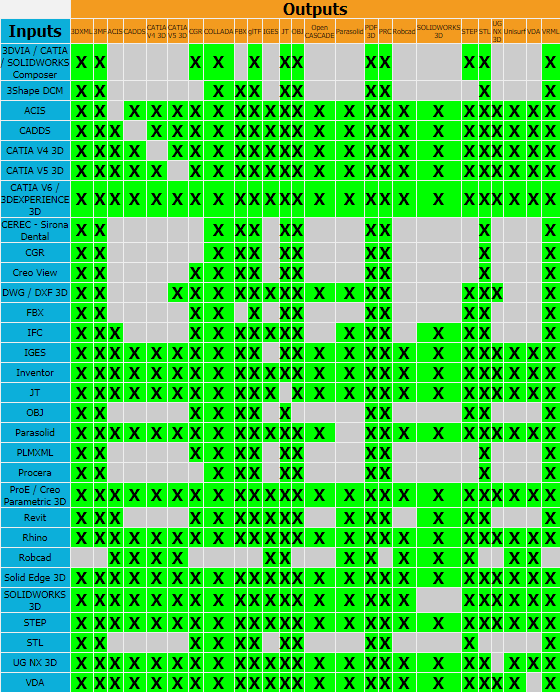
Datakit releases new version (2021.2) of its 2D/3D CAD file converters with new read/write functionalities


Datakit is a major independent player in CAD/CAM file converter markets. Constant improvement of its software performance and coverage is key in company’s strategy. Datakit quarterly releases updates of its file converters to efficiently support the latest versions of CAD and BIM software on the market.

Datakit’s update package for the 2nd quarter of 2021 includes SMG read and IFC 3D write functionalities. It also incorporates enhanced versions of its CATIA V5, JT, Parasolid and NX readers. Additionally, the new Datakit readers now supports Revit textures, and can process weld solid CREO functionalities.

Datakit’s SMG reader Libs and software are now available

SMG is the native format for CATIA Composer and SOLIDWORKS Composer (previously 3DVIA Composer) technical documentation software.

Datakit libs can now read versions 3.6 to 7.x of SMG format, including geometry and textures.

CrossManager, Datakit’s all in one converting solution for end-users, is also updated to convert versions 3.6 to 7.x of SMG format to a dozen of other formats for CAD end-users.

BIM : Datakit API supports IFC files read and write

The Industry Foundation Classes (IFC) format is an object-oriented file format intended to ensure interoperability between different digital mockup software. It is a free and open format which is meant to be the guarantor of an “open” BIM.

The Datakit SDK adds a IFC 3D Write lib to the existing IFC 3D Read library. Datakit can now write IFC 2×3, with mesh geometry, and name, color, metadata attributes.

Bidirectional conversion of IFC files is now supported by the Datakit API.

Upgrade of Datakit CATIA V5 reader, Datakit JT reader, Datakit PARASOLID reader, and Datakit NX reader

Datakit regularly upgrades its CAD file converters to remain compatible with the latest versions of CAD software.

The Datakit 2021.2 release includes upgraded readers for CATIA V5-6R2021 (R31), JT up to 10.6, PARASOLID up to 33.1, and NX up to 1961 series.

Datakit CAD file readers now support new Revit and PTC Creo features

All CAD software have their own specific features. As often as possible Datakit SDK converts those added value features.

The Datakit 2021.2 file exchange SDK can now read Revit 3D materials and textures, and process PTC Creo weld solid feature.

CrossManager, the Datakit all in one CAD converter solution for end-users, is also upgraded

End users, through the CrossManager software, can convert their models using always more combinations.

As of April 20th, 2021, the table of all possible combinations is available here.

Continuous improvements for the entire software line

Version 2021.2 also benefits from the continuous improvement of dozens of CAD interfaces provided by Datakit. They are, in fact, constantly maintained in order to improve their quality and support new entities, while optimizing execution time.

This concerns CrossManager and plug-ins, used by end users and CrossCad/Ware for software vendors integrating Datakit technology.

Datakit offers the possibility of testing its software by registering on its website.

About Datakit

Datakit is a leading company founded in 1994, specialized in CAD data exchange solutions and services. It offers standalone converters, plug-ins and SDK that import, analyze and export a large number of CAD formats. Datakit exposes a wide range of geometrical and semantic data (assemblies, annotations, metadata, PMI…) through its varied range of products. It also provides support services for the migration of CAD databases to help customers choose the best data transfer solutions. It works closely together with independent software vendors that currently integrate its CAD data exchange solutions to their own software. For more information, visit www.datakit.com.

Desktop Metal Qualifies 316L Stainless Steel for High Volume Manufacturing with Production System

0

BOSTON, MA, USA, Apr 22, 2021 – Desktop Metal (NYSE: DM), a leader in mass production and turnkey additive manufacturing solutions, announced it has qualified the use of 316L stainless steel for the Production System platform, which leverages patent pending Single Pass Jetting (SPJ) technology designed to achieve the fastest build speeds in the metal additive manufacturing market.


Connector_(1)
The Production System platform enables printing this heavy industry fluid connector in 316L stainless steel as a single, consolidated component and can support a throughput of nearly 5,500 parts per week. 


Known for its corrosion resistance and excellent mechanical properties at extreme temperatures, 316L stainless steel is well suited for applications in the most demanding conditions, such as parts exposed to marine or pharmaceutical processing environments, food preparation equipment, medical devices and surgical tooling. It also exhibits excellent weldability by standard fusion and resistance methods.

“The qualification of 316L stainless steel with leading mechanical properties on the Production System platform is part of our aggressive roadmap to support an array of materials for binder jetting and a testament to the advantages of SPJ technology, which enables mass production throughput without sacrificing part performance and repeatability,” said Jonah Myerberg, co-founder and CTO of Desktop Metal. “With 316L on the Production System P-50, businesses will now be able to leverage additive manufacturing to produce complex, end-use parts suitable for use in harsh environments at volumes and costs competitive with conventional manufacturing.”

316L Stainless Steel – Key Applications

Through extensive testing, the Desktop Metal materials science team has validated that 316L stainless steel printed on Production System technology and sintered by Desktop Metal meets MPIF 35 standards for structural powder metallurgy parts set by the Metal Powder Industries Federation. Parts printed with 316L have demonstrated excellent mechanical properties and corrosion resistance, while significantly decreasing production time and part cost.

  1. Rocker Arm for Salt Water Marine Environments
    Rocker arms are used to open and close intake and exhaust valves on an outboard marine engine. The use of 316L extends the part’s life and provides corrosion resistance against harsh salt water environments. Manufacturing on the Production System P-50 enables the production of more than a thousand parts per day with ribbing features and cutouts to deliver adequate strength and stiffness while maintaining low weight and a small footprint versus the standard cast alternatives, which require up to 8 to 14 weeks lead time.
  2. Fluid Connector for Chemical Processing Plants
    Heavy industry fluid connectors used in many chemical processing plants need to be manufactured in 316L for corrosion resistance against the chemicals moving through the part. The connector’s complex internal channels make it impossible to manufacture as a single component via conventional manufacturing methods. The Production System P-50 enables printing the fluid connector in 316L as a single, consolidated component and can support a throughput of nearly 5,500 parts per week, at a fully burdened cost of approximately $6.85 per part.
  3. Customized Surgical Tool for Medical Applications
    Because 316L is a surgical-grade steel, it is an ideal material for medical applications like surgical nozzles. By eliminating tooling, additive manufacturing enables mass production runs of different sized nozzles with no lead time, featuring internal channels that are optimized for individual patient needs. Printing on the Production System P-50 eliminates multiple fixturing steps otherwise required for machining, and results in a throughput of more than 24,000 parts per week at approximately $2.50 per part. By comparison, machining the same part would cost $20.00 -$40.00 per part, and require up to two months to create the same number of parts the P-50 can produce in just one week.
  4. Gear Shift Knob for the Automotive Industry
    High touch parts like this gear knob require materials that are easy to sanitize. 316L is an optimal material choice because it offers excellent corrosion resistance and cleans easily. This textured gear shift is an example of mass customization made possible by binder jetting on the Production System, which supports up to 200 parts per build and up to 6,700 parts per week. By comparison, casting would require 8 to 14 weeks lead time for tooling, just to begin volume production.

“As innovators in the automotive, medical, consumer products and petrochemical industries continue to embrace the benefits of additive manufacturing, implementing applications made possible with 316L stainless steel, we will begin to see even more widespread adoption of binder jetting technology,” said Myerberg. “Materials that push the boundaries of what AM technology can do will continue to advance the industry and drive unparalleled throughput while significantly reducing cost and waste.”

Production System – the World’s Fastest Way to 3D Print Metal Parts At-Scale

Created by the inventors of binder jetting and single-pass inkjet technology, the Production System is an industrial manufacturing platform powered by Desktop Metal’s SPJ technology. It is designed to achieve speeds up to 100 times those of legacy powder bed fusion additive manufacturing technologies and enable production quantities of up to millions of parts per year at costs competitive with conventional mass production techniques. The Production System platform consists of two printer models: the P-1, a solution for process development and serial production applications, and the P-50, a large form factor mass production solution for end-use parts, scheduled to begin commercial shipments in 2021. The Production System combines Desktop Metal engineered binders with an open material platform, allowing customers to produce high performance parts using the same low-cost metal powders used in the Metal Injection Molding (MIM) industry. An inert processing environment enables compatibility with a variety of materials, including the now qualified 316L stainless steel as well as high-performance alloys and even reactive metals, such as aluminum and titanium.

For more information on the Production System platform, visit https://www.desktopmetal.com/products/production.

About Desktop Metal

Desktop Metal, Inc., based in Burlington, Massachusetts, is accelerating the transformation of manufacturing with an expansive portfolio of 3D printing solutions, from rapid prototyping to mass production. Founded in 2015 by leaders in advanced manufacturing, metallurgy, and robotics, the company is addressing the unmet challenges of speed, cost, and quality to make additive manufacturing an essential tool for engineers and manufacturers around the world. Desktop Metal was selected as one of the world’s 30 most promising Technology Pioneers by the World Economic Forum and named to MIT Technology Review’s list of 50 Smartest Companies. For more information, visit www.desktopmetal.com.

PTC Adds Vuforia Expert Capture, Creo GDX to Onshape Offerings on Atlas

0

BOSTON, MA, USA, Apr 22, 2021 – PTC (NASDAQ: PTC) announced that it has expanded its robust Software as a Service (SaaS) capabilities with two new products shipping on the PTC Atlas SaaS platform. Atlas, announced at the LiveWorx 2020 Digital Transformation Conference, now supports an expanding portfolio of SaaS applications and production ready solutions. With the Vuforia Expert Capture and Creo Generative Design Extension (GDX) offerings joining the existing Onshape offering on Atlas, PTC continues to accelerate availability of SaaS products in the market.


a0gI3Jbd


“The Onshape team invested years of effort building a cutting-edge SaaS platform that could host a range of product development applications. As part of PTC, we’ve been able to accelerate the development of Atlas, and in turn leverage the Atlas platform to accelerate PTC’s overall SaaS strategy. The new Vuforia and Creo applications immediately gain the incredible operational and technical scalability of the modern, multi-tenant Atlas architecture,” said Andrew Kimpton, Vice President, PTC Atlas Development, PTC. “We are very excited to bring new levels of performance, security, and efficiency, as well as breakthrough new SaaS collaboration capabilities, to the entire PTC portfolio.”

“With the power of Atlas, we’re able to provide Vuforia users a robust set of capabilities that they need to scale deployments in the enterprise, including version control, content management, and approval workflows that would have taken years to deliver without Atlas,” says Mike Campbell, Executive Vice President and General Manager of Augmented Reality, PTC. “We’re proud to be able to offer market-leading AR offerings to our customers and partner network. Atlas helps make these offerings better, and we look forward to delivering a robust roadmap of Atlas-enabled benefits in the near future.”

Similarly, Creo GDX on Atlas delivers the most advanced AI-based generative design capabilities to the CAD market. “The seamless integration between GDX on Atlas and the Creo CAD environment gives our customers unparalleled access to the elastic compute resources needed for AI-driven generative design,” said Brian Thompson, Divisional Vice President and General Manager, CAD Segment, PTC.

With these new products shipping on the platform, PTC has dramatically accelerated its time-to-market with richer-featured products, greatly surpassing industry-standard time-to market statistics.

About PTC (NASDAQ: PTC)

PTC enables global manufacturers to realize double-digit impact with software solutions that enable them to accelerate product and service innovation, improve operational efficiency, and increase workforce productivity. In combination with an extensive partner network, PTC provides customers flexibility in how its technology can be deployed to drive digital transformation – on premises, in the cloud, or via its pure SaaS platform. At PTC, we don’t just imagine a better world, we enable it. For more information, visit https://www.ptc.com.

ENGYS Releases ELEMENTS 3.3.1 for Automotive CFD Design

0

LONDON, UK, Apr 21, 2021 – ENGYS is pleased to announce the new release of ELEMENTS 3.3.1, an open-source based CFD software suite for vehicle design applications produced by Streamline Solutions LLC. This release also includes new versions of the add-on modules ELEMENTS-Adjoint and ELEMENTS-Coupled.


elements-v331


ELEMENTS combines two simulation environments in one package: a dedicated virtual wind tunnel wizard for modelling external vehicle aerodynamics, and a general purpose CFD interface for solving other vehicle design applications (e.g. UHMT, HVAC, in-cabin flows, aeroacoustics, etc). The default methodology and best practices for external vehicle aerodynamics provided with this version of ELEMENTS have been widely tested and validated to conform to the latest regulations on alternative drag prediction methods proposed as part of the Worldwide harmonized Light vehicles Test Procedure (WLTP).

ELEMENTS 3.3.1 offers a wide range of extended capabilities and several refinements to remove known issues found in the previous release 3.3.0. Some of the new exciting features added in this version include:

  1. Extended Python based journaling system for batch automation to cover all components in ELEMENTS, including the virtual wind tunnel wizard for external aerodynamics calculations.
  2. Improved meshing, including better layer addition for low-Re meshes, faster mesh creation by refactoring the snapping stage, increased robustness of crack detection in geometries, better snapping at sharp edges, etc.
  3. New boundary conditions, including a new porous baffle and a complete refactoring of the arbitrary mesh interfaces (AMI).
  4. New fields mapping tool for efficient mapping of solutions between different computational grids.
  5. Added support for relative rigid multibody motion using generalised internal boundaries (GIB).
  6. New local GPU rendering option for remote client-server connections.
  7. New emake build system based on the industry standard cmake. This is now the default build system for HELYX-Core.
  8. Aero: added new option to the configuration files to selectively exclude assembly types from the computation of vehicle width.
  9. Aero: improved report functionalities, including the ability to add vector plots and the inclusion of dimensional units for data and legends.
  10. ELEMENTS-Adjoint: new symmetry condition for adjoint sensitivities around a user-defined plane.
  11. ELEMENTS-Coupled: added caching of block coupled AMG agglomeration for improved solver performance.

To learn more about ELEMENTS, please visit our website or contact ENGYS to schedule a demonstration of the software and discover several success stories from automotive OEMs, tier-1 suppliers and motorsport teams who are already benefiting from using our products.

About Streamline Solutions

Streamline Solutions LLC, a joint venture formed between ENGYS and Auto Research Center, was founded in the USA in early 2012 to serve the vehicle design software market, covering automotive, motorsports, commercial and military applications. The company develops and promotes the software ELEMENTS, a CFD analysis and vehicle design optimisation suite powered by open-source technologies developed by ENGYS. Streamline Solutions combines ENGYS’ leading-edge software development and support, a long and reputable participation in the open-source software business, with ARC’s proven vehicle design expertise and world leading wind tunnel and experimental facilities for validation purposes. For more information, visit https://engys.com/.