Home Blog Page 752

Gerber Announces PPE Retooling Package to Ramp Up PPE Production

0

NEW YORK, NY, USA, Apr 30, 2020 – Continuing to support the alleviation of global shortage of medical and consumer personal protective equipment (PPE), Gerber Technology is now empowering manufacturers to accelerate PPE production by offering a PPE Retooling Package. The package includes an end-to-end suite of software and a specially configured PPE Edition Gerber Paragon cutter with optimized cutting parameters that allow manufacturers to produce up to 150,000 medical gowns and 6 million non-medical masks per week. The package also includes PPE patterns, tech packs, and a regulatory consulting package for rapid conversion of conventional sewn goods production to PPE. The Gerber PPE Retooling Package will help manufacturers seamlessly convert their supply chain allowing them to quickly, efficiently, and sustainably manufacture quality PPE.


“We are dedicated to making our customers successful in every way possible as they navigate through these unprecedented times, to save lives and jobs,” said Leonard Marano, Vice President of Product Management & Marketing for Automation Solutions at Gerber Technology. “Since PPE materials are technical and complicated to work with, we want to ensure our customers have everything they need to make their transition to PPE production as smooth, efficient, and fast as possible.”

Materials used for PPE are complex and often require several materials to be layered together to meet regulations and compliance. In order for manufacturers to successfully transition to efficient PPE production at scale, they will need to make significant changes to the setup of their workflow. The Gerber PPE Retooling Package will simplify the transition through a pre-packaged set of options including vacuum regulation and cutting parameters, essential spare parts, 2D/3D CAD and PLM software to ensure accuracy and efficiency, and support from Gerber’s knowledgeable experts. By leveraging the Gerber consulting package, retooling your production can take less than one week and results in less wasted material than ‘learning by doing’.

“Since March, we have helped over 1,200 companies worldwide optimize their supply chains for PPE production by providing production-ready patterns and files, sharing best practices and connecting our global network of manufacturers and suppliers,” said Michelle Steenvoorden, Vice President, Professional Services and Technical Lead on Gerber’s PPE Task Force. “We know exactly what it takes to produce high-quality, sustainable products that are effective, and help companies retool as quickly as possible for maximum impact.”

People all around the world are currently at high risk of contracting COVID-19 due to the shortage of PPE for both medical and consumer use. Earlier this year, Gerber created the PPE Task Force and Manufacturer Matchmaking Program which is helping manufacturers produce 150+ million masks and several million gowns per week, saving hundreds of millions of lives and securing countless jobs around the world. The Gerber PPE Retooling Package will help further increase manufacturing capacity.

About Gerber Technology

Gerber Technology delivers industry-leading software and automation solutions that help apparel and industrial customers improve their manufacturing and design processes and more effectively manage and connect the supply chain, from product development and production to retail and the end customer. Gerber serves 78,000 customers in 134 countries, including more than 100 Fortune 500 companies in apparel and accessories, home and leisure, transportation, packaging and sign and graphics.

Based in Connecticut in the USA, Gerber Technology is owned by AIP, a New York based, global private equity firm specializing in the technology sector and has more than $3.0 billion assets under management. The company develops and manufactures its products from various locations in the United States and Canada and has additional manufacturing capabilities in China. For more information, visit https://www.gerbertechnology.com.
Invitation
Siemens sd17

Siemens Launches Simcenter FLOEFD 2020.1 for CAE Simulation

0

PLANO, TX, USA, Apr 29, 2020 – Siemens Digital Industries Software announces the latest release of its Simcenter FLOEFD software, a CAD-embedded computational fluid dynamics (CFD) tool. Simcenter FLOEFD is part of the Simcenter portfolio of simulation and test solutions that enables companies optimize designs and deliver innovations faster and with greater confidence. Simcenter FLOEFD helps engineers simulate fluid flow and thermal problems quickly and accurately within their preferred CAD environment. The latest version offers new modules and improvements that can improve accuracy and solve rates.


Siemens_SimcenterFLOEFDAn insulated-gate bipolar transistor thermal simulation with Simcenter FLOEFD, ready for a BCI-ROM extraction.


Featuring unique intelligent technology to enable fast and accurate simulation, Simcenter FLOEFD helps users frontload CFD simulation early into the design process to understand the behavior of their concepts and eliminate the less attractive options. Due to its unique technology, Simcenter FLOEFD can reduce the overall simulation time by as much as 65-75 percent and offers up to 40 times user productivity enhancement. Part of the Xcelerator portfolio, Simcenter FLOEFD helps design engineers increase productivity and contribute to the creation of a highly accurate digital twin.

The new Electronics Cooling Center module in Simcenter FLOEFD combines existing best electronics-specific capabilities and integrates new ones from Simcenter Flotherm software inside the user-friendly CAD-embedded interface to enhance electronics cooling functionality. A second new module helps users create a compact Reduced Order Model (ROM) that solves at a faster rate, while still maintaining a high level of accuracy. Its package creator helps users create thermal models of electronics packages easily and quickly. The Power Electrification module can now simulate an electrical device as an electro-thermal compact model, which can save significant user and computational time.

For more information on the latest release of Simcenter FLOEFD, please see here.

About Siemens Digital Industries Software

Siemens Digital Industries Software is driving transformation to enable a digital enterprise where engineering, manufacturing and electronics design meet tomorrow. The Xcelerator portfolio helps companies of all sizes create and leverage digital twins that provide organizations with new insights, opportunities and levels of automation to drive innovation. For more information on Siemens Digital Industries Software products and services, visit www.sw.siemens.com or follow us on LinkedInTwitterFacebook and Instagram. Siemens Digital Industries Software – Where today meets tomorrow.

Spatial Releases 3D SDK 2020 1.0.1

0

BROOMFIELD, CO, USA, Apr 29, 2020 – Spatial Corp, the leading provider of 3D software development toolkits for design, manufacturing, and engineering solutions, and a subsidiary of Dassault Systèmes, announces the production release of 2020 1.0.1. The release  2020 1.0.1 enables hybrid manufacturing workflows, improved application responsiveness, and enhanced robustness for simulation workflows.


2020-1.0_1


Enable super-fast review of large models

Selective import for optimal performance

3D InterOp’s selective import ability lets you optimize your data preparation application for handling large CAD models.

Your application can start by just importing the data required for visualization of the large CAD model, which with latest improvements typically takes a few seconds (see details below). This means that your users can start reviewing large models within seconds of uploading them in your application.


InterOp Workflow


While your users review the model, your application can start loading exact BRep data in the background. It can also allow your users to isolate and selectively import exact BRep for just a few parts in the large assembly, and continue the workflow without having to re-start the process.

Solidworks and CATIA together make up the majority1 of the PLM suppliers for C-Design (CAD/CAM/CAE/ECAD). Hence, in the 2020 1.0.1 release, we have radically enhanced the performance of visualization2 import from SolidWorks and CATIA parts and assemblies by up to 17 times. See the performance chart below for more details.

*1 – 2019 ARC PLM Market Results
*2 – SPAlopVisu… interfaces


2020 1-0-1 3D InterOp Chart_Bigger font
To replicate these gains, set these CATIA and SOLIDWORKS import options.


Expand the scope of your application to enable hybrid manufacturing 

Expand the Scope of a 3D Modeler

Operate on hybrid sets of data and perform both additive and subtractive manufacturing processes by leveraging CGM’s exact and polyhedral geometry modeling capabilities.

Enable your users to work with data designed in a CAD tool or generated by scanning a real 3D object. Prepare geometry for 3D printing by leveraging wall thickness analysis and offset operators to produce light-weight yet printable parts.

With the 2020 1.0.1 release, the following CGM operators can be used in hybrid workflows:


Hybrid workflowCustomize a scanned part with hybrid geometric operators for Additive manufacturing.

hollowing offsetHollowing using rolling ball offset


Add simulation to your application

Modular Workflow Solutions

Spatial’s modular SDKs enable you to add simulation to a new or existing application with minimal development effort.

Save time to focus on your differentiators by leveraging Spatial’s robust Booleans and meshing solutions for your data preparation needs. Spatial’s solution gives your application automatic CAD Associativity to the mesh, as well as the ability to automatically identify interfaces (contacts) between different domains, so your users can focus on their simulation.


simulation workflow

In 2020 1.0.1, we have enhanced the robustness of CGM’s non-regularized unite for exact geometry. It is now better suited to support interface generation and identification between different bodies in a CAD model thus allowing for automation in data preparation for CHT (Conjugate heat transfer), CFD (Computational fluid dynamics) etc. simulations.


Automatic InterfacingAutomatic interface generation and identification


ACIS, a proven modeler, further enhances booleans

Enhance the Experience of Existing ACIS Applications: Proven Modeler

ACIS applications are the most proven and robust on the market. With 30 years of continuous development, ACIS provides its customers a stable, flexible and performant experience.

With 2020 1.0.1, 3D ACIS Modeler is more stable at performing incremental Booleans (iterative Booleans that offer a higher rate of success than 1-step Booleans) when dealing with bad geometry like sliver faces, edge-face near coincidence etc. With a more robust preparation step, incremental Booleans deliver consistent success rates for complex and noisy data sets. This is especially relevant for ACIS based Simulation applications that perform multi-body Booleans.


ACISSliver Face Interaction: Sliver Face Can Be Present in Tool or Blank and It Is Interacting Other Body

 

Spatial is a solution advisor, not just a component provider

Enhance the Experience of Existing ACIS Applications: Solution Advisor

2020 1.0.1 release includes ACIS enhancements delivered as a result of direct engagements with ACIS customers. By leveraging Spatial’s 3D experts in the customer success team, you can get custom implementations done for your needs and strategies or schedule on-site trainings. To get started, contact your Account Manager or reach us at the support portal.

Some such 2020 1.0.1 enhancements include:

Up to 65% performance improvements in wrapping a large number of wire bodies on a face (api_wrap) by enabling multithreading. This can allow for real-time marking, engraving or etching of 3D objects.


2020 1-0-1 ACIS Graph


Reverse engineer point segments to generate line and arc segments.

This functionality can enable applications focused on converting scanned data to BRep or exact geometry.

Applications:

  1. Easy editing downstream
  2. Speed up 3D printing or robotic arm movement


ACIS Workflow

Other highlights in 2020 1.0.1

3D InterOp:

  1. CATIA V5 threads are now supported for all 3 modeler flavors of 3D InterOp.
  2. The demo tool, 3DScript has been enhanced to support new 3D InterOp interfaces:
    1. Multi-process import
    2. Activation of minimal data import policy to get high performance, and more
  3. New UConnect focused portal in documentation to help you adopt the new interface. More enhancements to this page will be coming soon. We will also continue to maintain and enhance the former Connect interface focused portal.
  4. Updated CAD version support:
    1. CATIA V5-6 R2020
    2. NX 1872 and 1899
    3. Parasolid 32.0.152
    4. JT 10.3 & 10.5
    5. Revit 2019
    6. PMI from Solidworks 2020

Refer to the 3D InterOp release notes for a complete list of updates

CGM:

  1. An updated list of hybrid operators is available here. Now you can perform splitsintersectionsdisconnect a group of wires, extract boundaries, create silhouette etc. on both exact BRep as well as polyhedral inputs.
  2. 3D Precise mesh, bridge between CGM and Distene MeshGems, supports any MeshGems version from 2.4 to 2.10.

Refer to the CGM release notes for a complete list of updates

ACIS:

  1. ACIS-HOOPS Bridge has been updated to support HOOPS Visualize 3DF API v24.10 on all platforms
  2. Generate miter faces when thickening connected sheets to create manufacturable parts
  3. Continued effort to prevent generation of zero-length edges from most ACIS algorithms as well as successfully handling them in legacy models

Refer to the ACIS release notes for a complete list of updates

About Spatial

Spatial Corp, a Dassault Systèmes subsidiary, is the leading provider of 3D software development toolkits for technical applications across a broad range of industries. Spatial 3D modeling3D visualization, and CAD translation software development toolkits help application developers deliver market-leading products, maintain focus on core competencies, and reduce time-to-market. For over 30 years, Spatial’s 3D software development toolkits have been adopted by many of the world’s most recognized software developers, manufacturers, research institutes, and universities. Headquartered in Broomfield, Colorado, Spatial has offices in the USA, Germany, Japan, China, and the United Kingdom. For more information, visit www.spatial.com.

ModuleWorks 2020.04 Released

0

AACHEN, Germany, Apr 29, 2020 –  ModuleWorks announces the release of its 2020.04 CAD/CAM software components. This is the first major release of 2020 and is available now for download from the ModuleWorks website.

Each ModuleWorks release contains new and enhanced features across the product range. This latest release contains new quality-enhancing features for 5-axis and 3-axis machining as well as improved visualization for the MultiXPost post processor.

5-Axis Machining

Automatic tilting to avoid collisions

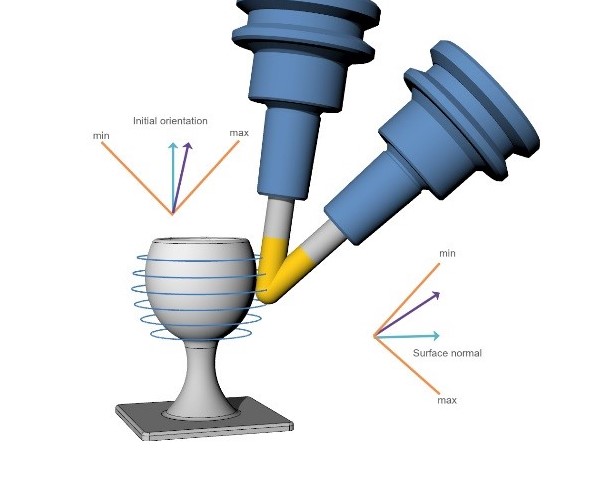
It is not always possible to create a collision-free lead for the machining process. The new automatic tilting feature uses an intelligent algorithm to automatically tilt the tool to avoid the collisions, thereby improving the safety and efficiency of the machining process, particularly when working with complex tool shapes such as barrel mill cutters.


Automatic Tilting


Limits relative to surface normal

Setting the constraints on the lead tilt angle and side tilt angle enables you to adjust the machining process in different ways depending on the tool’s contact point and the machining surface. To provide even more application flexibility, the user-defined contact point and angle limits can now be measured relative to the surface normal instead of the initial tool orientation. When working with barrel mill cutters, this feature gives you better control over the cutting conditions upon tool engagement.


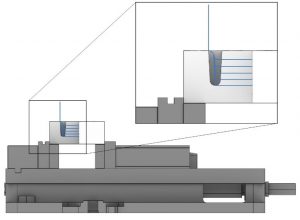
More accurate tool definitions

The shoulder length is a cylindrical part located directly above the flute. ModuleWorks now incorporates the shoulder length into its tool definitions, resulting in more accurate definitions.


tool-definition


3-Axis Machining

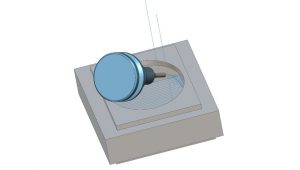
Floor finishing for wireframe-based toolpath calculations

Floor machining for pocket/boss areas is now available to complete the basic product portfolio of roughing and finishing cycles based on a wireframe geometry.


Floor-finishing


Number of slices for engraving

To optimize tool loading, you can now create a specified number of engraving toolpath slices with variable depths.


number of slices for engraving


Multi-Axis Post Processor (MultiXPost)

Keep the table and head in fixed positions

Posting 3-axis toolpaths on a machine usually requires constant adjustments to the position of the table or head, which may not always be desired when viewing the simulation. To provide an improved user experience, MultiXPost is now able to eliminate the continuous movement and keep the table or head axis in a fixed position while ensuring the whole toolpath is simulated within the machine limits.


fixed-positions


For further details about the ModuleWorks 2020.04 release, see the latest ModuleWorks YouTube videos: What’s New in ModuleWorks 2020.04

About ModuleWorks

ModuleWorks is the leading software component provider for the CAD/CAM industry. With over 170 employees and 800 man years of software development, ModuleWorks’ expertise in toolpath creation and simulation is recognized throughout the industry and its software components are already optimizing the performance and quality of over 500,000 installed seats of CAD/CAM software around the world.

From standard products to exclusive development projects, we work in close cooperation with you to bring your own vision of Industry 4.0 to life. Our comprehensive product portfolio and cutting-edge software components enable you to optimize your CAD/CAM solutions and connect to CNC/MTB systems to increase your competitiveness and help you Get There Faster. For more information, visit https://www.moduleworks.com.

Moldex3D Extends License Support for Work-from-Home until June 30 amid Corona Pandemic

0

HSINCHU, Taiwan, Apr 29, 2020 – CoreTech System Co., Ltd. (Moldex3D) has made an announcement to support users who need to work from home during the period of COVID-19 pandemic. Moldex3D is hereby allowing the authorized users to access Moldex3D software license through their corporate secured VPN from their homes, notwithstanding any contractual restrictions on remote access stated in Moldex3D software license agreement. The policy is effective immediately on March 27th through June 30th, 2020. This temporary arrangement requires no further paperwork and applies to all authorized users.

For those who are not able to access the authorized license server, or who have no authorized Moldex3D licenses but would like to learn Moldex3D during the work-from-home period, we are happy to help. Please fill out the web form requesting for Work-from-Home Support, and we will get in touch with you as soon as possible. Should you have any further issues, please feel free to contact us anytime.

If you already have access to Moldex3D, you are more than welcome to participate in our online training program. It’s a great timing to learn more about Moldex3D from home. We offer a selection of comprehensive Moldex3D Online Training Resources. We can also schedule online web training upon your request.

About CoreTech System (Moldex3D)

CoreTech System Co., Ltd. (Moldex3D) has been providing the professional CAE analysis solution “Moldex” series for the plastic injection molding industry since 1995, and the current product “Moldex3D” is marketed worldwide. Committed to providing advanced technologies and solutions to meet industrial demands, CoreTech System has extended its sales and service network to provide local, immediate, and professional service. CoreTech System presents innovative technology, which helps customers troubleshoot from product design to development, optimize design patterns, shorten time-to-market, and maximize product return on investment (ROI). More information can be found at www.moldex3d.com.

Moldex3D 2020 Released

0

HSINCHU, Taiwan, Apr 29, 2020 – CoreTech System Co., Ltd. (Moldex3D) announced the release of a new version of its molding analysis software Moldex3D 2020. The new generation of Moldex3D continues the tradition from the past and optimizes the solver architecture as well as enhances the software performance. At the same time, many powerful analysis modules were also released to empower our customers in various industries to be able to flexibly face the rapidly changing global market. In addition, iSLM, a system that integrates the design of molds and the molding big data-driven team, is also released to respond to the trend of transformation due to smart manufacturing and to help enterprises establish their systematic data management and online operation system to practically implement teamwork.


moldex3d-2020


The important updates and highlights of Moldex3D 2020 are as follows:

A Customer-centered, Easy-to-use, and Highly Efficient Molding Analysis Software

The feature innovations of Moldex3D 2020 are all based on customers’ needs to help with conducting molding analysis in a faster and more convenient manner. With the optimization of solver architecture of the software, the computational performance of Moldex3D is greatly improved, which enables users to save on analysis time by more than 20%. In addition, many new geometrical and mesh repairing tools have been added to enable users to process geometric and mesh problems in a more convenient and faster manner, and hence the pace of design changes is effectively enhanced.

Moldex3D 2020 also has a breakthrough in the simulation capability which includes the Heat Transfer Coefficient (HTC), delayed ejection, and occurrence of ear flow due to certain characteristics of materials in the software simulation and verification, to greatly enhance the accuracy of warping and cooling analysis. Furthermore, the existing functions of modules have also been improved, as the users will be able to consider the impact of the warpage of the first shot on the second shot when opening the insert molding module in the new version; at the same time, the True 3D Barrel Compression Simulation  is also optimized to obtain a more precise injection pressure result.

Optimization of the Advanced Process to Adapt to the Rapidly Changing Market Demands

Industries are facing more severe challenges due to the rapidly changing market demands and the impact of the current global trade situation. Moldex3D provides comprehensive advanced process to empower users to be more competitive in product innovation and development! The new version of Moldex3D can consider the 2D woven fabric in Resin Transfer Molding (RTM) to achieve the prediction that is more close to the actual warpage of product; it’s also a breakthrough of chemical foaming module that supports the analysis of dissolution and temperature for the foaming gas, as well as the retraction simulation for thermoset materials.

In addition to the breakthroughs in RTM and foaming module, Moldex3D 2020 also improves its simulation capability of fiber composite materials for the realization of changes in fiber concentration or length, which can obtain the simulation result of changes in flow behavior. With this adjustment, users will be able to predict the melt flow behavior faster and thus the work efficiency will be greatly enhanced.

For the Realization of Smart Manufacturing, it is Necessary to Work with a Big Data-driven Team

Manufacturing transformation is inevitable in the trend of smart manufacturing. A set of systematic management tools will be able to assist enterprises to collect data and centralize the management, as well as derive value from the process to enhance the team’s work efficiency! Moldex3D iSLM is a service developed to fulfill this demand. iSLM is based on cloud architecture and users can access via a web browser for the three major features such as Solution Management, Mold Tryout Management, and Knowledge Management. All information can be configured for data access authorization to effectively protect confidential documents of enterprises as well as reduce traditional paperwork and tedious email communication and backup, to help enterprises practically realize team collaboration across geographical environments!

For more information about the new features of Moldex3D 2020, please visit our product release page at: https://www.moldex3d.com/en/products/moldex3d-2020

About CoreTech System (Moldex3D)

CoreTech System Co., Ltd. (Moldex3D) has been providing the professional CAE analysis solution “Moldex” series for the plastic injection molding industry since 1995, and the current product “Moldex3D” is marketed worldwide. Committed to providing advanced technologies and solutions to meet industrial demands, CoreTech System has extended its sales and service network to provide local, immediate, and professional service. CoreTech System presents innovative technology, which helps customers troubleshoot from product design to development, optimize design patterns, shorten time-to-market, and maximize product return on investment (ROI). More information can be found at www.moldex3d.com.

CIMdata Adds Digital Skills Transformation Program

0

ANN ARBOR, MI, USA, Apr 29, 2020 – CIMdata, Inc., the leading global PLM strategic management consulting and research firm, announces the addition of a Digital Skills Transformation program. These strategic services focus on leading an organization through the assessment, definition, implementation, and continuous improvement of the digital skills of its employees. Using a highly collaborative process, CIMdata works with its clients to form a lasting structure for training, education, and skill enhancement.

According to CIMdata’s President & CEO, Mr. Peter Bilello, “A well-defined Digital Skills Transformation program is multi-faceted, and typically includes organizational, process, technology, and content considerations. The resulting education and training framework, implementation, and support structure typically cover several different organizational processes and supporting technology platforms, as well as incorporating different experience and skill levels into one repeatable standard applicable throughout an enterprise, no matter its size or complexity.” He continued, “With such a structure in place, the enterprise is in a better position to proactively handle growth, reduce employee turnover, and successfully deal with technological and process changes encountered in today’s rapidly evolving digital world.”

CIMdata’s Digital Skills Transformation methodology follows a comprehensive set of proven principles—each representing a critical component needed to maximize the organization’s return on talent investment. The top five guiding principles of a well-defined and executed digital skills transformation are as follows:

  1. The program must be aligned with the organization’s overall strategic goals.
  2. The enterprise’s overall digital skills framework should result in a positive return on investment.
  3. The program should ensure that learning is aligned with and directly supported by organizational structures, lines of authority, decision-making, values, and other appropriate business practices.
  4. The program should incorporate different platforms and utilize them to reinforce outcomes and ensure that people get the right skills at the right time, in the right way, and at the right cost.
  5. The program must demonstrate integrated learning achieved not only by doing but by establishing shared accountability.

CIMdata’s Digital Skills Transformation services leverage the company’s more than 35 years of experience serving industrial companies, and software and service providers through strategic management consulting, market research and analysis, and best practices education. For more information, visit CIMdata.com or contact CIMdata at info@cimdata.com or +1 734.668.9922.

CIMdata to Host Free Webinar on PLM Status & Trends

0

ANN ARBOR, MI, USA, Apr 29, 2020 – CIMdata, Inc., the leading global PLM strategic management consulting and research firm, announces an upcoming free educational webinar, “PLM Status & Trends.” The webinar will take place on Thursday, 14 May 2020, at 11:00 a.m. (EDT) and will last for one hour.


Webinar


This webinar will provide an insight into the results of CIMdata’s recent global PLM Status & Trends research. The goal of the study was to deepen the global PLM community’s collective understanding of the status, drivers, and preconditions necessary for companies to derive value from their investment in PLM. The main topics to be covered include spending trends, the focus of implementations, value perception, and processes that are enabled, to name a few. Additionally, comments that describe some of the key potential PLM industry disruptors will be made.

This webinar will help attendees:

  1. Understand how PLM is being used.
  2. Understand what processes are being enabled by PLM.
  3. Understand what drivers and preconditions are necessary to derive value from PLM.
  4. Understand where executives perceive value in PLM.
  5. Understand the main focus areas of leading companies.

According to Peter Bilello, CIMdata’s President & CEO, and the host for this webinar, “The global PLM industry is rapidly evolving through the incorporation of new technologies, business process focus, and an organizations’ push to digitally transform. Companies need to constantly understand and evaluate where the industry is and where it is going so that the maximum value is achievable from its implementation.”

Mr. Bilello has more than 30 years of experience in the development of business-enabling IT solutions for research, engineering, and manufacturing organizations worldwide. He has participated in PLM analysis, selection, implementation, and training; CAD/CAM/CAE/CIM implementation and management; synchronous and lean manufacturing consulting; software engineering; and general data management strategy development and support. He has authored numerous papers and research reports on PLM and related topics, and his articles, commentaries, and perspectives have appeared in publications throughout the Americas, Europe, and Asia.

This webinar will be useful to a broad audience including executives, directors, and managers responsible for PLM initiatives, those responsible for digital transformation, PLM team leaders, PLM team members, PLM users, product managers, IT leadership, solution providers, and anyone else who wants to understand the trends and status of the global PLM industry.

During the webinar, attendees will have the opportunity to ask questions about the topics discussed.

  1. To find out more, visit: https://www.cimdata.com/en/education/educational-webinars/2020-plm-status-trends.
  2. To register for this webinar, please visit: https://register.gotowebinar.com/register/3786661273382693122.

FTI’s FormingSuite 2020 Features 3D Die Scanning, Design Productivity Tools

0

OAKVILLE, ON, USA, Apr 28, 2020 – Forming Technologies (FTI), part of Hexagon’s Manufacturing Intelligence division, has announced new virtual manufacturing capabilities that improve productivity setting up sheet metal process simulation with CAD design interoperability and Hexagon 3D scanning.


FTI-Launches-FormingSuite-2020


FTI’s FormingSuite software helps manufacturers to evaluate the cost of tooling and material in sheet metal processes, assess the feasibility of designs to avoid costly product changes and reduce time to market. Its FormingSuite 2020 release introduces features that enable cost engineers, designers and die-makers to work more productively together throughout early product design and improve the accuracy of virtual try-out.

Stamping dies are frequently modified through grinding and spotting during try-out, before they are put into production, which renders CAD designs obsolete. For the first time, users can now connect FormingSuite to Hexagon’s 3D metrology systems so that any die can be quickly scanned to capture these modifications and feed real manufacturing parameters back into virtual try-outs. This scanned data is then used directly in simulations to perform accurate validation of the stamping process.

Some stampers require the ability to run two different shaped blanks in their transfer presses. These lines are equipped with advanced features such as oscillating shears, indexing conveyors, and rotate stations so the stamper also can process rectangle, trapezoid, mitre, parallelogram, and developed (shaped) blanks into the same large-bed press.

A new workflow provides easy setup to optimize the cost and tooling for processes with two unique coils. Furthermore, engineers can now save time by optimizing conceptual designs for manufacture in FormingSuite, then exporting the blanking die process geometry from the transfer die layout and the progressive die strip layout directly to their CAD system to use as the basis for their design.

New features make it easier for manufacturers to set up more accurate process simulations by automating repetitive tasks and more flexible design tools. A powerful new Sketch Web tool provides engineers a fast and accurate way to create custom web designs outside of standard shapes. Furthermore, automatic and user-defined mesh refinement for trimming improves the precision of die models. When evaluating materials utilization, design changes can now be automatically applied to the opposite, symmetrical side of the part. These improvements, combined with refinements to the software’s calculation and costing methods, enable manufacturers to make better manufacturing decisions at the design stage.

Andy Melang, Business Development Manager at Ultratech, commented: “One of our customers came to us for a small bracket that is a late add to a new frame. Most of the tooling for the frame was built in China, but due to time restrictions they re-shored it locally and needed quotes immediately as the tool needed to be built in 12-16 weeks. Using FormingSuite COSTOPTIMIZER Professional, the time from them saying ‘we need this part’ to the time we sent the total cost with cost breakdown was a couple of hours. I didn’t have a day or two to get assistance from our tool designer, but because we could turn this around so quickly it not only looks like we want the job, but we look professional doing it.”

“Approximately 70% of decisions related to the overall cost have already been committed in the early design phase and optimizing forming delivers a high return for high volume manufacturing,” commented Hendrik Schafstall, CEO. “Our goal remains to be intuitive and accessible to everyone that needs better process knowledge, not necessarily CAE experts. FormingSuite’s new features improve the productivity – and the competitiveness – of our customers by speeding up their time to market with better decision making upfront.”

Availability

FormingSuite 2020 is now available from FTI’s website forming.com for customers, with free trial licenses also available.

About Hexagon | FTI

Hexagon is a global leader in sensor, software and autonomous solutions. We are putting data to work to boost efficiency, productivity, and quality across industrial, manufacturing, infrastructure, safety, and mobility applications.

Our technologies are shaping urban and production ecosystems to become increasingly connected and autonomous – ensuring a scalable, sustainable future.

Forming Technologies (FTI), part of Hexagon’s Manufacturing Intelligence division, provides computer-aided engineering software to optimise the design for manufacturing, material utilisation and cost of sheet metal components. Learn more at forming.com. Hexagon’s Manufacturing Intelligence division provides solutions that utilise data from design and engineering, production and metrology to make manufacturing smarter.

Hexagon (Nasdaq Stockholm: HEXA B) has approximately 21,000 employees in 50 countries and net sales of approximately 3.9bn EUR. Learn more at hexagon.com and follow us @HexagonAB.

Altair Inspire Latest Release Integrates SimSolid, Accelerates Simulation-Driven Design

0

TROY, MI, USA, Apr 28, 2020 – Altair, (Nasdaq: ALTR) a global technology company providing solutions in product development, high-performance computing (HPC), and data analytics, introduced a new version of Altair Inspire, the company’s fully-integrated generative design and simulation solution that accelerates the creation, optimization, and study of innovative, structurally efficient parts and assemblies.

The latest release offers an even more powerful and accessible working environment, enabling a simulation-driven design approach that will cut time-to-market, reduce development costs, and optimize product performance.


Figure 1 (1)Results of a modal analysis on a 400 parts assembly in Altair Inspire, solved with the speed and accuracy of Altair SimSolid


Inspire now integrates Altair SimSolid for fast, accurate structural analysis of complex assemblies, as independently validated by NAFEMS. Integration with Inspire’s interactive design engineering environment sees SimSolid join two more trusted industry solvers, empowering users across the engineering and manufacturing sectors:

  1. Altair OptiStruct – the market leader and industry standard for structural efficiency and topology optimization for the generative design of practical, viable and manufacturable geometry.
  2. Altair MotionSolve – multi-body systems analysis for dynamic motion simulation, including loads extraction.
  3. Inspire CastInspire FormInspire Extrude and Inspire Print 3D – manufacturing simulation for product designers and manufacturing simulation specialists.

Developed with engineering leaders, product engineers and simulation specialists in mind, Inspire is intuitive, easy-to-learn in just a few hours and runs on standard laptops and workstations. No additional investment in expensive GPUs is required, and users do not need CAD or other specialist skills. Design changes can be made directly on models without reverting to the original CAD system, and interactive modifications such as geometry edits, dimensional changes, and part replacements can now be re-analysed ‘on the fly’ with SimSolid.


Figure 2 (1)Complex solid parts can be analyzed in Altair Inspire without removing any of the geometrical features


“It’s no longer a question of who is responsible for simulation, but when and where it features in the process,” said James Dagg, Altair chief technology officer – design and simulation solutions. “Instead of employing it purely for validation at the end of the cycle, Inspire enables users to test more alternatives at the earliest opportunity, make better design decisions, and avoid implementing costly modifications at a later stage. The integration of SimSolid further strengthens these capabilities, making it even easier to access remarkable speed, accuracy and flexibility.”

“While offering the potential to significantly expand the usage of analysis to design engineers, the use of Inspire with SimSolid also has high value to simulation and CAE specialists who do not typically use 3D CAD tools,” said Don Tolle, practice director for simulation-driven systems design at CIMdata, a global independent firm providing consulting to maximize an enterprise’s ability to design and deliver innovative products and services through the application of Product Lifecycle Management (PLM). “We believe that the Inspire environment augmented with the SimSolid technology has the potential to be a major positive factor in achieving the PLM industry’s quest for democratization of simulation and the long promised business benefits of simulation-driven design.”


Figure 3

Multiple design variants can be easily created and modified within Altair Inspire without the use of a CAD tool


Inspire enables both simulation analysts and designers to perform ‘what-if’ studies faster, easier, and earlier, encouraging collaboration and reducing product time to market. Additional Inspire features include:

  1. Dynamic Motion – Easily generate dynamic motion of complex mechanisms and use these dynamic loads as loadcases for optimization.
  2. Topology Optimization – Leverage the world’s leading topology optimization capabilities, including advanced manufacturing constraints, to create manufacturable solutions to real-world problems.
  3. Design for Additive Manufacturing – Employ overhang shape controls to create more self-supporting structures, then simulate the process to identify and correct potential deformation, delamination, and excessive heating issues before building a part.
  4. Structural Analysis – Investigate linear static and normal modes analysis on a model and visualize displacement, factor of safety, percent of yield, tension and compression, and more.
  5. Assembly Configuration – Create multiple assembly configurations which can be used to evaluate various design scenarios and the resulting concepts.
  6. Manufacturing Simulation – The extended manufacturing versions of Inspire provide high quality simulations of casting, sheet metal forming, 3D printing, extrusion and, soon, injection molding. These solutions provide quick feasibility checks on manufacturability as well as detailed simulations of the manufacturing process.

Availability

The latest version of Inspire is now available and SimSolid also remains available to users as a standalone solution. For more information about Inspire, visit: www.altair.com/inspire

About Altair

Altair (Nasdaq: ALTR) is a global technology company that provides software and cloud solutions in the areas of product development, high performance computing (HPC) and data analytics. Altair enables organizations across broad industry segments to compete more effectively in a connected world while creating a more sustainable future. To learn more, please visit www.altair.com.