LUCERNE, Switzerland, Jan 8, 2026 – BETA CAE Systems is thrilled to announce the release of the major version 2025.2 of its product line for ANSA, EPILYSIS, META, KOMVOS, SPDRM, FATIQ, ANSERS and RETOMO.

This brand-new version offers an increased number of new tools and features, along with elevated performance, enhanced user experience and noteworthy key-features that add value to your daily tasks and processes.
Elevated pre-processing workflows in ANSA
The new version comes with numerous implementations in the area of Modular Environment. The implementation of Solver Submission functionality allows the submission of Simulation Runs on local or remote resources, with real-time monitoring of convergence or key model indicators, whereas other features such as contents-based versioning and containers’ comparison add value to the streamlined workflows.
Focusing on Model Build, thanks to the GPU-accelerated Part Classifier, we can now train a custom Part Classifier to predict any part label based on historical data. Moreover, all related depenetration functionality has been organized under a dedicated ribbon, offering a standard and efficient workflow.
In the Meshing area, several enhancements have taken place affecting the Middle Surface extraction, especially with regards to the performance. Meanwhile, advanced algorithms effortlessly generate node-to-node hexa/penta solid mesh also on voids, like battery foam, electronics or CFD models, while preserving existing FE entities.
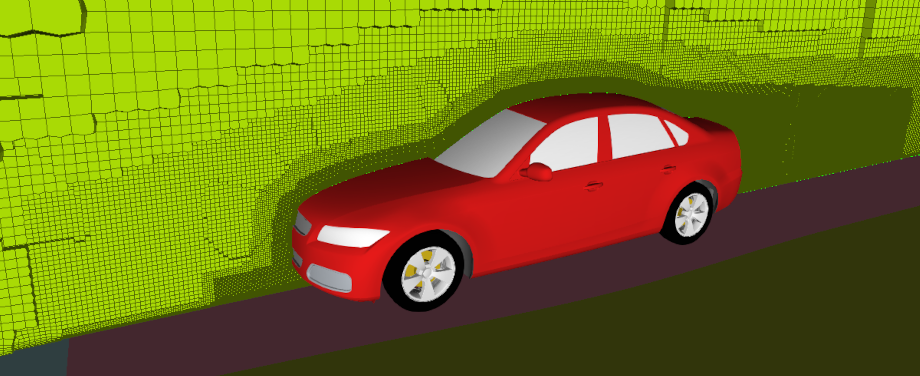
Focusing on CFD, HexaPoly connection to boundaries is now performed with polys instead of tetras, whereas Hextreme Volume Meshing has also undergone significant enhancements: easier Hextreme mesh output by automatically disabling original geometry in Model Browser and noticeable improvements in quality and gap resolution, accompanied by more controls for Layers specs and assigned quality criteria.
Speaking of Crash & Safety, the Human Body Model functionality comes with new tools: HBM to Car positioning tool, according to Euro NCAP TB 024 (CP 540), HBM Inherit Anthropometric tool, for the identification and export of the anthropometric dimensions of a reference surface and HBM Autopositioning tool, assigning regression models based postures (C-IASI, EuroNCAP Frontal VTC, UMTRI-Reclined).
2025.2 equips NVH with Actran Aeroacoustics in pre-processing, offering a handy – yet complete – setup of iCFD analysis.
The Oil Canning tool in Durability has been enhanced even more, with the creation of target points based on raster projection and template-driven definition of contacts, steps and boundary conditions.
In Design & Morphing, fully parameterizable features, ready-to-be-used in optimization loops, can now be created, whereas modeling of features can be further improved with inclusion of corresponding stamping results through Inverse forming.
Furthermore, new Optimization Algorithms have been added, along with Key Performance Indicators (KPIs) for Kriging RSM algorithm, such as accuracy metrics, performance plots and model explanation plots. New solvers have also been supported in ANSA Optimization tool workflow; in specific, output formats for FidelityCFD and META FRF Assembly. Lastly, advanced expressions between all available variables (Design Variables and Responses) can be defined for Constraints and Objectives.
The new version comes with a significant variety of new features, focusing on Electronics. Pin and Package Projection Controls allow for the precise control of pin and package projection per component, with the ability to generate projections even without importing components. SOLDERMASK can be created based on IPC file specifications and for all levels of board detail. Bending of rigid-flex PCB models is now possible and IPC-2581 rev C format for all levels of board details is now supported.
In the AR/VR area, hands inspection has been introduced, with female/male, size adjustable hands and real time occlusion with models.
Closing with numerous implementations that boost User Productivity, such as enhancements in the Renumber tool and the Cut Plane functionality, the redesign of ANSA Annotation tool to fully align with META, encryption capabilities for sensitive LS-DYNA and Abaqus entities and the Job Submission on local or remote resources, with real-time monitoring of convergence or key model indicators.
Significant enhancements and a new solver deck for EPILYSIS
EPILYSIS 2025.2 comes with a new solver deck, tailored to the EPILYSIS keywords and parameters, aiming in boosting overall functionality.
Apart from that, several performance enhancements have also been accomplished: Block Lanczos accuracy and performance have been improved to deliver more reliable and efficient solver results and the penetration detection algorithm in Contacts has been redeveloped from the ground up, with several new options added. Moreover, a significant improvement in memory usage has been achieved for topology optimization (SOL 200), in cases where “minimum member size” constraints are introduced.
Cross-disciplinary efficiency in META
The new version comes with a vast range of new features for post-processing across disciplines.
Starting with CFD, Parametric Point Paths position can be interactively modified, whereas a new interactive functionality for editing the position of Cut Planes and Flow Paths has been implemented.
In the Crash & Safety field, 2025.2 offers a new HBM Certification tool for the certification of Pedestrian HBMs for Euro NCAP TB 024 (CP 540).
Focusing on NVH and specifically on exterior acoustics in FRF Assembly tool, pressure can be calculated on Field Points using Rayleigh integral method, whereas modal and panel participation calculations can also take place on requested Field Points.
Referencing Durability, the focus is placed on Bolt assessment; bolt diameter and class libraries for Eurocode 3 calculations are now supported, whereas section forces and moments for all cross-sections can be calculated over time. Eurocode 3 can also be used to predict failure of the critical cross section.
A vast variety of features boost User Productivity in the new version; the Model Comparison tool offers a streamlined workflow that unifies the comparison of geometry, attributes, materials and results across multiple simulation models. Conditional formatting can take place in report tables and curve data can be imported from XLSX file format. Measurements are now introduced as separate entities in DB browser, and therefore users can select, delete and control visibility or create measurements on local coordinate systems. Not to be missed, the progressive display of identified entities during zoom, avoiding overlap and clutter.
Closing, similarly to ANSA AR/VR, hands inspection has been introduced, with female/male, size adjustable hands and real time occlusion with models.
Expanded Data Management and AI-assisted functionality in KOMVOS
Among the numerous implementations in 2025.2, the new access control features take System Configuration to the next level, by configuring permissions per object type, per project and for different object families, along with configuring different version spin-up possibilities and controlling the attribute values available for different user roles.
Focusing on Model and Run Configuration, the new Simulations Builder streamlines the simulation setup for modular models, based on templates: From include files to Simulation Models and from Simulation Models to Loadcases and Simulation Runs.
Referencing Data Management, thanks to the new DM Schema Editor, data model customizations can be easily deployed. Among other elevating features of the new version, reside the editing of primary attributes of DM objects, the efficient management of deleted data and the streamlined data migration between SPDRM environments.
Focusing on Optimization Studies, Single Disciplinary, Multi Disciplinary Optimization Processes, DOE and Response Surface Model training processes can now take place in the new Optimality space, when connected to SPDRM.
Closing, AI-Assistant marks its entrance in KOMVOS, similarly to the rest BETA software products:
- Further facilitating Data Search, it effortlessly turns natural language into precise BETA QL.
- In Process Design, a new agentic mode has been added for design and modification of workflows.
- For Documentation Queries, the AI-Assistant understands questions and delivers accurate, context-aware responses, simplifying access to different sources.
- CFD in KOMVOS has been also AI-powered in the new version, enabling the creation of non-parametric CFD predictors, starting from DOE studies, or selection of Simulation Runs. Built-in checks ensure a healthy dataset and a simulation convergence evaluation graph, based on saved monitors. Lastly, easy definition of pre-processing and training of hyper-parameters is now provided, including support for training at remote resources.
Design Smarter, Simulate Faster, Scale Confidently
The latest version of SPDRM delivers groundbreaking enhancements to simulation process and data management. A major highlight is SPDRM Lite, a fully portable, single-user edition that provides enterprise-level capabilities without infrastructure dependencies: No databases, no server configuration or IT setup required. Advanced workflows such as Part Build Orchestrator, HPC Submission, Simulation Builder, and Design Optimization can now be accessed instantly.
Process management has been significantly improved through the new, multi-JMA topology, decentralized configuration, and redesigned file streaming for real-time HPC job monitoring. The new AI-Assistant for Process Design enables workflow creation from natural language prompts, reducing setup time and making advanced process design accessible to non-expert users.
Additional capabilities include Simulations Builder for template-driven configuration of modular simulation runs and the new DOE and Response Surface Model training process for the creation of ML predictors from a multi-disciplinary DOE space.
Further enhancements include seamless update of existing SSL-configured installations via the improved SPDRM Installer, and major performance improvements in processing concurrent uploads, queries and exports: Up to 50% faster processing and certified scalability for 1,000+ concurrent users.
New calculation methods and further implementations in FATIQ
The new release comes with numerous upgraded FATIQ features.
In specific, the new calculation method Solder Joints fatigue has been introduced, supporting solder joints (Ball Grid Array – BGA) life prediction based on creep.
Seamweld assessment can now take place, according to various fatigue guidelines, and the Material Generator allows for the generation of S-N and E-N fatigue material properties by selecting the material class and specifying the ultimate tensile strength (UTS).
Closing, thanks to the Contribution Analysis in post-processing, users can now identify the most contributing modes or channels to the examined duty cycle and track the root cause of stress peaks and overall damage.
New supported features in ANSERS
The newly introduced Admin Page for the management of BALs in ANSERS provides the administrators with the ability to check the status and the logs of running BETA Apps Launcher services.
Moreover, morphing within ANSA web panel can take place, through supported morphing actions for morph parameters and boxes.
The new version also comes with a dedicated UI that allows the storage of values in variables to be used throughout a dashlet in queries, actions and display functionality.
Closing, several new options and supported entities add value in ANSERS 2025.2:
- A new option to have a System Connection DM microservice managed internally by ANSERS has been introduced.
- A new option in dashlets to set a variant as reference and view differences across media panels, lists, tables and bar charts has been added.
- Actions have been supported for the execution of ANSA/META/python scripts for items selected in an ANSERS list.
- Report type PDF is now supported.
For more details about the new software features, enhancements and fixes, please refer to the Release Notes documents.
Download
Where to download from
- Customers who are served directly by BETA CAE Systems, or its subsidiaries, may download the new software, examples and documentation from their account on our server. They can access their account through the “download” link on our website.
- Contact us if you miss your account details. The Downloads menu items give you access to the public downloads.
- Customers who are served by a local business agent should contact the local support channel for software distribution details.
What to download
All files required for the installation of this version reside in the folders named “BETA_CAE_Systems_2025.2”, “KOMVOS_2025.2”, “SPDRM_2025.2”, “ANSERS_2025.2”, “FATIQ_2025.2” and “RETOMO_2025.2” and are dated as of December 23, 2025. These files should replace any pre-releases or other files downloaded prior to that date.
The distribution of this version of our pre- and post-processing suite is packaged in one, single, unified installation file, that invokes the respective installer and guides the procedure for the installation of the required components.
For the installation of the software on each platform type, download from the respective folders, the .sh file for Linux or the .msi file for Windows.
In addition to the above, optionally, the META Viewer is available to be downloaded for each supported platform.
The tutorials and the example files reside in the folder named “TUTORIALS”. This folder includes a complete package, and one with only the updated files.
The Abaqus libraries required for the post-processing of Abaqus .odb files are included in the installation package and can be optionally unpacked.
Earlier software releases are also available in the sub-directory called “Previous_Versions” or in a folder named after the product and version number.
About BETA CAE Systems
BETA CAE Systems is a private engineering software company committed to the development of state of the art CAE software systems that meet the requirements of all simulation disciplines. The company’s products, the ANSA pre-processor/ EPILYSIS solver and META post-processor suite, and SPDRM, the simulation-process-data-and-resources manager, hold a worldwide leading position across a range of industries, including the automotive, railway vehicles, aerospace, motorsports, chemical processes engineering, energy, electronics, heavy machinery, power tools, and biomechanics.
Committed to its mission to produce best-in-class CAE software systems, BETA CAE Systems offers products that consistently exceed expectations and provides exemplary technical support to its customers. The company’s continuously growth attest to the high level of customer satisfaction and user confidence. For more information, visit http://www.beta-cae.com.