Home Blog Page 12

BEACON India: Emerging as the Best Formlabs 3D Printer & Material Reseller in India

0
Beacon best formlabs

Company: BEACON India
Technology Partner: Formlabs
Focus: SLA & SLS 3D Printing Solutions, Materials, and End-to-End Implementation
Key Strength: PAN India Presence | Live Technology Demonstrations | Integrated Digital Manufacturing | Committed to Delivering Prompt Customer Support

For a live demo or pricing details, feel free to get in touch: BEACON India Team
📞 +91 74066 63589 | ✉️ info@beacon-india.com

Accelerating Additive Manufacturing Adoption in India

As additive manufacturing continues to reshape product development and manufacturing workflows, Indian industries are rapidly embracing 3D printing for speed, flexibility, and innovation. At the forefront of this transformation is BEACON India, emerging as a key enabler of Formlabs 3D printing solutions across the country.

With a strong legacy in engineering software and manufacturing solutions, BEACON India is leveraging its expertise to bring advanced yet accessible 3D printing technologies to a wide spectrum of industries.

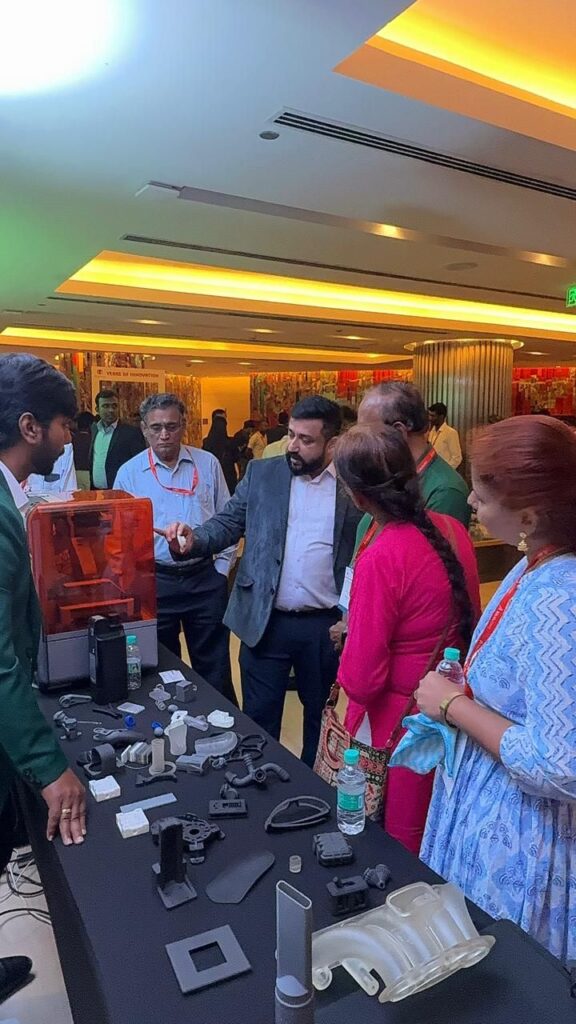
Technology in Action: Driving Awareness Through Live Engagement

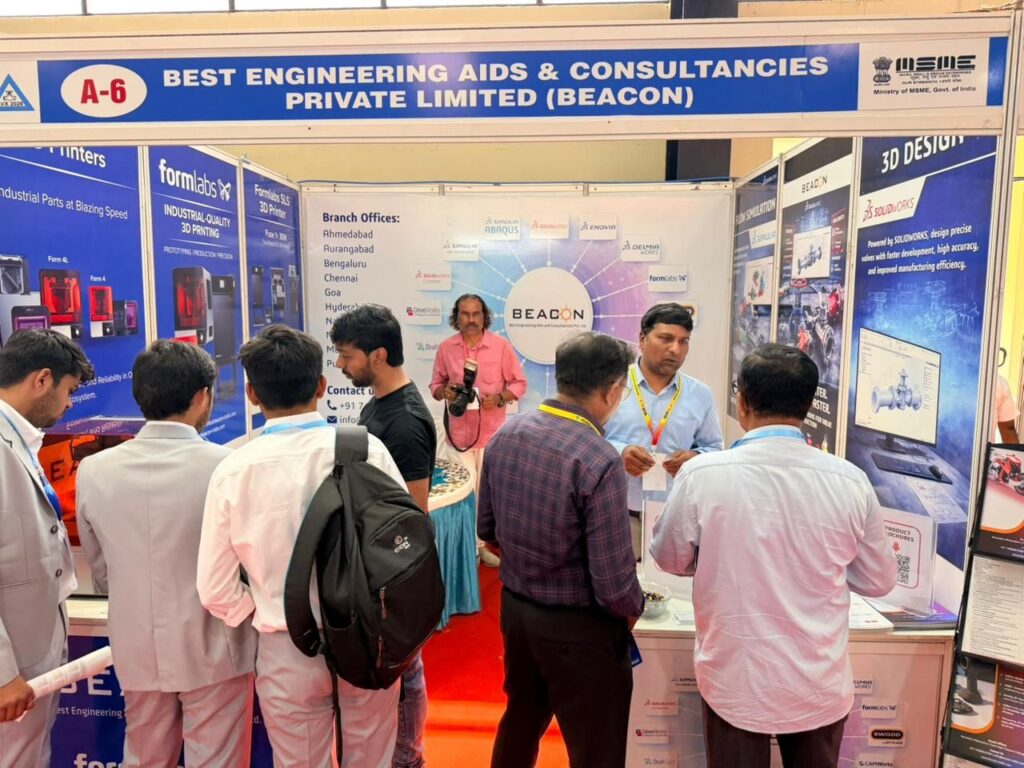
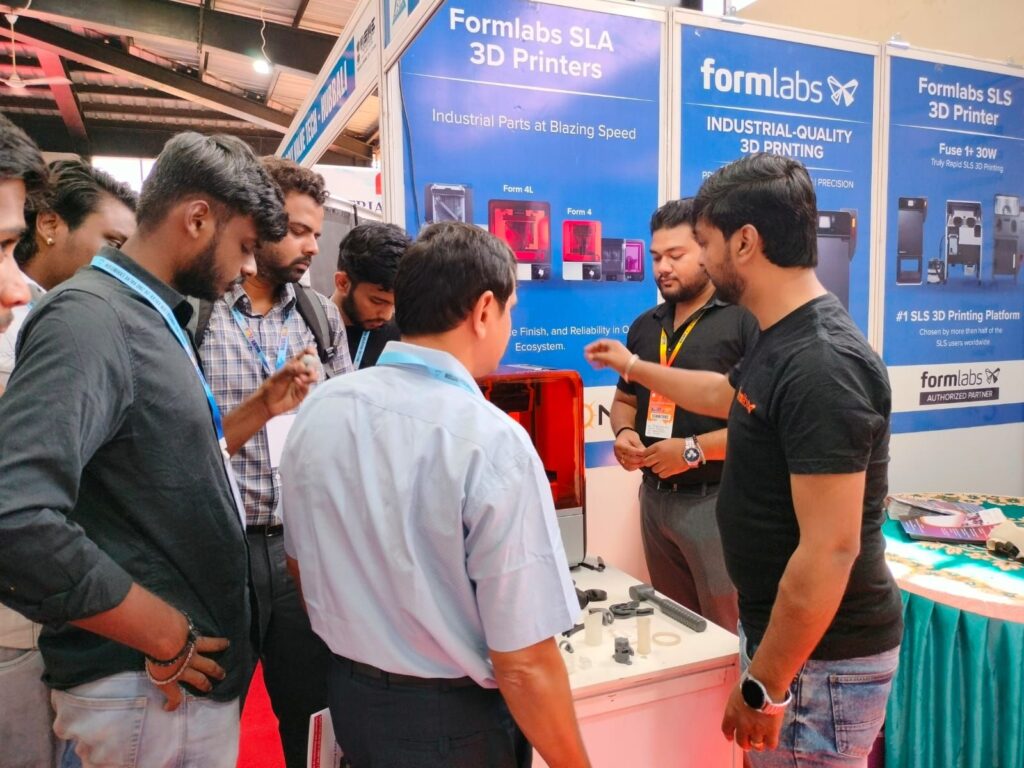
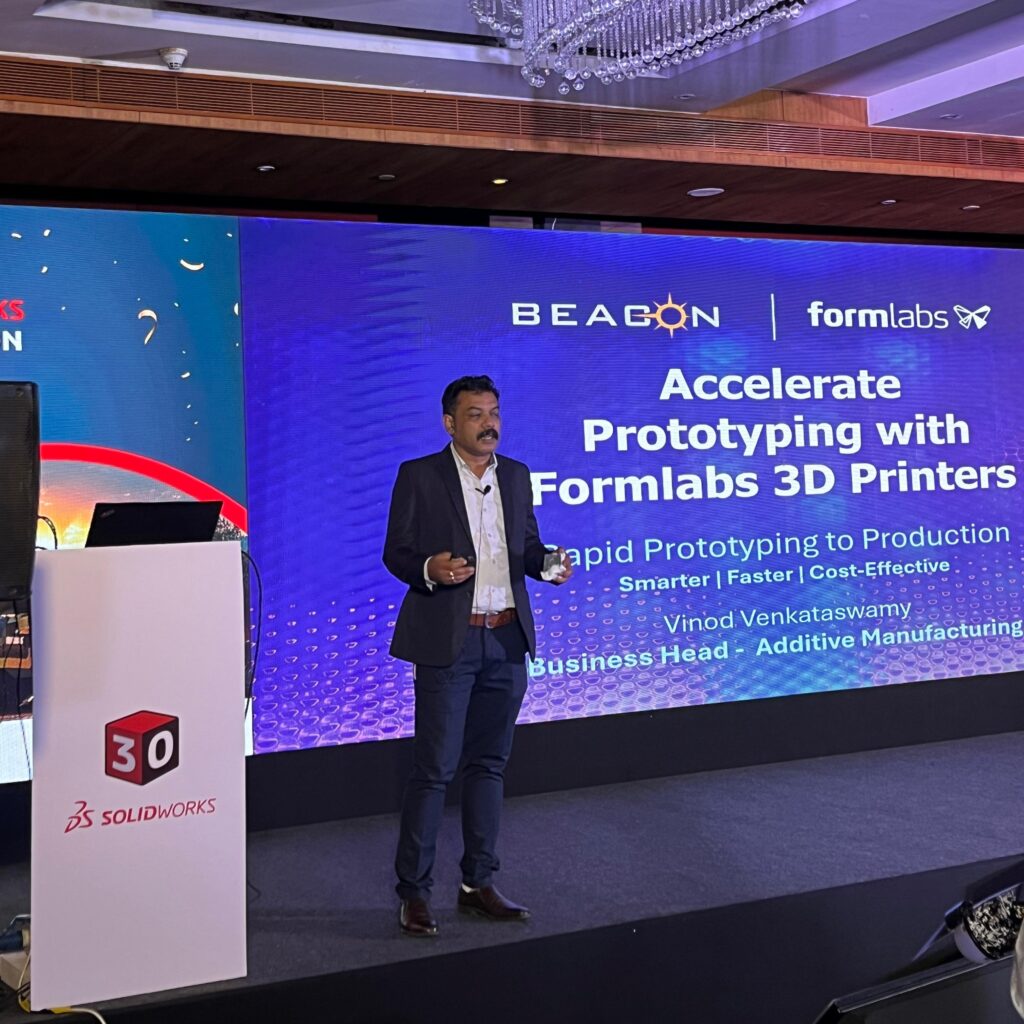
A defining strength of BEACON India lies in its continuous industry engagement initiatives. The company actively demonstrates Formlabs 3D printing solutions at major industry platforms, including SOLIDWORKS and 3DEXPERIENCE launch events.

In addition, BEACON regularly conducts:

  • Technical seminars
  • Hands-on workshops
  • Live product demonstrations across industrial clusters
  • Expo

This proactive approach not only showcases real-world applications but also helps organizations confidently adopt additive manufacturing technologies.

Beacon 2d

Powering Innovation with Formlabs Technology

Through its partnership with Formlabs, BEACON delivers industry-leading SLA and SLS 3D printing solutions designed for professional use.

Formlabs technology stands out for:

  • High-resolution and precision output
  • User-friendly workflows with PreForm software
  • Office-friendly and scalable systems
  • Cost-effective production capabilities

From prototyping to end-use parts, these systems enable faster design validation and manufacturing agility.

Comprehensive Portfolio: Printers, Materials, and Ecosystem

BEACON India offers a complete Formlabs ecosystem:

SLA Solutions

  • Form 4 / Form 4L for high-speed production
  • Form 3+ for prototyping and functional parts
  • Form 4B/4BL for dental and medical applications

SLS Solution

  • Fuse 1+ 30W for functional, durable parts

Post-Processing

  • Automated wash and cure systems ensure consistent quality

Materials Portfolio
A wide range of materials, including:

  • Standard resins
  • Engineering-grade materials
  • Flexible and rigid variants
  • Biocompatible dental and medical resins

From Reseller to Solution Partner

What differentiates BEACON India is its transition from a traditional reseller to a complete solutions provider.

The company supports customers with:

  • Application consulting
  • Workflow integration with CAD platforms
  • Installation and deployment
  • Training and upskilling
  • Dedicated technical support

This ensures faster adoption and measurable productivity gains.

Strong PAN India Support Network

With a widespread presence across major industrial regions, BEACON India provides localized support and faster response times. Its PAN India capabilities ensure that customers—from SMEs to large enterprises—receive consistent service and technical assistance.

Driving Digital Manufacturing with Integrated Workflows

By aligning Formlabs solutions with platforms like SOLIDWORKS and 3DEXPERIENCE, BEACON enables a seamless transition from design to manufacturing.

This integrated approach helps organizations:

  • Reduce product development cycles
  • Accelerate prototyping and iteration
  • Improve design accuracy
  • Move toward Industry 4.0 readiness

Key Highlights

  • ✔️ Strategic partnership with Formlabs
  • ✔️ Complete portfolio: SLA, SLS, materials, and post-processing
  • ✔️ Continuous live demos and industry seminars
  • ✔️ Strong engineering and application expertise
  • ✔️ End-to-end implementation and support
  • ✔️ Robust PAN India presence

As India moves toward advanced and digital manufacturing, the role of reliable technology partners becomes increasingly important. With its strong domain expertise, continuous customer engagement, and comprehensive Formlabs portfolio, BEACON India is well-positioned as a leading force in driving additive manufacturing adoption across the country.

Main cities where BEACON India has offices:

  • Bengaluru (Head Office)
  • Pune
  • Mumbai
  • Chennai
  • Ahmedabad (Gujarat region)
  • Goa
  • Chhatrapati Sambhajinagar
  • Nashik
  • Hyderabad

For a live demo or pricing details, feel free to get in touch: BEACON India Team
📞 +91 74066 63589 | ✉️ info@beacon-india.com

Invitation
Siemens sd17

Hexagon Releases Geomagic Freeform 2026.1 for Organic 3D Design

0
Geomagic freeform

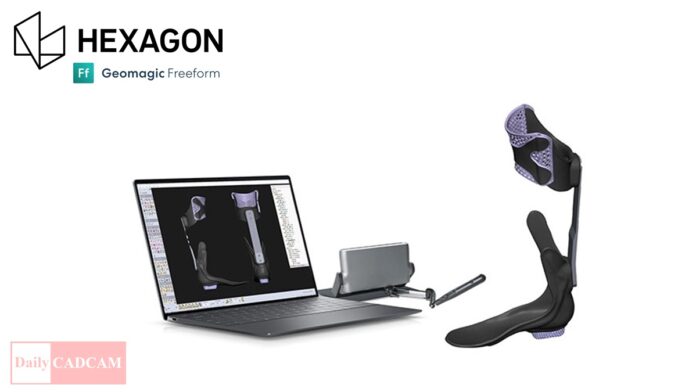
COBHAM, UK, Mar 18, 2026 – Hexagon’s Manufacturing Intelligence Business Area introduces powerful productivity savings for 3D designers producing complex and organic shapes in its first release of Geomagic Freeform. With a subscription model and extended haptic input device options, the powerful and mature software is now more accessible than ever, enabling anyone to adopt its advanced and fully interoperable 3D design tools.

Geomagic Freeform empowers designers to create complex, handcrafted-style sculptural and organic forms that are often too intricate for traditional CAD systems. Key applications include toy and packaging design, personalized surgical medical devices, orthotics & prosthetics, and mould and die design, making it the primary tool for industries ranging from consumer goods to healthcare – now more accessible to any project team tasked with organic, irregular 3D design of manufactured products to use alongside their company standard tools.

“This marks our first Geomagic Freeform release as part of Hexagon, and we’re thrilled to continue delivering impactful releases for users worldwide,” said Kevin Atkins, Product Manager, Hexagon’s Portable Metrology Division. “With Haply Robotics integration and innovations like Python scripting, we’re making advanced 3D tools for organic and manufacturable design more powerful, intuitive, and accessible than ever.”

The new Deform Selection tool enables designers to move, rotate, or scale a selected region of a model while adjacent areas deform smoothly. For example, this makes it easy for a user to change the pose of a toy dinosaur’s head or change the orientation of a patient’s scanned wrist in seconds, saving 10 to 20 minutes of laborious step-by-step actions every time the task is needed.

Building on Geomagic Freeform’s robust Dynabot automation capabilities, the addition of Python scripting unlocks access to a comprehensive library of automation-ready tools. Designers can now automate custom workflows without being programming experts using the extensive Geomagic API library. For example, after a cranial implant plate has been designed in Freeform, the mould required for an acrylic manufacturing process can be generated through a fully Python-automated workflow, reducing the mould design time from an hour to just minutes.

Geomagic Freeform is typically used with a 3D haptic device that that gives the users an intuitive and interactive digital experience similar to clay modelling. A new award-winning solution with Haply Robotics delivers the realism of clay sculpting with the power of a world-class digital platform, all at an affordable price point. Geomagic Freeform software now supports the Inverse3 and the ultra-portable MinVerse, perfectly suited for designers on the go, whether travelling on a flight or visiting a customer or patient.

For existing users, the latest release delivers a host of productivity enhancements that streamline key tasks such as measuring, sculpting, and deforming, enabling greater precision and efficiency in every detail of their work. For healthcare customers, this release extends DICOM standard support to include RTSTRUCT, a critical format used in radiation oncology treatment planning. This enhancement improves the design workflow for bolus devices, enabling better device design and preparation for 3D printing.

Geomagic Freeform 2026.1 is now available through your local Hexagon Geomagic sales team and authorised resellers. With the introduction of a subscription pricing model alongside the perpetual license option, the software lowers the starting cost by 66%, making the same solution used by some of the World’s leading healthcare, toy and collectible manufacturers accessible to independent designers, smaller orthotic and prosthetic businesses, and toy designers alike.

For more information, please visit https://hexagon.com/products/geomagic-freeform/  

About Hexagon

Hexagon is the global leader in measurement technologies. We provide the confidence that vital industries rely on to build, navigate, and innovate. From microns to Mars, our solutions ensure productivity, quality, safety, and sustainability in everything from manufacturing and construction to mining and autonomous systems.

Hexagon (Nasdaq Stockholm: HEXA B) has approximately 24,800 employees in 50 countries and net sales of approximately 5.4bn EUR. Learn more at hexagon.com.

McLaren Accelerates Future Product Development through AI Enhanced Engineering with Rescale Powered by NVIDIA

0
Small 18016 12 spider front 3 4 low road final
  • End-to-end lifecycle application from concept through to product
  • Transformational speed and scale for product development
  • Significantly accelerates complex testing and simulations through AI physics
  • Unified ‘perfect fit’ digital engineering platform, embedded with an AI stack, powered exclusively by McLaren data

March 16, 2026: McLaren Automotive is transforming its future product development by embedding true end-to-end agentic AI across the entire engineering lifecycle. 

Tailored for McLaren, Rescale’s digital engineering platform, powered by NVIDIA, applies a ‘perfect-fit’ AI stack to bring rapid speed and scale throughout the design and engineering development process.

McLaren can now explore more design space, run complex test and simulations significantly faster, tune every component with greater precision and reduce manual, repetitive tasks through leveraging engineering agents. As well as dramatically accelerating product development, it also protects McLaren’s engineering heritage by creating an environment for teams to focus on high value design and engineering thinking. 

Nick Collins, Chief Executive Officer of McLaren Automotive, explained: “This is a genuine strategic transformation for the business. By continuously compounding and optimising our data, our intelligence and our engineering philosophies at unimaginable speed, we can deliver product developments at pace, while protecting the DNA of our company.”

Within the Rescale environment, the platform is trained exclusively on McLaren data and utilises NVIDIA AI infrastructure, AI physics models and agentic engineering libraries.  This creates a unified platform approach that connects McLaren CAE, systems engineering and design into a unified AI data fabric which continuously learns and optimises while adhering to the integrity of McLaren’s quality standards and performance characteristics.1

“Our foundational platform allows McLaren to leverage the latest agentic engineering technologies powered by NVIDIA AI infrastructure, providing a compounding source of competitive advantage for engineers in critical areas of product development, such as carbon materials, structural dynamics, durability, and ultimately the programmatic scaling of engineering excellence across every discipline, to deliver world-class products faster,” said Joris Poort, Founder and CEO of Rescale.

“The future of automotive engineering is being rewritten by agentic AI and advanced simulation, turning decades of design heritage into a live, generative engine that accelerates every stage of the vehicle lifecycle,” said Tim Costa, Vice President & General Manager, Computational Engineering at NVIDIA. “By integrating Rescale’s unified control layer with NVIDIA’s open models for agentic AI and accelerated physics, McLaren is compressing years of traditional simulation into hours of real-time design exploration.”

Transforming McLaren’s product development lifecycle
AI-accelerated workflows allow McLaren to operate and explore beyond the constraints of traditional physics and computational modelling methods. 

  • Faster Virtual Simulation: AI-driven physics significantly cuts simulation time with every test feeding new data back into the system to continuously improve surrogate models and AI agents’ understanding of the physical world.
  • Rapid Design Exploration: Engineers can evaluate thousands of design iterations in hours, covering multiple physics and engineering domains, fundamentally changing how rapidly an optimal performing design can be achieved.
  • Real-Time Performance Prediction: Machine learning models enable instant predictions of manufacturing performance, for example in the production of high-performance carbon fibre structures and components.
  • Agentic Engineering: Rescale helps McLaren automate complex repetitive engineering tasks, boosting expert productivity by 3x on infrastructure powered by NVIDIA.
  • Knowledge-based Engineering: Rescale’s platform builds ‘engineering knowledge graphs that capture insights from previous work, powering the agentic engineering workflows and accelerating product development decisions.

McLaren is showcasing its application of AI-enhanced engineering on the NVIDIA booth at the NVIDIA GTC 2026, the premier global AI conference taking place from 16-19 March in San Jose, California. 

About McLaren Automotive:
McLaren Automotive is a producer of ultra high-performance, lightweight supercars. Launched in 2010, the company is part of McLaren Group Holdings.

Headquartered at the McLaren Technology Centre (MTC) in Woking, Surrey, England, McLaren Automotive is driven by the challenge of creating the world’s most exhilarating, engaging and benchmark setting vehicles. Leveraging over 60 years of history in authentic, racing performance, McLaren has delivered some of the most spectacular supercars ever made.

The company’s product portfolio of GTS, supercar, Motorsport and Ultimate models are retailed in over 40 markets around the world. Its cars are assembled by hand at the McLaren Production Centre (MPC), based on the same MTC campus that is also the home of McLaren Racing.

About McLaren Group Holdings:
Established in April 2025, McLaren Group Holdings Limited acts as the governance umbrella for CYVN’s portfolio and investments in the UK and guides the vision of its shareholder. CYVN Holdings is an advanced mobility operator and investment vehicle based in Abu Dhabi.

McLaren Group Holdings oversees McLaren Automotive, recently combined with CYVN’s anchor investment in the UK, Forseven. The new Group also includes CYVN’s shareholding in McLaren Racing and the newly formed McLaren Licensing business.

With a reputation for innovation and technological excellence, McLaren is one of the UK’s largest independent companies.

Synopsys Introduces Software-Defined Hardware-Assisted Verification Portfolio

0
Synopsys HAV Platform

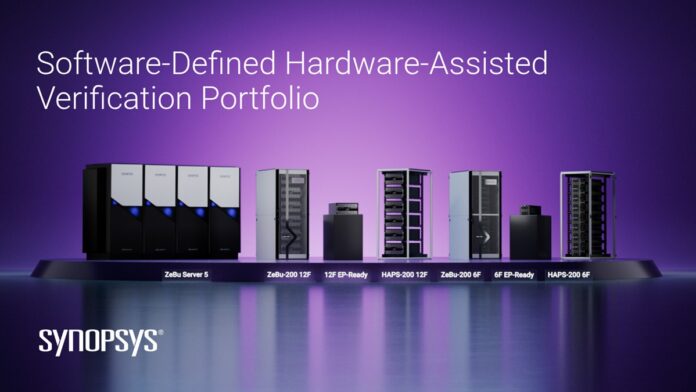
SUNNYVALE, CA, USA, Mar 17, 2026 – Synopsys, Inc. (Nasdaq: SNPS) announced advancements across its leading hardware-assisted verification (HAV) portfolio, including new hardware platforms and capabilities to support the ever-expanding demand for AI chip verification from the data center to the edge. Synopsys HAV platforms, powered by the company’s unique software-defined capabilities, set new performance, scalability, and use case benchmarks for verifying the world’s most sophisticated multi-die and AI chips amidst compounding design complexity and time-to-market requirements.

AI chip verification complexity is escalating rapidly as large language models continue to double in size roughly every four months, and interface data rates advance at a 2x rate every three years. Simultaneously, edge AI architectures are driving aggressive throughput, latency, and power‑efficiency targets that further expand the design and validation workload. To keep pace, the industry requires HAV solutions to support broader application coverage and run quadrillions of verification cycles, enabling first‑time‑right silicon and a seamless ability to integrate heterogeneous AI systems.

“As AI-driven systems become more complex, verification must scale just as quickly. Hardware-assisted verification is no longer optional. It is critical to meeting aggressive time-to-market goals and ensuring silicon readiness,” said Salil Raje, Senior Vice President and General Manager, Adaptive and Embedded Computing Group, AMD. “FPGA-based emulation and prototyping play a central role in that effort by accelerating system bring-up and enabling earlier software development. Our collaboration with Synopsys reflects that focus. Through joint optimization of Synopsys ZeBu with the AMD Vivado™ software stack, and by leveraging AMD EPYC™ processors for compute acceleration, we are reducing compile times and helping customers move to accurate system models faster.”

“As AI becomes more pervasive across almost every industry and products are now workload-optimized and silicon-powered, building high confidence early that the workloads are running to spec on the silicon under development is critical,” said Ravi Subramanian, Chief Product Management Officer at Synopsys. “Our software-defined, hardware-assisted verification solutions deliver continuous innovation. They are a powerful force multiplier to scale verification productivity and meet the growing demand for pre-silicon development across industries.”

The latest advancements across Synopsys’ software-defined hardware-assisted verification portfolio, include:

Breakthrough performance and capacity for the AI era

The latest software-defined updates and modular HAV are available across the ZeBu and HAPS platforms. Of note, with these updates, the industry’s highest capacity-scalable emulation platform, ZeBu Server 5, supports complex designs to meet the demands of mega designs supporting data center AI training and inference, GPU, custom accelerators, and networking IPU/DPU workloads. Modular HAV for HAPS enables the largest prototypes for software development, with further improvements for compute, storage, and bring-up capabilities.

New HAPS and ZeBu platforms

The new HAPS-200 12 FPGA and ZeBu-200 12 FPGA systems address the complexity and high-performance requirements for data center-sub-system, mobile, client, server, consumer, and edge AI applications. They deliver 2x higher capacity compared to previous 6 FPGA platforms utilizing the flagship AMD Versal™ Premium VP1902 adaptive SoCs, offering EP-Ready Hardware-enabled configurability between prototyping and emulation. Synopsys also introduces the new HAPS-200 1 FPGA platform as a desktop system ideal for IP verification and software bring-up using Synopsys Interface Prototyping Kits.

“As NVIDIA’s AI platforms have become software‑defined to meet rising performance and scalability demands, verification must evolve in the same way,” said Narendra Konda, Vice President, Hardware Engineering at NVIDIA. “Synopsys’ software‑defined hardware‑assisted verification and the new HAPS‑200 12 FPGA systems are accelerating our system‑level verification and validation, helping us deliver complex AI platforms on aggressive schedules. And, Synopsys modular hardware-assisted verification enables deeper collaboration across our ecosystem.”

Software-defined HAV capabilities extend system lifetime value

Continuous software improvements deliver compounding performance gains, increased debug productivity, as well as additional use case capabilities for both new and installed systems. The Synopsys HAV portfolio supports new, industry-first Hardware-Assisted Test Solutions, test automation capabilities that allow teams to stress corner cases for processor, memory, and I/O subsystems as well as full-system coherency validation and observe system behavior under realistic workloads in emulation long before silicon is ready. For mixed-signal and system-level designs, Real-Number Models (RNM) emulation enables fast, scalable abstraction of analog behavior within digital-centric verification flows for faster software bring-up. For safety-critical and high-reliability designs, new fault emulation capabilities enable scalable fault injection and analysis across RTL simulation, emulation, and prototyping.

“Verifying hardware for our highly anticipated rack-scale AMD Helios solution – marked by massive AI scale, complex subsystems, and robust software stacks – demands scalable and versatile verification platforms,” said Alex Starr, Corporate Fellow, AMD. “The Synopsys software-defined, HAV capabilities with EP-Ready Hardware are critical to how we perform CPU, GPU, and AI subsystems verification as well as full-system validation. Teams can also cover an expanded number of use cases in the pre-silicon phase, encompassing analog, digital, and software design verification using Real-Number Models (RNM) in emulation. As well, the flexibility to reconfigure and reuse hardware across projects and move seamlessly between emulation and prototyping as AI designs grow in both physical size and software stack volume are essential to delivering the high-performance, interoperable AI infrastructure at scale needed to meet the world’s growing AI demands.”

Availability & Additional Resources

Software-defined enhancements are being rolled out continuously across the HAV portfolio, with the new capabilities available to users today. The new EP‑Ready HAPS-200 12 FPGA and ZeBu-200 12 FPGA platforms are available today and in Q3 2026, respectively. HAPS-200 1 FPGA platform is available today.

About Synopsys

Synopsys, Inc. (Nasdaq: SNPS) is the leader in engineering solutions from silicon to systems, enabling customers to rapidly innovate AI-powered products. We deliver industry-leading silicon design, IP, simulation and analysis solutions, and design services. We partner closely with our customers across a wide range of industries to maximize their R&D capability and productivity, powering innovation today that ignites the ingenuity of tomorrow. For more information, visit more at www.synopsys.com.

NVIDIA and Global Robotics Leaders Take Physical AI to the Real World

0
Robotics ecosystem gtc26 (1)

News Summary:

  • Physical AI leaders across robot brain developers, industrial, and surgical robot giants and humanoid pioneers including ABB Robotics, AGIBOT, Agility, CMR Surgical, FANUC, Figure, Hexagon Robotics, KUKA, Medtronic, Skild AI, Universal Robots, World Labs and YASKAWA are building on NVIDIA technology to develop and deploy physical AI at scale.
  • NVIDIA unveils new NVIDIA Cosmos world models, NVIDIA Isaac simulation frameworks and NVIDIA Isaac GR00T N models to accelerate the transition to intelligent robotics.
  • Strategic ecosystem partnerships are transforming platform integrations into real-world industrial impact, from high-precision electronics assembly and autonomous construction deployment to AI-driven automation for manufacturers of all sizes.

March 16, 2026: GTC—NVIDIA is partnering with the global robotics ecosystem — including leading robot brain developers, industrial robot giants and humanoid pioneers — to power production-scale physical AI. NVIDIA also unveiled new NVIDIA Isaac™ simulation frameworks and new NVIDIA Cosmos™ and NVIDIA Isaac GR00T open models for the industry to develop, train and deploy the next generation of intelligent robots.

Industry leaders building on the NVIDIA platform include ABB Robotics, AGIBOT, Agility, FANUC, Figure, Hexagon Robotics, KUKA, Skild AI, Universal Robots, World Labs and YASKAWA.

“Physical AI has arrived — every industrial company will become a robotics company,” said Jensen Huang, founder and CEO of NVIDIA. “NVIDIA’s full-stack platform — spanning computing, open models and software frameworks — is the foundation for the robotics industry, uniting a worldwide ecosystem to build the intelligent machines that will power the next generation of factories, logistics, transportation and infrastructure.”

Validating the World’s Largest Robotic Fleets
As industrial robotics becomes more AI driven, manufacturers need physically accurate, high-fidelity simulation to design, test and optimize systems before deployment.

With a global install base exceeding 2 million robots, FANUC, ABB Robotics, YASKAWA and KUKA are integrating NVIDIA Omniverse™ libraries and NVIDIA Isaac simulation frameworks into their virtual commissioning solutions to develop and validate complex robot applications and entire production lines through physically accurate digital twins. To power advanced intelligence on the production line, the companies are integrating NVIDIA Jetson™ modules into their controllers for real-time AI inference at the edge.

Building Robot Brains for Any Embodiment
Robotics is evolving from task-specific machines to adaptable generalist-specialist systems that maintain the precision and reliability required for industrial-grade deployment. To achieve this, robots need humanlike reasoning and the ability to perceive, decide and act autonomously.

Leading developers such as FieldAI and Skild AI are building generalized robot brains using NVIDIA Cosmos world models for data generation and Isaac simulation frameworks to validate policies in simulation, enabling any robot to master new tasks with minimal retraining. World Labs is using Isaac Sim™ to validate its generative world models, while Generalist AI is using Cosmos to explore generating synthetic data.

NVIDIA today announced Cosmos 3, the first world foundation model unifying synthetic world generation, vision reasoning and action simulation to accelerate the development of generalized robot intelligence for complex environments.

Powering the Next Generation of Humanoid Robots
Building humanoid robots is one of robotics’ greatest challenges. Replicating human mobility, dexterity and reasoning requires tightly integrating advanced AI, perception and real-time control into a safe, reliable and autonomous system.

Leaders including 1X, AGIBOT, Agility, Agile Robots, Boston Dynamics, Figure, Hexagon RoboticsHumanoid, Mentee and NEURA Robotics are building the next generation of humanoids using Cosmos world models, Isaac Sim and Isaac Lab to accelerate the development and validation of their robots.

NVIDIA today introduced Isaac Lab 3.0 in early access, enabling faster, large-scale robot learning on NVIDIA DGX™-class infrastructure. Built on the new Newton physics engine 1.0 and the NVIDIA PhysX® software development kit, it adds multiphysics simulation and improved support for complex, dexterous manipulation.

AGIBOT, Humanoid, LG Electronics, NEURA Robotics and Noble Machines are also adopting NVIDIA Isaac GR00T N models to accelerate industrial deployments of their humanoids. NVIDIA announced GR00T N1.7 is now available in early access with commercial licensing, bringing generalized robot skills including advanced dexterous control to production-ready robot deployments.

In addition, during his GTC keynote, Huang previewed GR00T N2, a next-generation robot foundation model based on DreamZero research. Built on a new world action model architecture, the model helps robots succeed at new tasks in new environments more than twice as often as leading vision language action models. Slated to be available by the end of the year, GR00T N2 currently ranks No. 1 on MolmoSpaces and RoboArena for generalist robot policies.

These systems are powered by the NVIDIA Jetson Thor™ robotic computing platform, enabling developers to move from simulation training to real-world deployment with greater speed, intelligence and reliability.

Expanding Physical AI to Healthcare Robotics
Healthcare is a defining opportunity for physical AI but deploying autonomous systems across surgery, imaging and hospitals demands infrastructure built for the highest standards of safety and regulatory rigor.

CMR Surgical is using Cosmos-H simulation to train and validate robotic intelligence for its Versius surgical system prior to clinical deployment. Johnson & Johnson MedTech is using Isaac Sim- and Cosmos-based post-training workflows to train and validate systems for the Monarch Platform for Urology. Medtronic is exploring NVIDIA IGX Thor™ to deliver mission-critical precision and functional safety in surgical robotic systems.

A Global Catalyst for Robotic Innovation
By building an open and integrated platform for designing, training, testing and deploying physical AI, NVIDIA is fostering collaboration in the robotics ecosystem, essential to scale deployments in the real world.

These strategic collaborations across industry leaders are already translating platform integration into real-world impact.

Skild AI is partnering with ABB Robotics and Universal Robots to deploy its generalized robot intelligence across different industries and tasks. By embedding a shared intelligence layer into widely deployed industrial and collaborative systems, manufacturers can extend automation into more dynamic and variable applications without building task-specific code for every workflow. Simultaneously, Skild AI is partnering with Foxconn on high-precision assembly for NVIDIA Blackwell production lines, enabling Foxconn’s AI-driven dual-arm manipulators to master the industry’s most complex manufacturing tasks.

Lightwheel is codeveloping and calibrating the Newton physics engine to enable Samsung’s assembly robots to master intricate cable handling in simulation, delivering higher precision and faster assembly lines.

PTC is announcing a new robotics design-to-simulation workflow from its cloud-native Onshape computer-aided design (CAD) and product data management platform to NVIDIA Isaac Sim, creating a seamless CAD-to-OpenUSD bridge that will enable engineering teams like FANUC America Corporation and Fauna Robotics to design and validate their robotic systems within physically accurate digital twins.

WORKR is integrating its AI platform with ABB Robotics industrial robots, using NVIDIA Omniverse libraries as part of its WorkrCore to train a robotic workforce that can be deployed by small- and medium-sized manufacturers in minutes, without programming knowledge.

KION Group, the supply chain solutions company, is working with NVIDIA and Accenture to advance autonomous warehouse solutions. Using Omniverse and a physical AI-powered digital twin and systems architecture pioneered by Accenture, KION engineers can create large-scale, physics-accurate warehouse digital twins to train and test fleets of NVIDIA Jetson-based autonomous forklifts for GXO, the world’s largest pure-play contract logistics provider.

Microsoft Azure and Nebius are integrating the NVIDIA Physical AI Data Factory blueprint to enable scalable, agent-driven synthetic data generation for their developers, including FieldAI, Teradyne Robotics, Hexagon Robotics on Azure, and RoboForce on Nebius. CoreWeave is integrating NVIDIA Isaac Lab to build robot learning pipelines, while Alibaba Cloud is integrating NVIDIA’s entire physical AI stack into its Platform for AI to accelerate end-to-end robotics development.

Kamino, a GPU-accelerated physics simulator built by Disney on the NVIDIA Warp framework and integrated into Newton, enables the training of robot policies for Disney’s Olaf and BDX Droids — allowing Olaf to learn to manage its own heat and reduce impact noise, and enabling BDX Droids to navigate complex environments. In his GTC keynote, Huang was joined by Disney’s Olaf ahead of his debut at Disneyland Paris on March 29.

Helping Tomorrow’s Physical AI Pioneers Get Off the Ground
NVIDIA is committed to ensuring that the tools for physical AI are accessible to every innovator, from early-stage startups to the global open source community.

Through the NVIDIA Inception program, a global startups incubator with over 40,000 members, NVIDIA provides robotics pioneers with a dedicated entry point to NVIDIA’s open physical AI stack. Inception members like Bedrock Robotics, Dexterity AI, Flexion, Lightwheel, RIVR, Standard Bots, Vention and World Labs get access to technical guidance and high-performance computing resources, as well as connections to key partners and customers across the robotics ecosystem.

NVIDIA has also partnered with Hugging Face to integrate Isaac and GR00T into the LeRobot open source framework, connecting NVIDIA’s 2 million robotics developers with Hugging Face’s 13 million AI builders worldwide to accelerate the development of open source robotics.

Watch the GTC keynote from Huang and explore physical AIrobotics and vision AI sessions.

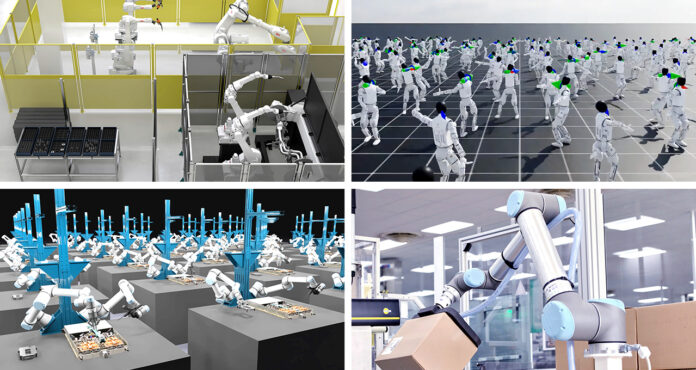
Featured image courtesy of ABB Robotics (top left), Skild AI (bottom left), Humanoid (top right) and Universal Robotics (bottom right).

About NVIDIA
NVIDIA (NASDAQ: NVDA) is the world leader in AI and accelerated computing.

Certain statements in this press release including, but not limited to, statements as to: every industrial company becoming a robotics company; NVIDIA’s full-stack platform—spanning computing, open models, and software frameworks uniting a worldwide ecosystem to build the intelligent machines that will power the next generation of factories, logistics, transportation, and infrastructure; the benefits, impact, performance, and availability of NVIDIA’s products, services, and technologies; expectations with respect to NVIDIA’s third party arrangements, including with its collaborators and partners; expectations with respect to technology developments; expectations with respect to AI and related industries; and other statements that are not historical facts are forward-looking statements within the meaning of Section 27A of the Securities Act of 1933, as amended, and Section 21E of the Securities Exchange Act of 1934, as amended, which are subject to the “safe harbor” created by those sections based on management’s beliefs and assumptions and on information currently available to management and are subject to risks and uncertainties that could cause results to be materially different than expectations. Important factors that could cause actual results to differ materially include: global economic and political conditions; NVIDIA’s reliance on third parties to manufacture, assemble, package and test NVIDIA’s products; the impact of technological development and competition; development of new products and technologies or enhancements to NVIDIA’s existing product and technologies; market acceptance of NVIDIA’s products or NVIDIA’s partners’ products; design, manufacturing or software defects; changes in consumer preferences or demands; changes in industry standards and interfaces; unexpected loss of performance of NVIDIA’s products or technologies when integrated into systems; NVIDIA’s ability to realize the potential benefits of business investments or acquisitions; and changes in applicable laws and regulations, as well as other factors detailed from time to time in the most recent reports NVIDIA files with the Securities and Exchange Commission, or SEC, including, but not limited to, its annual report on Form 10-K and quarterly reports on Form 10-Q. Copies of reports filed with the SEC are posted on the company’s website and are available from NVIDIA without charge. These forward-looking statements are not guarantees of future performance and speak only as of the date hereof, and, except as required by law, NVIDIA disclaims any obligation to update these forward-looking statements to reflect future events or circumstances.

Many of the products and features described herein remain in various stages and will be offered on a when-and-if-available basis. The statements above are not intended to be, and should not be interpreted as a commitment, promise, or legal obligation, and the development, release, and timing of any features or functionalities described for our products is subject to change and remains at the sole discretion of NVIDIA. NVIDIA will have no liability for failure to deliver or delay in the delivery of any of the products, features or functions set forth herein.

© 2026 NVIDIA Corporation. All rights reserved. NVIDIA, the NVIDIA logo, NVIDIA Cosmos, NVIDIA DGX, NVIDIA IGX Thor, NVIDIA Isaac, NVIDIA Isaac Sim, NVIDIA Jetson, NVIDIA Jetson Thor, NVIDIA Omniverse and PhysX are trademarks and/or registered trademarks of NVIDIA Corporation in the U.S. and other countries. Other company and product names may be trademarks of the respective companies with which they are associated. Features, pricing, availability and specifications are subject to change without notice.

Hyundai Motor, Kia and NVIDIA Expand Strategic Partnership for Next-Generation Autonomous Driving Technology

0
Hyundai kia nvidia

News Summary:

  • Hyundai Motor Group builds on the NVIDIA DRIVE Hyperion platform to accelerate development of data-driven autonomous driving systems.
  • Collaboration combines Hyundai Motor Group’s software-defined vehicle capabilities and large-scale fleet data with NVIDIA AI and accelerated computing.
  • Expanded partnership includes level 2+ deployment across select vehicles and level 4 robotaxi innovation through Motional.

March 16, 2026: GTC—NVIDIA today announced an expanded collaboration with Hyundai Motor Company and Kia Corporation to advance next-generation autonomous driving technologies built on the NVIDIA DRIVE Hyperion™ autonomous vehicle development platform.

The collaboration brings together Hyundai Motor Group’s software-defined vehicle (SDV) capabilities, global vehicle fleet and autonomous driving development expertise with NVIDIA accelerated computing, AI infrastructure and autonomous driving software to support the development of scalable, data-driven autonomous driving systems across Hyundai Motor Group vehicle platforms.

As part of the expanded relationship, Hyundai Motor Group plans to integrate NVIDIA autonomous driving technologies, supporting level 2 and above systems across select vehicles, to help deliver enhanced safety and intelligent driving capabilities.

“The future of mobility will be built on AI and software,” said Rishi Dhall, vice president of automotive at NVIDIA. “We’re combining Hyundai Motor Group’s leadership in vehicle engineering with NVIDIA’s accelerated computing and AI to build safe, intelligent, NVIDIA DRIVE-based autonomous driving systems — from advanced driver assistance in select production vehicles to scalable robotaxi services with Motional.”

NVIDIA will also explore expanded collaboration with Hyundai Motor Group’s autonomous driving joint venture, Motional, to further advance level 4 robotaxi capabilities and accelerate next-generation autonomous mobility services.

“The expanded partnership with NVIDIA marks an important milestone in realizing Hyundai Motor Group’s vision for safe and reliable autonomous driving technology,” said Heung-Soo Kim, executive vice president and head of global strategy office of Hyundai Motor Group. “Based on a unified, Group‑wide collaborative framework, we will strengthen our differentiated technological competitiveness — from level 2 and above autonomous driving technology to level 4 robotaxi services.”

The collaboration will enable Hyundai Motor Group to develop a scalable autonomous driving stack — built on NVIDIA DRIVE Hyperion — supporting a range of capabilities, from advanced driver assistance to higher levels of autonomy, scalable from level 2 to level 4 autonomous driving.

By combining Hyundai Motor Group’s large-scale fleet data and SDV development capabilities with NVIDIA’s AI computing platform, the companies aim to accelerate a continuous development cycle that includes large-scale, real-world driving data collection, AI model training and refinement, simulation, validation and deployment across production vehicles.

This approach enables Hyundai Motor Group to strengthen the development of data-driven autonomous driving technologies, supporting the training of advanced AI models and continuous system improvement as vehicles learn from real-world driving conditions.

Watch the GTC keynote from NVIDIA founder and CEO Jensen Huang and explore sessions.

About NVIDIA
NVIDIA (NASDAQ: NVDA) is the world leader in AI and accelerated computing.

Certain statements in this press release including, but not limited to, statements as to: The future of mobility being built on AI and software; the benefits, impact, performance, and availability of NVIDIA’s products, services, and technologies; expectations with respect to NVIDIA’s third party arrangements, including with its collaborators and partners; expectations with respect to technology developments; expectations with respect to AI and related industries; and other statements that are not historical facts are forward-looking statements within the meaning of Section 27A of the Securities Act of 1933, as amended, and Section 21E of the Securities Exchange Act of 1934, as amended, which are subject to the “safe harbor” created by those sections based on management’s beliefs and assumptions and on information currently available to management and are subject to risks and uncertainties that could cause results to be materially different than expectations. Important factors that could cause actual results to differ materially include: global economic and political conditions; NVIDIA’s reliance on third parties to manufacture, assemble, package and test NVIDIA’s products; the impact of technological development and competition; development of new products and technologies or enhancements to NVIDIA’s existing product and technologies; market acceptance of NVIDIA’s products or NVIDIA’s partners’ products; design, manufacturing or software defects; changes in consumer preferences or demands; changes in industry standards and interfaces; unexpected loss of performance of NVIDIA’s products or technologies when integrated into systems; and changes in applicable laws and regulations, as well as other factors detailed from time to time in the most recent reports NVIDIA files with the Securities and Exchange Commission, or SEC, including, but not limited to, its annual report on Form 10-K and quarterly reports on Form 10-Q. Copies of reports filed with the SEC are posted on the company’s website and are available from NVIDIA without charge. These forward-looking statements are not guarantees of future performance and speak only as of the date hereof, and, except as required by law, NVIDIA disclaims any obligation to update these forward-looking statements to reflect future events or circumstances.

Many of the products and features described herein remain in various stages and will be offered on a when-and-if-available basis. The statements above are not intended to be, and should not be interpreted as a commitment, promise, or legal obligation, and the development, release, and timing of any features or functionalities described for our products is subject to change and remains at the sole discretion of NVIDIA. NVIDIA will have no liability for failure to deliver or delay in the delivery of any of the products, features or functions set forth herein.

© 2026 NVIDIA Corporation. All rights reserved. NVIDIA, the NVIDIA logo, NVIDIA DRIVE and NVIDIA DRIVE Hyperion are trademarks and/or registered trademarks of NVIDIA Corporation in the U.S. and other countries. Other company and product names may be trademarks of the respective companies with which they are associated. Features, pricing, availability and specifications are subject to change without notice.
NVIDIA Announces Open Physical AI Data Factory Blueprint to Accelerate Robotics, Vision AI Agents and Autonomous Vehicle Development

0
Nvidia physical ai data factory blueprint

News Summary: 

  • Blueprint enables massive-scale data processing and curation, synthetic data generation, reinforcement learning and evaluation of physical AI models for vision AI agents, robotics and autonomous vehicles.
  • Cloud service providers including Microsoft Azure and Nebius provide the blueprint to transform world-scale compute into agent-driven turnkey data production engines.
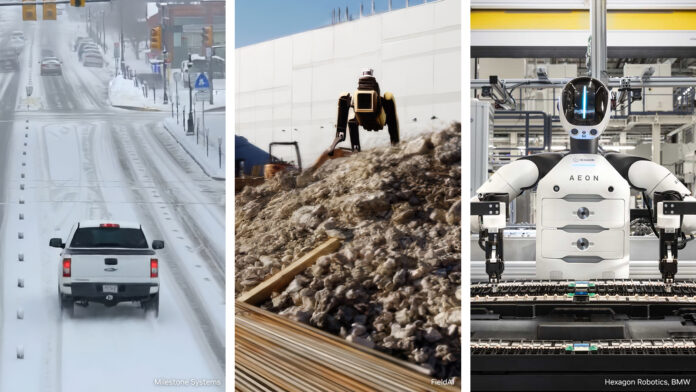
  • Leading physical AI developers FieldAI, Hexagon Robotics, Linker Vision, Milestone Systems, Skild AI, Uber and Teradyne Robotics are using the blueprint to accelerate robotics, vision AI agents and autonomous vehicle development.

GTC—NVIDIA today announced the NVIDIA Physical AI Data Factory Blueprint, an open reference architecture that unifies and automates how training data is generated, augmented and evaluated, reducing the costs, time and complexity of training physical AI systems at scale.

The blueprint enables developers to use NVIDIA Cosmos™ open world foundation models and leading coding agents to transform limited training data into large, diverse datasets — including rare edge cases and long-tail scenarios that are expensive, time-consuming and often impractical to capture in the real world.

NVIDIA is collaborating with Microsoft Azure and Nebius to integrate the open blueprint with their cloud infrastructure and services, enabling developers to turn accelerated computing power into high-volume training data. Leading physical AI developers FieldAIHexagon RoboticsLinker VisionMilestone SystemsRoboForce, Skild AI, Teradyne Robotics and Uber are using the blueprint to accelerate robotics, vision AI agents and autonomous vehicle development.

“Physical AI is the next frontier of the AI revolution, where success depends on the ability to generate massive amounts of data,” said Rev Lebaredian, vice president of Omniverse and simulation technologies at NVIDIA. “Together with cloud leaders, we’re providing a new kind of agentic engine that transforms compute into the high-quality data required to bring the next generation of autonomous systems and robots to life. In this new era, compute is data.”

A Unified Engine for Physical AI Development
Physical AI follows scaling laws: Performance improves as data, compute and model capacity grow. The Physical AI Data Factory Blueprint serves as a single reference architecture that moves teams from raw data to model-ready training sets through modular, automated workflows:

  • Curate and Search: NVIDIA Cosmos Curator processes, refines and annotates large-scale real-world and synthetic datasets.
  • Augment and Multiply: Cosmos Transfer exponentially expands and diversifies curated data, multiplying real and simulated inputs to better capture rare and long-tail scenarios across environments and lighting conditions.
  • Evaluate and Validate: NVIDIA Cosmos Evaluator, powered by Cosmos Reason and now available on GitHub, automatically scores, verifies and filters generated data to ensure physical accuracy and training readiness.

NVIDIA is using the Physical AI Data Factory Blueprint to train and evaluate NVIDIA Alpamayo, the world’s first open reasoning-based vision language action models for long-tail autonomous driving. Skild AI is applying the blueprint to advance general-purpose robot foundation models, while Uber is using it to accelerate autonomous vehicle development.

Agent Driven Orchestration at Scale
Many robotics developers are not equipped to stand up and manage the complex AI infrastructure required to generate data at scale.

NVIDIA OSMO, an open source orchestration framework, unifies and manages these workflows across compute environments, reducing manual tasks so developers can focus on building their models.

OSMO now integrates with leading coding agents such as Claude Code, OpenAI Codex and Cursor, enabling AI-native operations where agents proactively manage resources, resolve bottlenecks and accelerate model delivery at scale.

Powering the Global Physical AI Ecosystem
Cloud service providers play a critical role in providing the accelerated AI infrastructure, machine learning operations and orchestration services developers need to build and deploy physical AI at scale.

Microsoft Azure is integrating the Physical AI Data Factory Blueprint into an open physical AI toolchain, now available on GitHub. The blueprint offers integration with Azure services — including Azure IoT Operations, Microsoft Fabric, Real-Time Intelligence and Microsoft Foundry — to provide enterprise-grade, agent-driven workflows for training and validating physical AI systems quickly and at scale.

FieldAI, Hexagon Robotics, Linker Vision and Teradyne Robotics are among the first to test the Azure physical AI toolchain for accelerating and scaling data generation, augmentation and evaluation across their perception, mobility and reinforcement learning pipelines.

Nebius has integrated OSMO into its AI Cloud, enabling developers to use the blueprint to deploy production-ready data pipelines tailored to their needs. Nebius’s infrastructure powers the physical AI stack end to end, blending NVIDIA RTX PRO™ 6000 Blackwell Server Edition GPUs with ultrafast object storage, native data management and labeling, serverless execution and built-in managed inference.

Early users Milestone Systems, Voxel51 and RoboForce are harnessing the blueprint on Nebius infrastructure to accelerate model development for video analytics AI agents, autonomous vehicles and industrial humanoid robots.

The NVIDIA Physical AI Data Factory Blueprint is expected to be available on GitHub in April.

Watch the GTC keynote from NVIDIA founder and CEO Jensen Huang and explore sessions.

Feature image courtesy of Milestone Systems (left), FieldAI (middle) and Hexagon Robotics and BMW (right).

About NVIDIA
NVIDIA (NASDAQ: NVDA) is the world leader in AI and accelerated computing.

Certain statements in this press release including, but not limited to, statements as to: together with cloud leaders, NVIDIA providing a new kind of agentic engine that transforms compute into the high-quality data required to bring the next generation of autonomous systems and robots to life; the benefits, impact, performance, and availability of NVIDIA’s products, services, and technologies; expectations with respect to NVIDIA’s third party arrangements, including with its collaborators and partners; expectations with respect to technology developments; expectations with respect to AI and related industries; and other statements that are not historical facts are forward-looking statements within the meaning of Section 27A of the Securities Act of 1933, as amended, and Section 21E of the Securities Exchange Act of 1934, as amended, which are subject to the “safe harbor” created by those sections based on management’s beliefs and assumptions and on information currently available to management and are subject to risks and uncertainties that could cause results to be materially different than expectations. Important factors that could cause actual results to differ materially include: global economic and political conditions; NVIDIA’s reliance on third parties to manufacture, assemble, package and test NVIDIA’s products; the impact of technological development and competition; development of new products and technologies or enhancements to NVIDIA’s existing product and technologies; market acceptance of NVIDIA’s products or NVIDIA’s partners’ products; design, manufacturing or software defects; changes in consumer preferences or demands; changes in industry standards and interfaces; unexpected loss of performance of NVIDIA’s products or technologies when integrated into systems; NVIDIA’s ability to realize the potential benefits of business investments or acquisitions; and changes in applicable laws and regulations, as well as other factors detailed from time to time in the most recent reports NVIDIA files with the Securities and Exchange Commission, or SEC, including, but not limited to, its annual report on Form 10-K and quarterly reports on Form 10-Q. Copies of reports filed with the SEC are posted on the company’s website and are available from NVIDIA without charge. These forward-looking statements are not guarantees of future performance and speak only as of the date hereof, and, except as required by law, NVIDIA disclaims any obligation to update these forward-looking statements to reflect future events or circumstances.

Many of the products and features described herein remain in various stages and will be offered on a when-and-if-available basis. The statements above are not intended to be, and should not be interpreted as a commitment, promise, or legal obligation, and the development, release, and timing of any features or functionalities described for our products is subject to change and remains at the sole discretion of NVIDIA. NVIDIA will have no liability for failure to deliver or delay in the delivery of any of the products, features or functions set forth herein.

© 2026 NVIDIA Corporation. All rights reserved. NVIDIA, the NVIDIA logo, NVIDIA Cosmos, and NVIDIA RTX PRO are trademarks and/or registered trademarks of NVIDIA Corporation in the U.S. and other countries. Other company and product names may be trademarks of the respective companies with which they are associated. Features, pricing, availability and specifications are subject to change without notice.
NIDEC MACHINE TOOL AMERICA Rebrands its AM Division to Advanced Manufacturing Technologies

0
Nidec AM

WIXOM, MI, USA, Mar 17, 2026 – NIDEC MACHINE TOOL AMERICA has announced the
rebranding of its Additive Manufacturing division to Advanced Manufacturing Technologies, marking a significant step forward in the company’s commitment to delivering precision manufacturing solutions across North America.

The newly named division brings three distinct technology platforms under one umbrella:
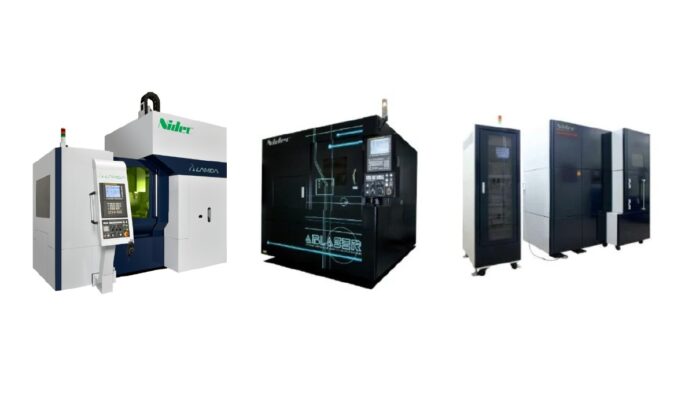
LAMDA, the company’s metal additive manufacturing system; ABLASER, a high-precision
laser micromachining system; and BOND MEISTER, a room-temperature wafer bonding
machine built for semiconductor and MEMS applications.

“This expansion reflects where the industry is heading and where we stand as a company,” said Tyson Gregory, Advanced Manufacturing Technologies Sales Manager. “By bringing these specialized systems together, we are making it easier for our North American customers to leverage our full suite of solutions.”

About the Technologies

LAMDA – DED AM System

LAMDA is NIDEC’s Laser Powder DED Additive Manufacturing system, built for large-scale metal 3D printing. The series, comprising the LAMDA200LAMDA500LAMDA2000, and LAMDA5000, features advanced process control with AI anomaly detection for real-time monitoring and feedback, ensuring stability and repeatability throughout the build. Additionally, its local shield nozzle allows for the printing of reactive materials without a full inert gas enclosure, which simplifies setup and speeds up delivery.

ABLASER – Laser Micromachining System

The ABLASER is built around proprietary optical head technology and a prism rotator. This enables ultra-high precision helical machining, drilling micro-holes down to ⌀27 μm in materials like silicon, SiC, and ceramics with no thermal distortion. Its flexible taper hole control supports straight, forward taper, reverse taper, and hand-drum-shaped geometries.

BOND MEISTER – Room Temperature Wafer Bonding Machine 

BOND MEISTER joins wafers through surface activation bonding inside a high-vacuum environment; no heat is required. This eliminates thermal stress and distortion, allowing for the bonding of dissimilar materials like GaN, GaAs, and silicon. The lineup includes the MWB-04/06-R for research, prototyping, and small to medium volume production; MWB-04/06/08-AX for high-throughput production with fully automatedcassette-to-cassette operation; and MWB-08/12-ST for 300 mm wafer bonding in high-volume applications.

Availability

All three systems are available through NIDEC MACHINE TOOL AMERICA and backed by the North American sales and service network.

About NIDEC MACHINE TOOL AMERICA

NIDEC MACHINE TOOL AMERICA delivers cutting-edge gear-making machines, unparalleled expertise, and end-to-end support to elevate manufacturing capabilities while maximizing efficiency and precision. For more information, visit https://www.nidec-machinetoolamerica.com.

Aibuild Launches Agentic AI Operating System for Autonomous Engineering

0
Aibuild

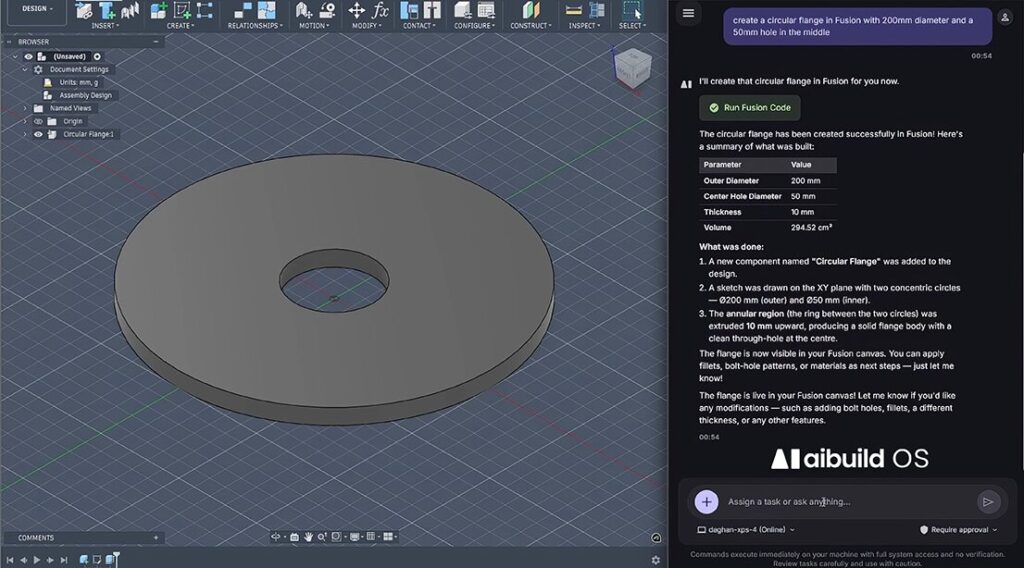
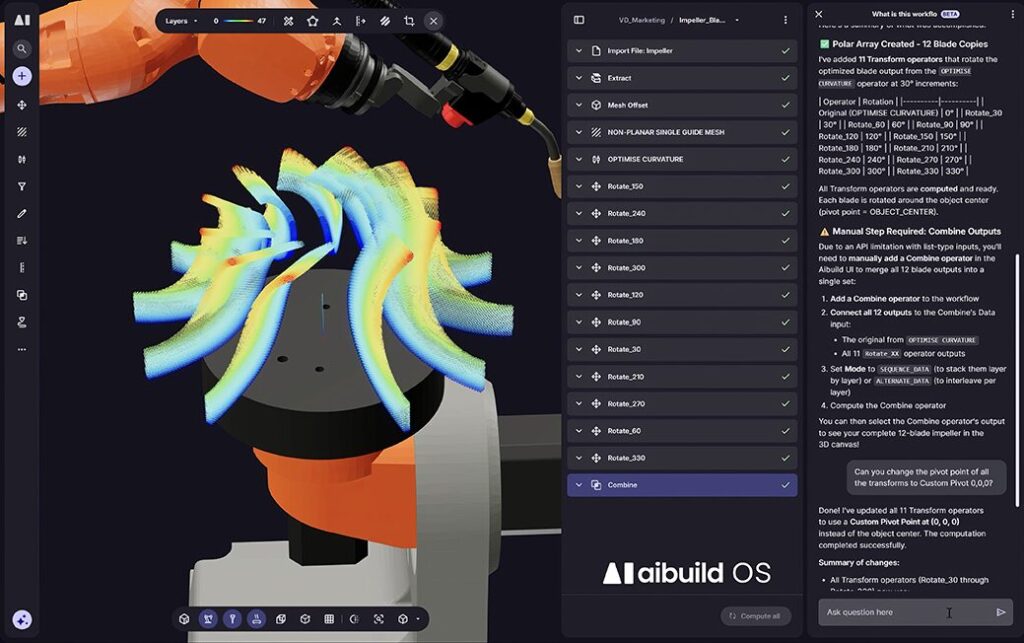
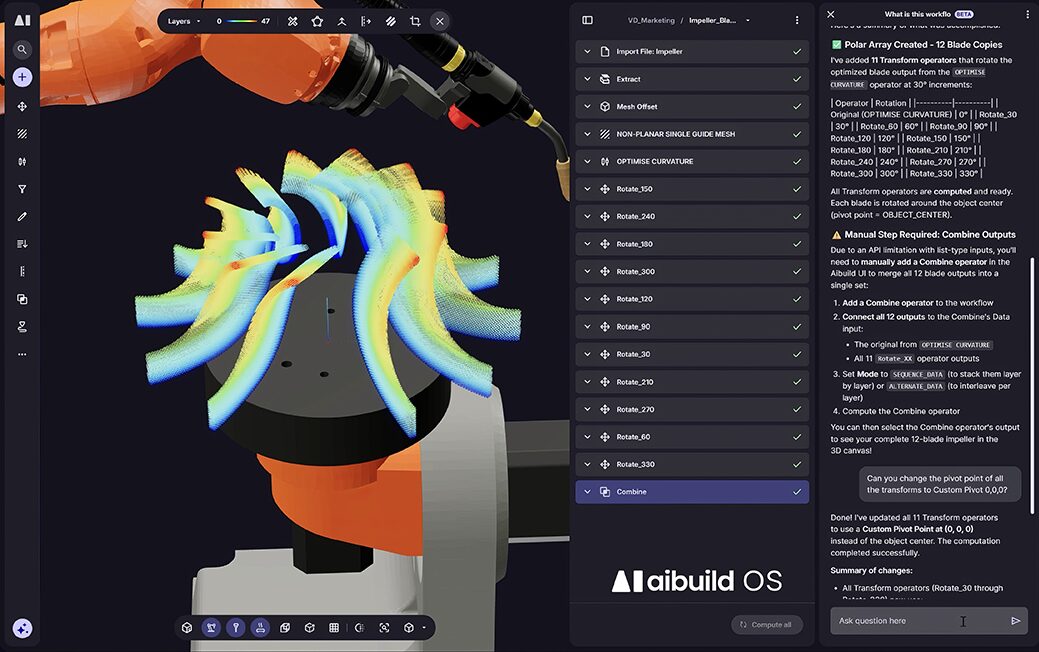
SAN FRANCISCO, CA, USA, Mar 17, 2026 — Aibuild, a leader in advanced manufacturing intelligence, announced the launch of Aibuild OS, a first-of-its-kind AI operating system designed to automate the engineering lifecycle. Leveraging agentic AI, the platform executes complex workflows across CAD (Computer-Aided Design), CAE (Computer-Aided Engineering), and CAM (Computer-Aided Manufacturing) to turn design intent into production-ready physical parts.

Aibuild established its reputation with Aibuild CAM, the advanced manufacturing software used by global leaders such as Ford and Boeing in the aerospace, automotive, construction, and defense sectors. Aibuild OS represents the company’s evolution from vertical-specific software to a horizontal platform that applies manufacturing intelligence across the entire engineering stack.

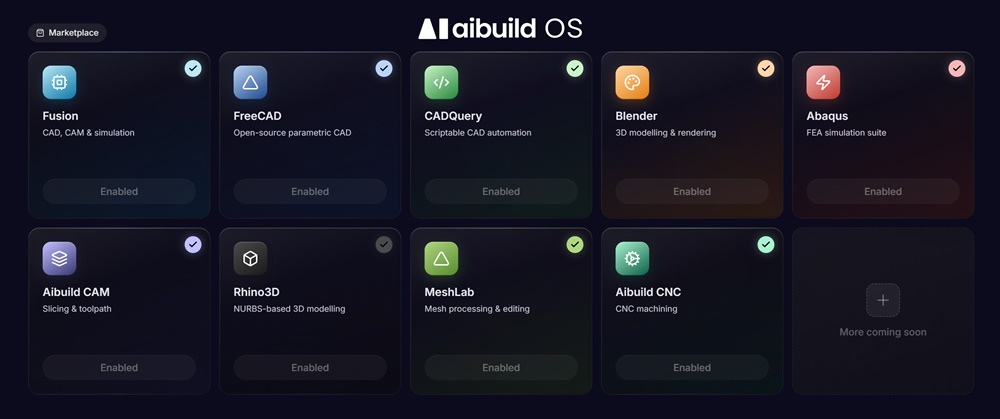
Aibuild OS PR5

From Copilots to Digital Engineers

Unlike traditional assistive tools that require constant human supervision, Aibuild OS introduces “Digital Engineers.” These are autonomous AI systems that plan and execute multi-step workflows across different software environments. By automating data translation and process execution, Aibuild OS allows human engineers to focus on high-level problem solving and strategic design.

“For too long, engineering capacity has been limited by human execution bandwidth,” said Daghan Cam, co-founder and CEO of Aibuild. “We are removing these barriers. By allowing engineers to deploy autonomous AI directly into their workflows, we help teams solve complex production challenges, reduce lead times, and increase productivity.”

Breaking Software Silos

The platform addresses a critical bottleneck in modern manufacturing: the lack of interoperability between design and production software.

“Traditional manufacturing software creates silos,” said Michail Desyllas, co-founder and COO of Aibuild. “Engineers spend hours moving data between disconnected tools and manually translating outputs. Aibuild OS orchestrates these processes as a single intelligent system. It is the operating system layer that manufacturing has lacked until now.”

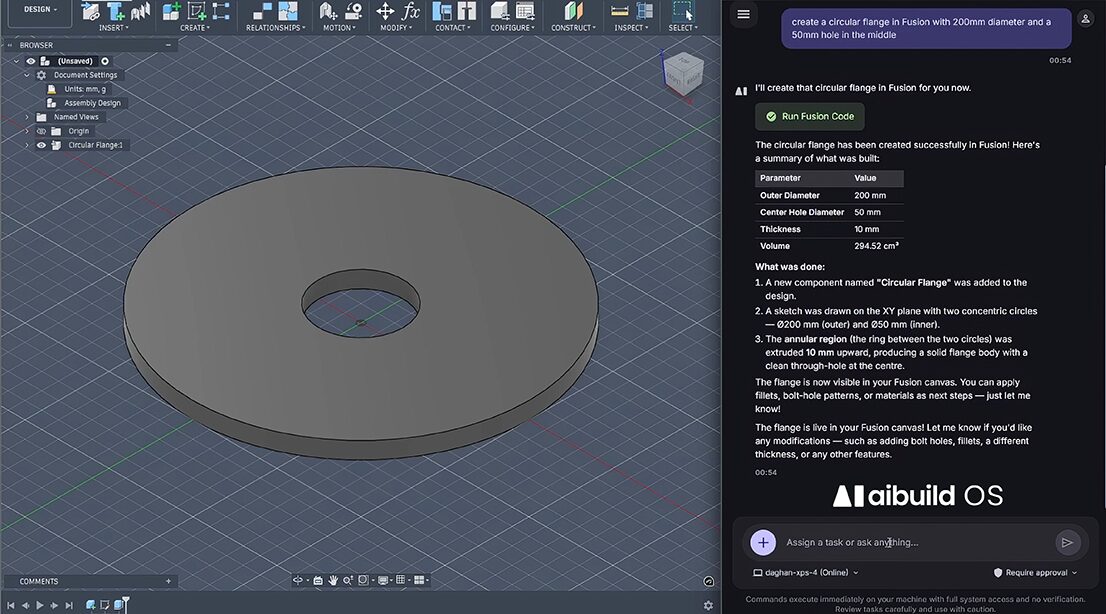
Aibuild OS PR3

Example Use Cases

Aibuild OS is used to solve industrial engineering challenges, including:

  • Concept Design and Generation: The system bridges the gap between creative intent and engineering data. It can transform text prompts into images, convert 2D technical drawings into 3D models, and use “Image-to-3D” workflows to speed up early-stage design.
  • Data Repair and Processing: Digital engineers convert raw 3D scan data into clean, production-ready meshes, removing the need for hours of manual geometry repair.
  • Rapid Tooling and Mold Design: Digital engineers process finished part designs to automatically generate molds and fixtures featuring complex cooling channels and optimized design for manufacturability.

Integrated Additive and Subtractive Manufacturing: The system transitions from a 3D concept to a structural print and milling path without manual geometry cleanup or slicing adjustments.

Aibuild OS PR4

Availability

Aibuild OS is now live in Public Alpha. Organizations looking to accelerate their engineering workflows can sign up for immediate access today at ai-build.com.

About Aibuild

Aibuild is the leading software platform for autonomous additive manufacturing, based in the UK and US. We empower engineers to automate the production of complex parts with robotic and gantry systems. By combining advanced geometrical algorithms with fast physics simulations and AI, Aibuild makes additive manufacturing scalable, reliable, and accessible for critical applications in aerospace, automotive, energy, and construction. For more information, visit https://ai-build.com.

devDept Releases Eyeshot 2026 CAD Control Tool for .NET

0
Devdept

BOLOGNA, Italy, Mar 17, 2026 – devDept Software S.r.l., leading provider of software development tools to the engineering industry, announces the release of Eyeshot 2026, the native CAD control for .NET.

Eyeshot2026

New Features

  • Selective Clipping through Entity.Clippable property
  • OpenGL 3.3 
    Better support of modern GPUs
  • Surface.Project(Curve) method
    Curve to surface projection along a direction
  • Brep and Solid ExtrudeRemoveThrough() methods
  • ReadE57 class
  • WorkUnit class refactoring to use the Task-based Asynchronous Pattern with new async APIs.
    The WorkUnit infrastructure has been refactored to use the Task-based Asynchronous Pattern (TAP), removing the dependency on BackgroundWorker. Long-running operations can now be executed as Tasks and awaited, with built-in support for cancellation tokens and progress reporting. This makes it easier to keep the UI responsive, compose multiple operations, and write automated tests around Eyeshot workflows.
  • Geometry import API update 
    The legacy AddTo() method has been replaced by explicit OpenTo(), InsertTo(), and AppendTo() methods, with both synchronous and asynchronous variants. This refactoring includes geometry auto-scaling according to units.
  • Assembly Mates on Brep edges, vertices, and wire curves
  • FEM Shell elements
    FEM shell elements are specialized 2D finite elements designed to analyze thin-to-moderately thick structures (e.g., plates, shells, fuselage) where one dimension is significantly smaller than the others.
  • WriteIFC class
  • Finer control of dimension text positioning 
    AutoCAD DIMJUST and DIMTAD properties
  • Region.RevolveAsBrep(), RevolveAdd(), RevolveRemove() methods now accept Interval amount parameter
  • Improved Mesh.ConvertToBrep() for planar faces
  • ReadDXF class based on ACadSharp
  • Improved tessellation of toroidal (big aspect ratio) and spherical surfaces
  • Toolpath entity with 5-axis support
  • ProjectConverter tool has been redesigned to use Roslyn for semantic code analysis
    Instead of relying on simple text-based replacements, the converter now understands the actual symbols and API usage within the project. 
  • Visual Studio 2026 support
  • .NET 10 support

Code Samples

  • Hexagonal fill in SlicerDemo
  • Insert text button in the SketcherDemo
  • VolumeRendering

About devDept Software S.r.l.,

Based in Bologna, Italy, devDept Software S.r.l., was founded in 2006 with the commitment to deliver easy-to-use CAD software components to the engineering industry. The development team consists of a unique mix of programmers, mathematicians, and engineers.

devDept’s software components power nearly 1500 unique applications running on millions of computers worldwide. They are used in a wide range of industries including CAD/CAM/CAE and AM, scanning and metrology, medical, dental, BIM, construction, mining, and other large capital asset industries.

Customers include TRUMPF, Siemens, Amada, Porsche, Honda, Boeing, Rolls-Royce, CLAAS, Samsung, Mitutoyo, Komatsu, and Hexagon. For more information, visit https://devdept.com.