Home Blog Page 722

Autodesk Q2 FY21 Conference Call on Aug 25, 2PM PT

0

SAN RAFAEL, CA, USA, Aug 4, 2020 – Autodesk, Inc. (NASDAQ: ADSK) announced it will broadcast its second quarter fiscal 2021 financial results conference call live via its website Tuesday, August 25, 2020, at 2:00 p.m. Pacific Time. Autodesk will host a live webcast call Tuesday, August 25, 2020 at 2:00 p.m. PT at www.autodesk.com/investors. An audio replay webcast will also be available after 5:00 p.m. PT on Autodesk’s website at www.autodesk.com/investors.

For more information, please call Autodesk Investor Relations at 415-507-6373.

About Autodesk

Autodesk makes software for people who make things. If you’ve ever driven a high-performance car, admired a towering skyscraper, used a smartphone, or watched a great film, chances are you’ve experienced what millions of Autodesk customers are doing with our software. Autodesk gives you the power to make anything. For more information visit autodesk.com or follow @autodesk.

Invitation
Siemens sd17

Siemens to Acquire California-based Avatar, to Expand its EDA Footprint with Place and Route Technology

0

PLANO, TX, USA, Aug 3, 2020 – Siemens has signed an agreement to acquire Santa Clara, CA-based Avatar Integrated Systems Inc., a leading developer of place and route software for integrated circuit (IC) design. Avatar helps engineers optimize power, performance, and area (PPA) for complex chips with fewer resources. Siemens plans to add Avatar’s technology to the Xcelerator portfolio as part of Mentor’s IC suite of software, capitalizing on the growing segment of place and route. Avatar will be integrated with existing market-leading products from Mentor, a Siemens Business, including the Calibre® platformTessent software, and Catapult HLS software, to help customers develop solutions that address today’s and tomorrow’s design implementation challenges.


Light from Microchip


“Customers are accelerating their move to advanced process nodes. Navigating the increasing complexity is a crucial challenge,” said Joseph Sawicki, executive vice president, Mentor IC EDA, Siemens Digital Industries Software. “Avatar’s innovative software architecture, as well as a reputation for ease of use, helps customers overcome this complexity with advanced node place and route capability. The Avatar solution, backed by Siemens’ investment, will offer customers shorter time to design closure with better PPA results than existing competitive offerings. We welcome the Avatar team and community to Siemens.”

At 7nm and below, detailed routing must be considered during placement. Avatar pioneered a detailed-route-centric architecture that has been built bottom-up on a unified in-memory data model, designed to enable all engines to access full design data and attributes at any time. This empowers each engine (placement, routing, timing, optimization, clock tree synthesis, etc.) to dynamically invoke other engines incrementally.

“Avatar’s approach can lead to excellent correlation through all phases of place and route, with improved PPA results,” said Ping San Tzeng, Chief Technical Officer, Avatar Integrated Systems. “As a part of Siemens, Avatar can further develop this approach, accelerate R&D, and grow market share by leveraging a much larger pool of resources. We are proud of our technical achievements and well-known record for excellent customer support and look forward to enhancing these strengths as part of Siemens.”

Avatar’s products are built on technologies acquired from ATopTech Inc. in 2017. The product line includes Aprisa, a netlist-to-GDS full-function block-level physical implementation tool, and Apogee, a complete top-level prototyping, floor-planning and chip assembly tool. The industry’s top semiconductor foundries have qualified Avatar’s products for designs at established and advanced process nodes, such as 28nm and 7nm – with 6nm and 5nm currently under development.

Siemens’ acquisition of Avatar is expected to close in the second half of 2020. Terms of the transaction are not disclosed.

For further information on Siemens’ IC offerings, please see www.siemens.com/mentor.

About Siemens Digital Industries Software

Siemens Digital Industries Software is driving transformation to enable a digital enterprise where engineering, manufacturing and electronics design meet tomorrow. The Xcelerator portfolio helps companies of all sizes create and leverage digital twins that provide organizations with new insights, opportunities and levels of automation to drive innovation. For more information on Siemens Digital Industries Software products and services, visit www.sw.siemens.com or follow us on LinkedInTwitterFacebook and Instagram. Siemens Digital Industries Software – Where today meets tomorrow.

About Siemens Digital Industries

Siemens Digital Industries (DI) is an innovation leader in automation and digitalization. Closely collaborating with partners and customers, DI drives the digital transformation in the process and discrete industries. With its Digital Enterprise portfolio, DI provides companies of all sizes with an end-to-end set of products, solutions and services to integrate and digitalize the entire value chain. Optimized for the specific needs of each industry, DI’s unique portfolio supports customers to achieve greater productivity and flexibility. DI is constantly adding innovations to its portfolio to integrate cutting-edge future technologies. Siemens Digital Industries has its global headquarters in Nuremberg, Germany, and has around 76,000 employees internationally.

About Siemens AG

Siemens AG (Berlin and Munich) is a global technology powerhouse that has stood for engineering excellence, innovation, quality, reliability and internationality for more than 170 years. The company is active around the globe, focusing on the areas of power generation and distribution, intelligent infrastructure for buildings and distributed energy systems, and automation and digitalization in the process and manufacturing industries. Through the separately managed company Siemens Mobility, a leading supplier of smart mobility solutions for rail and road transport, Siemens is shaping the world market for passenger and freight services. Due to its majority stakes in the publicly listed companies Siemens Healthineers AG and Siemens Gamesa Renewable Energy, Siemens is also a world-leading supplier of medical technology and digital healthcare services as well as environmentally friendly solutions for onshore and offshore wind power generation. In fiscal 2019, which ended on September 30, 2019, Siemens generated revenue of €86.8 billion and net income of €5.6 billion. At the end of September 2019, the company had around 385,000 employees worldwide. Further information is available on the Internet at www.siemens.com.

‘Digitalization Key to Making Indian Cities Globally Competitive’ – Siemens Report

0

MUMBAI, India, Jul 31, 2020 – Cities in India can compete globally on parameters such as optimal use of resources, how we get around, ways to improve our productivity and well-being, according to the Atlas of Digitalization, a data-driven index created by Siemens. The Atlas compares the transformation of cities around the world. Each city’s unique challenges – including traffic congestion, water availability, and air quality – have been given scores based on digitalization readiness and digitalization potential.

Sunil Mathur, Managing Director and Chief Executive Officer, Siemens Limited, said, “Many cities in India have a huge potential to improve the quality of life and ease of doing business. While each city has its own unique challenges, the Atlas of Digitalization and its study of Bengaluru gives a good reference for other cities to further improve on their sustainability, mobility and opportunity parameters.”

Robert H.K. Demann, Head of Smart Infrastructure, Siemens Limited, said, “Siemens has the digital technology innovations and extensive global expertise to transform cities. While Bengaluru is part of the Atlas of Digitalization, we are engaging with stakeholders in multiple cities across India to implement integrated smart infrastructure solutions.”

Bengaluru features in the Atlas of Digitalization along with global cities like Berlin, Buenos Aires, London, Singapore, Dubai, Johannesburg, Los Angeles and Taipei. It is one of the world’s fastest growing cities, with a 47% surge in population density over the last ten years. Home to a third of India’s science and technology talent, it has the highest employability rate in the country, with a large proportion of tech-savvy early adopters. This gives Bengaluru a strong appetite to build a city that symbolizes the world-leading services it delivers across the globe.<

Siemens has already implemented digital solutions for city infrastructure. The company is partnering with the airport’s operators to deliver an extensive range of proposed projects. A cloud-based IoT operating system is set to optimize operational efficiency and passenger experience across diverse aspects such as building management and intelligent baggage handling. Services such as Siemens City Air Management monitor air quality and provide five-day forecasts that can help cities to protect residents.

More information: https://atlas.dc.siemens.com/cities/bengaluru.

About Siemens Limited

Siemens Limited focuses on the areas of power generation and distribution, intelligent infrastructure for buildings and distributed energy systems, and automation and digitalization in the process and manufacturing industries. It is also a leading supplier of smart mobility solutions for rail and road transport and infrastructure solutions for Smart Cities. Siemens Limited, in which Siemens AG holds 75% of the capital, is the flagship listed company of Siemens AG in India. As of September 30, 2019, Siemens Limited had Revenue of INR 13,323 crore and 9,437 employees. Further information is available on the Internet at www.siemens.co.in.

ITC Releases IntelliCAD 10

0

PORTLAND, OR, USA, Jul 31, 2020 – The IntelliCAD Technology Consortium (ITC) announced the release of IntelliCAD 10.0.


R10 Rendered Chair


IntelliCAD 10.0 is a major release that includes numerous new features.

The OpenGL ES graphics device is now supported for enhanced display quality and performance, which also includes new visual styles. A new materials library contains materials that can be assigned to entities and layers and then displayed with visual styles; spot and point lights can also now display in-program with visual styles. The redesigned View Manager has more options available and allows users to make selections dynamically for the view’s background, perspective, lens length, etc. New dynamic input incorporates command prompts and measurement guides at the cursor. Printing with .pc3 customization files is enhanced with the ability to set margins, page size, .pmp files, and settings that vary according to the output file type. New import file formats include .obj and .stl. Many new properties are available for various entity types in the Properties pane, including the ability to view properties of custom entities. IntelliCAD 10 also includes the ability to migrate user interface customizations from previous versions.

Smaller features that will have a big efficiency boost for end-users are the ability to re-order and sort layer filters, combine paragraphs and clear formatting of multiline text, determine which user interface items are hidden when cleaning the screen, use new videos and online resources from the Start page, convert closed entities to solids, specify a layer state for each published sheet, a redesigned status bar, enhancements for Section 508 usability, better 4K display support, and an initial Hungarian translation.

For versions of IntelliCAD that work with BIM files, draw roofs and beams, create mitered joints for beams, explode attached BIM underlays into polyface meshes and polylines that can be edited while retaining underlay functionality, and use new options for section lines and elevation lines.

For versions of IntelliCAD that open, save, and edit .dgn files in their native format, the supported command set now includes Multiline Text, Chamfer, and Dimension Styles.

For technical users, IntelliCAD 10 incorporates ODA SDKs version 2020 Update 2 and enhanced .NET and IRX functionality for increased API capabilities.

Other improvements and fixes are found in performance, working with files, editing and selecting entities, text, printing, and more.

David Lorenzo, ITC President, stated, “IntelliCAD 10 is a huge structural update with new core libraries from the ODA, a new geometry library, updated graphics, and new APIs. Yes, there are several interesting new features for users too, but the structural changes provide a much stronger foundation on which ITC members can build even more complex and diverse applications.”

An overview video of IntelliCAD 10.0 features is on YouTube at https://youtu.be/FmyaEugUMio.

IntelliCAD 10.0 is supported on Microsoft Windows 10, Windows 8, and Windows 7 64-bit versions. IntelliCAD Mobile Viewer versions are available for Windows desktop, Google Android, Apple macOS and iOS.

Interested IntelliCAD users can contact ITC members to receive details about availability of IntelliCAD software.

Companies interested in more details about IntelliCAD and membership in the ITC should contact the ITC directly. For more information about IntelliCAD and the ITC, including case studies, please visit http://www.intellicad.org.

About IntelliCAD Technology Consortium

The IntelliCAD Technology Consortium is an independent, non-profit organization funded and directed by its members specifically for the shared development of the IntelliCAD technology. The IntelliCAD Technology Consortium licenses the IntelliCAD technology to its commercial members, who in turn market and sell applications based on IntelliCAD to their end users. Commercial members have access to the IntelliCAD source code, documentation, developer support, and more. The ITC is also a founding member of the Open Design Alliance, thereby contributing to interoperability in the engineering industry.

For more information, visit http://www.intellicad.org or call 1-503-293-7655.

CGTech Releases VERICUT v9.1 for CNC Simulation

0

IRVINE, CA, USA, Jul 31, 2020 – CGTech is pleased to announce the latest release of VERICUT software, Version 9.1. VERICUT CNC machine simulation, verification, and optimization software simulates all types of CNC machining, additive, and hybrid manufacturing processes. The software operates independently, but can also be integrated with leading CAM systems.


VERICUT91


VERICUT 9.1 raises the bar for CNC simulation once again with several new cutting-edge features that increase efficiency and empower users to do more in less time. New visibility options, plus enhancements to toolpath optimization, Additive Manufacturing, tooling & Multi-tool Stations, measuring & Inspection/Reporting are just a few of the noteworthy features in this latest release. Hundreds of customer-driven improvements and software requests were also incorporated in this latest version.

“VERICUT 9.1 continues to enhance the User Experience through continued advancements with graphics and display controls, streamlined user controls, and more new capabilities and features than ever before”, says VERICUT Product Manager, Gene Granata. “Version 9.1 also introduces a Learn mode for Force optimization – a form of Artificial Intelligence for faster/easier NC Program optimization. Using Learn mode, almost anyone can create highly optimized NC programs from existing programs, without having to reprogram them.”

Enhanced Visibility

New visibility features have been added to the Project Tree and VERICUT’s right-click convenience menus for components and models, enabling users to toggle between visible and invisible states, or to enable/disable 3-D objects for the simulation. Quickly see unobstructed views of the cutting process and gain better access to the part by removing enclosures, models of sheet metal or shrouding, and other “in-the-way” objects via “Invisible” or “Disable” actions.

New Visibility Options for AUTO-DIFF

Similar to the above, new features have been added to AUTO-DIFF giving users a higher degree of control over component visibility, such as when Fixture models should appear.

X-Caliper Annotated Images

Setup Plan has been renamed to Annotated Images. VERICUT Inspection is also now included with Annotated Images. Both Setup Plan and Inspection functionality is greatly enhanced with dimensions, notes and tolerances for checking parts at various stages of machining. Easily create professional looking and informative setup plans and inspection images stored with view layouts – ready to print as “shop aid” documents, or to appear in VERICUT’s comprehensive Reports.

Shanks in Cutting Tool Assemblies

Defining shanks as separate objects from the holder and cutter enables programmers to see where these non-cutting portions of the cutter are – relative to the stock workpiece, and allows more discrete control over near miss and collision detection properties and tolerances. Tool holder models can also be used as “Shanks”.

Streamlined Optimization with A.I.

The Optimize Control window has been streamlined to fit in a single window with no tabs. Relevant features become active in subsections depending on which Mode is selected. A new Force “Learn” Mode is available, providing Artificial Intelligence (A.I.) for optimization. In Learn mode, VERICUT learns from simulating cutting, then automatically configures & optimizes tools for increased cutting efficiency and reduced machining times.

Force Charts

New “Save All As” Optimization Settings option added to the right mouse menu when clicking on a Force Chart. New ability to ‘Learn From Results’ enables optimization settings for a tool or all tools that were analyzed.

Additive Manufacturing

VERICUT 9.1 has a new “Additive” Default Machining Type. This enables VERICUT to predict system resources that will be needed to additively build the as-designed part, including a starting stock build plate or model.

VERICUT can build multiple parts created by a “nested” build NC program, enabling additively built parts to be independently relocated or assembled for finish machining, or exported. This feature is especially helpful for Big Area Additive Manufacturing (BAAM) and Large Scale Additive Manufacturing (LSAM) parts.

DXF Import

The DXF Import feature has been enhanced with several new features. The DXF reader can now read the layers within a DXF file and automatically detect CUT/NOCUT layers. Additional layers can be checked on to use as additional components.

To learn more about the new features in VERICUT 9.1, click here.

About CGTech

CGTech’s VERICUT software is the standard for CNC simulation, verification, optimization, analysis, and additive manufacturing. CGTech also offers programming and simulation software for composites automated fiber-placement, tape-laying, and drilling/fastening CNC machines. VERICUT software is used by companies of different sizes in all industries. Established in 1988, and headquartered in Irvine, California; CGTech has offices worldwide. For more information: visit the CGTech website at cgtech.com, call (949) 753-1050, or email info@cgtech.com.

Spatial Manager for GstarCAD Now Available

0

SUZHOU, China, Jul 31, 2020 – Gstarsoft is pleased to announce the availability of  “Spatial Manager for GstarCAD”.

“Spatial Manager for GstarCAD” is a lightweight yet powerful GstarCAD plug-in designed for GstarCAD users. It runs inside GstarCAD and helps GstarCAD users import, export, manage and enhance their spatial data in a simple, fast and inexpensive way.


20200730024910_31


A closer look at the ribbon and commands

The ribbon and commands are intuitive and task-based, therefore accessing them is easy and quick.


20200730025148_648


Powerful Import & Export

One of the basic needs of GstarCAD users is to handle geospatial information, luckily, Spatial Manager for GstarCAD has made it easy and productive to import from and export to a large number of geospatial data sources, batch import and save structured tasks for repetitive importing processes.


20200730025226_545


Dynamic background maps technology

With this technology, users can not only use application preset and user defined maps, but also capture high-resolution static map images as raster or OLE objects.


20200730025324_790


Interactive and synchronized Data Grid

The powerful data grid allows users to review objects data, sort or export them.


20200730025510_569


Explore other features

Spatial Manager for GstarCAD will take your design to the next level with its other important features such as smart search window, etc. We invite you to explore more by watching the video and try it first !

Check the video to get the preview of the application.

To download, click here and enjoy the benefits and latest features now!

About Gstarsoft

Founded in 1992, with more than 25 years of experience in CAD business, Gstarsoft has gained a large number of users and global partners through quality products and premium service. The worldwide distribution networks cover over 50 countries and most partners have more than 10 years of cooperation with Gstarsoft. With 4 R&D centers and over 150 software development professionals, Gstarsoft keeps devoting to streamlining the design procedures and revolutionizing the design industry by providing more innovative CAD solutions with new technologies in the fast-changing market. For more information, visit http://www.gstarcad.net.

Gstarsoft Releases GstarCAD 2020 SP2

0

SUZHOU, China, Jul 31, 2020 – In a continuing effort to improve the user experience and product quality of GstarCAD 2020, Gstarsoft is pleased to announce the release the SP2 for GstarCAD 2020.


20200719234139_778


Keep up-to-date with GstarCAD: Improve efficiency and save time !

GstarCAD has always been chosen by worldwide CAD users for its great performance, high-compatibility and cost-effectiveness thanks to useful commands and innovative tools.


20200719234348_691


GstarCAD never misses a chance to surprise our users. This new release features improvements centered around performance and stability, which facilitates the working process and increases the working efficiency of designers and draftsmen in a wide range of industries.

Free trial is available

For those who want to keep up with the latest version of GstarCAD 2020 and enjoy the efficiency while performing difficult tasks, please download the fast, simple and free trial here https://www.gstarcad.net/cad/.

About Gstarsoft

Founded in 1992, with more than 25 years of experience in CAD business, Gstarsoft has gained a large number of users and global partners through quality products and premium service. The worldwide distribution networks cover over 50 countries and most partners have more than 10 years of cooperation with Gstarsoft. With 4 R&D centers and over 150 software development professionals, Gstarsoft keeps devoting to streamlining the design procedures and revolutionizing the design industry by providing more innovative CAD solutions with new technologies in the fast-changing market. For more information, visit http://www.gstarcad.net.

Mastercam Introduces 5X Mill Post Processors for Siemens SINUMERIK CNCs

0

TOLLAND, CT, USA, Jul 31, 2020 – CNC Software, Inc., producers of Mastercam CAD/CAM software, announced new 5-axis milling post processors that will unleash the highest productivity on SINUMERIK-controlled machine tools. These new post processors were developed utilizing the technical expertise of Siemens CNC engineers.


SINUMERIK ONE Controller
Digital Twin of CNC


These post processors include support for SINUMERIK 840D and SINUMERIK ONE CNCs from Siemens. Some features include:

  1. Table/Table (AC/BC/Nutating) Support.
  2. Rotary and Vector Programming.
  3. Advanced Surface / Top Surface (COMPCAD / COMPSURF).
  4. CYCLE 832 Support for High Speed Settings (OTOL).
  5. CYCLE 800 Tilted Workplane (3+2).
  6. TRAORI – Tool Center Point Control (ORIWKS, ORIMKS, ORIAXIS, ORIVECT, and ORISON/ORISOF).
  7. SUPA (suppress all [offsets]).
  8. Work offset support matching control capabilities (G54-G57/G507-G599).
  9. Optimized Drilling Cycles (CYCLE 82, 83, 84, 85, 86, 840).
  10. Numerical tool call with offset D#.
  11. TOFFR functionality to support cutter comp wear strategy.
  12. A Siemens application guide.

“Providing this new 5-axis post for Mastercam continues to extend the benefit of our ongoing relationship with Siemens from the creation of our 3-axis, 4-axis, and now the 5-axis post processors that will bring the highest productivity gains to machine tools for customers. Our post engineers and Siemens engineers have done a fantastic job making sure we provide the most common options for our mutual customers,” says Mastercam Post Department Manager Pedro Sanchez, Jr.

It is cooperation like this that provides Mastercam users the opportunity to truly complement their CAM investment and give their shops the best chance at a more efficient manufacturing solution, from design to part.

Chris Pollack, Virtual Technical Application Center Manager, Siemens Industry, Inc. comments, “When driving advanced technology, such as 5-axis machine tools, the quality and capability of the post processor is arguably one of the most important pieces in the manufacturing process chain. After working with the exceptional Post Engineers at CNC Software, I can truly say that this latest post is a thing of beauty. It allows both the SINUMERIK CNC as well as Mastercam to operate at its fullest potential.”

According to Dr. Jochen Bretschneider, Product Manager SINUMERIK Technologies, Siemens AG Erlangen, “It is well known that the post processor determines the efficiency of 5-axis simultaneous machining that end users can achieve on their machines. Only if the correct command set of the CNC control is addressed by the post processor can the full performance in terms of machining times and surface quality be achieved. With the new Mastercam 5-axis mill post processor it is guaranteed that not only the proven SINUMERIK 840D sl can be optimally operated, but also the future-oriented, powerful SINUMERIK ONE. End users therefore can cover existing machinery with SINUMERIK 840D sl as well as brand new machines equipped with SINUMERIK ONE.”

For more information about Mastercam, visit www.mastercam.com.
For more information about Siemens, visit www.usa.siemens.com/cnc.

CIMdata Publishes 2020 PLM Industry Analysis Report

0

ANN ARBOR, MI, USA, Jul 31, 2020 – CIMdata, Inc., the leading global PLM strategic management consulting and research firm, announces the release of the CIMdata PLM Industry Analysis Report, the fifth of five modules of the CIMdata 2020 PLM Market Analysis Report Series. The MAR Series provides detailed information and in-depth analysis on the worldwide PLM market during 2019. It contains analyses of major trends and issues, revenues of leading PLM providers, and revenue analyses for geographical regions, industry sectors, and historical and projected data on market growth.

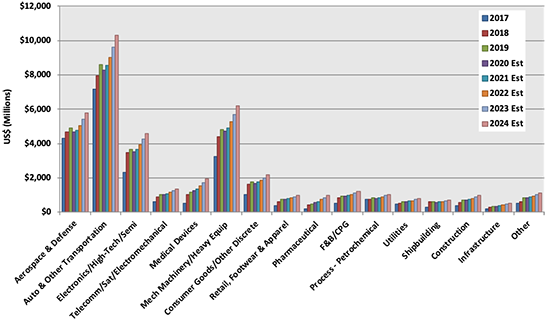
All industries saw growth in PLM spending in 2019, as shown in the figure below. CIMdata forecasts continued growth in all sectors during the five-year forecast period.


Figure 1


PLM spending is greatest in automotive & other transportation, mechanical machinery and heavy equipment, and aerospace & defense. It is lower in the process industries and utilities. However, there are some good process-focused PLM solutions available, and they are becoming more important with growing concerns about food safety, particularly in emerging economies. Growth in PLM for medical devices is driven by stringent compliance requirements that can vary by country, something that PLM strategies and enabling solutions can address. All industries are being affected by the trend toward smart, connected products, either directly or because of the effects of the Internet of Things (IoT) and the drive toward Industry 4.0, an initiative that originated in Germany, that has inspired programs and spending in countries around the world. CIMdata believes there are good opportunities in all segments as corporate management continues to become more aware of the value of PLM and its positive impacts on both the top and bottom lines of a business. During 2019, comprehensive providers continued to expand their efforts to deliver more industry-focused and functionally-packaged solutions that are easier and less expensive to acquire and deploy. This is fueled, in part, by continued mergers and acquisitions activity in most PLM segments. The global COVID-19 pandemic is already having a significant impact on the PLM market in 2020, and CIMdata’s forecasts include consideration of its continuing effects in 2020 and beyond. Different industries will see different impacts, and this is discussed in the report.

“The global PLM market grew strongly in 2019 at 7.7%, just under our forecast of 8.9%,” states Stan Przybylinski, CIMdata’s Vice President. “The leading PLM solution providers continue to consolidate their portfolios after years of acquisitions. Revenue increases in 2019 are due, in part, to solution providers expanding their footprint at their existing clients. Industrial companies are embracing digitalization strategies and using PLM to enable highly collaborative, distributed, flexible design and manufacturing environments to help better manage the entire product or plant lifecycle. This ability is critical to all industries and only becomes more complex as smart, connected products must act as parts of larger systems. CIMdata believes that while the COVID-19 pandemic is a serious threat to global commerce, the underlying trends driving changes in product development, manufacturing, and in-service support will continue to drive investments in 2020 and the years that follow.”

The CIMdata PLM Market Analysis Report Series comprises five modules:

  1. The CIMdata 2020 Executive PLM Market Report provides an overview of CIMdata’s complete global analysis. It includes key charts on PLM market investment statistics through 2019, forecasts of investments for 2020 through 2024, and a summary of PLM solution providers’ performance in 2019.
  2. The CIMdata 2020 PLM Industry Review and Trends Report is mainly qualitative and focuses on key issues facing the global PLM ecosystem of solution providers and end-user organizations. It highlights changes that occurred in 2019, what effects those changes may have in the short and medium terms, and what is on the horizon in the years to come.
  3. The CIMdata 2020 PLM Market and Solution Provider Analysis Report details measures of and forecasts for the overall PLM market and its key segments in 2019, including Tools, cPDm, and Digital Manufacturing. The Tools section has additional details on sub-segments, including MCAD, NC, S&A, EDA, and AEC. It also includes CIMdata’s estimates of PLM solution provider revenues in these segments and sub-segments for 2020 through 2024.
  4. The CIMdata 2020 PLM Market Geographic Analysis Report provides an additional view of the 2019 market results, by major geography. The report offers CIMdata’s 2019 estimates and market forecasts for PLM and the major PLM market segments for the Americas, EMEA, and Asia-Pacific. Also, the report includes estimates and forecasts for the cPDm segment within specific European and Asia-Pacific countries and regions.
  5. The CIMdata 2020 PLM Market Industry Analysis Report provides an industry segmentation view of the 2019 market results. The report provides CIMdata’s 2019 estimates and market forecasts for PLM and cPDm for ten different industry sectors: aerospace and defense, automotive and other transportation, electronics/telecommunications, fabrication and assembly, process-packaged goods, process—petrochemical, utilities, construction, infrastructure, and shipbuilding.

The CIMdata PLM MAR Series is available as a five-module set, or each module can be purchased separately. Those who buy MAR volumes can also purchase Excel workbooks with the complete annual analysis at an extra fee. Parts of the MAR series are available as part of CIMdata’s Community Memberships. CIMdata also publishes country-specific MAR reports for Brazil, China, France, Germany, India, Italy, Japan, Russia, South Korea, the United Kingdom, and the United States. Further details and pricing information about the reports and Community Memberships are available at www.cimdata.com.

Maplesoft Releases MapleSim Insight to Simplify Machine-Level Controller Testing

0

WATERLOO, ON, Canada, Jul 30, 2020 – Maplesoft announced the release of MapleSim Insight, a new software product from Maplesoft that gives machine builders powerful, simulation-based debugging and 3D visualization capabilities that directly connect to their automation tools. As a result, engineers can perform simulation-based testing of their controller easily and efficiently.

Simulation-based testing of machine control strategies is a key element of virtual prototyping and using digital twins for virtual commissioning. However, this step can be cumbersome, as many automation tools provide limited options for machine-level, simulation-based controller testing, and these options often require moving development to an entirely new platform. By providing a real-time connection to most common automation platforms, MapleSim Insight shows machine designers exactly how their control strategies will impact the machine. Adjustments and fine-tuning of the design can happen virtually, reducing the number of expensive physical prototypes that will be required.

MapleSim Insight works with any automation tool that supports compiled Function Mock-up Units (FMUs), such as the Rockwell Studio 5000 Environment or MathWorks Simulink. The machine model is first developed in MapleSim, the advanced system-level modeling tool from Maplesoft, and then exported as an FMU, an open standard format for sharing models. MapleSim Insight connects to the automation tool, and displays visual results in real-time to show how the model behaves as the controller is running. MapleSim Insight provides both 3-D visualizations for quick visual feedback, and 2-D plots to get precise answers for testing and debugging, so the engineer can always get the level of detail required.

“Digital models are invaluable for the design and testing of a system, acting as a virtual test bench for the machine’s control software. But hooking the model into your preferred controller platform can be very difficult, and often one of the critical pieces for debugging – the visualization of the mechanism itself – is lost,” said Chad Schmitke, Senior Director, Product Development, Maplesoft. “Now, with MapleSim Insight, visualizing and interrogating your model is as simple as running an FMU in your preferred automation environment. You get the robust back-end code to emulate the physics, coupled with the plotting and visualization necessary to interpret what is happening. ”

MapleSim Insight is part of the MapleSim family of modeling and simulation products from Maplesoft. The newly released MapleSim 2020 lets you build and test models more quickly than ever, providing faster simulations, powerful new tools for machine builders, and expanded modeling capabilities. The MapleSim 2020 product family also includes the new MapleSim Ropes and Pulleys Library add-on, which allows engineers to easily incorporate winch and pulley systems in their machine models.

About Maplesoft

Maplesoft is the leading provider of high-performance software tools for engineering, science, and mathematics. Maplesoft Engineering Solutions provide advanced tools and services for system simulation, calculation management, and systems engineering, helping organizations maximize the power of their engineering knowledge so they can complete their projects quickly and successfully. The Maplesoft product suite includes Maple, for technical computing and calculation management, MapleSim, the advanced system-level modeling and simulation tool, and MapleMBSE, which supports a model based systems engineering approach to requirements management. Maplesoft products and services are used in machine design, robotics, aerospace, automotive, industrial automation, and many other fields where engineers face complex challenges. Key applications include the creation of digital twins, dynamic analysis of mechanisms, battery systems modeling, heat transfer modeling, and bus fleet electrification. Customers include Boeing, FLSmidth, Ford, Google, Intel, NASA, and Samsung.

Maplesoft is a subsidiary of Cybernet Systems Group.

For more information about Maplesoft, visit www.maplesoft.com.