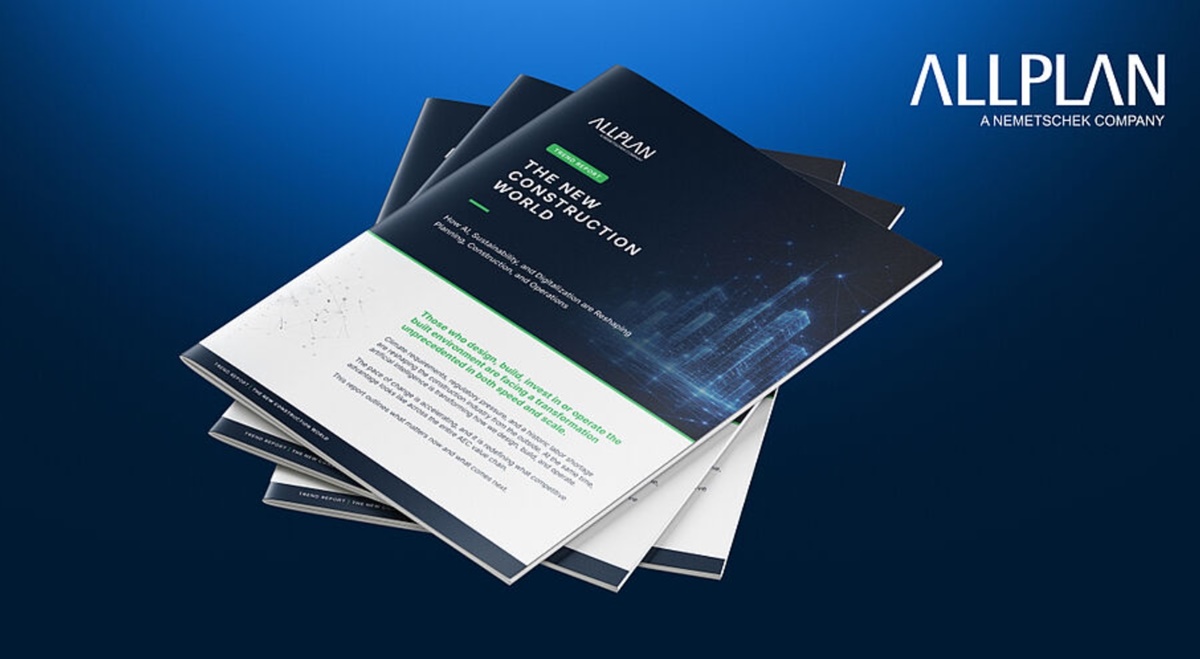
MUNICH, Germany, Sep 14, 2026 – Artificial intelligence is moving from experimentation into everyday design and engineering workflows – but its full potential depends on access to structured, reliable project data. At the same time, AI is making it easier to create, structure and use the data required for BIM-based processes. This convergence of AI and BIM is one of the key developments identified in the new Allplan Trend Report, The New Built World – How AI, BIM and Sustainability Are Transforming the Construction Industry.
Against a backdrop of increasing sustainability requirements, skilled labor shortages and persistent productivity challenges, the report examines how AI, BIM, digital twins and automation are reshaping the built environment. It highlights three developments in particular – Any-to-BIM, semantic mapping and AI-supported generative design – that could help turn fragmented project information into connected, data-driven workflows.
Stefan Kaufmann, Head of Product AI at Allplan, says: “Artificial intelligence will not replace the expertise of architects and engineers. It will fundamentally change how that expertise is applied. AI delivers its greatest value when it is not treated as a standalone tool, but as an intelligent orchestration layer embedded within connected BIM-based workflows. This enables better decisions, more efficient processes and seamless continuity across design, construction and operations.”
BIM as the Foundation for Intelligent Workflows
BIM provides the methodological framework for model-based, interdisciplinary planning. The data structured within the BIM model forms the basis for automation, simulation, and informed decision-making. Today, unstructured as-built data, time-consuming manual data maintenance, high barriers to entry, and interoperability gaps between software solutions and standards are hindering its wider adoption.
This is where AI can make a significant difference. It can structure information from PDFs, spreadsheets, 2D drawings and heterogeneous BIM models, making it available for model-based workflows. The result is fewer information silos, better utilization of existing data and a more consistent basis for decision-making.
Three Technologies Defining the Next Generation of Digital Design
One of the key developments highlighted in the report is Any-to-BIM. Multimodal inputs from drawings, documents and natural language can increasingly be used to generate structured models and model content more efficiently. Rather than automating design, the objective is to create workflows in which human expertise and artificial intelligence work together to achieve better outcomes.
Another important development is semantic mapping. AI-powered technologies can interpret and classify unstructured information before assigning it to BIM objects or data structures. This significantly improves the management of existing assets while facilitating collaboration across different software platforms and project teams.
Generative Design is also becoming increasingly important. AI can rapidly generate and evaluate multiple design alternatives based on predefined criteria such as energy performance, material consumption, cost, ergonomics and structural performance. This enables design teams to assess a wider range of options and make better-informed decisions much earlier in the project lifecycle.
Embedding Sustainability from the Earliest Design Stages
Sustainability must become an integral part of the design process from the very beginning. According to the Trend Report, the construction industry accounts for approximately 33 percent of global CO₂ emissions, while the built environment is responsible for 50 percent of Europe’s material consumption. Lifecycle assessments, material performance data and other sustainability metrics therefore need to be integrated directly into design decisions.
Combined with BIM, AI enables project alternatives to be evaluated not only in terms of cost and quality, but increasingly also according to their environmental impact. This creates the basis for transparent sustainability decisions and more reliable environmental reporting.
Digital Twins and Automation Extend the Value of Data
The value of a BIM model no longer ends with project handover. Connected to sensors, IoT technologies and real-time data, it becomes a digital twin capable of continuously reflecting the condition and performance of buildings and infrastructure. This supports predictive maintenance, energy optimization, ESG reporting, as well as better-informed decisions regarding refurbishment, adaptive reuse and long-term investment planning.
Automation and robotics are also becoming increasingly important across both construction sites and manufacturing facilities. Digitized production lines, industrial robots, autonomous transport systems, drones and automated layout technologies can improve precision, reduce rework and make project delivery more predictable. These technologies deliver their greatest value when they are built on reliable, high-quality digital data.
Human Expertise Remains Essential
Technology alone is not enough. Alongside their technical expertise, architects and engineers will increasingly require a solid understanding of data, digital workflows, artificial intelligence and measurable sustainability.
The report reaches a clear conclusion: artificial intelligence alone will not transform the construction industry. Real change will come from the combination of AI, structured data, open BIM standards and the expertise of architects and engineers.
The complete Trend Report, The New Built World – How AI, BIM and Sustainability Are Transforming the Construction Industry, is available to download at: Trend Report – The New World of Construction.
About ALLPLAN
ALLPLAN is a global provider of AEC software with BIM solutions for architecture, civil engineering, detailed design, fabrication, and construction. True to our “design to build” philosophy, we offer tools that enable early, data-driven design decisions, support digital fabrication, and make information usable throughout the entire construction process. The integrated cloud technology also optimizes interdisciplinary collaboration on construction and infrastructure projects. Our innovative workflows enable architects, engineers, and construction professionals to execute their projects more productively, safely, and sustainably.
More than 650 dedicated employees worldwide are continuing ALLPLAN’s success story. Headquartered in Munich, ALLPLAN is part of the Nemetschek Group, a pioneer of digital transformation in the construction industry. For more information, visit www.allplan.com/de.
About Nemetschek Group
The Nemetschek Group is a globally leading software provider for digital transformation in the AEC/O and media industries. Its intelligent software solutions cover the entire lifecycle of building and infrastructure projects and enable creatives to optimize their workflows. Customers can design, build, and manage buildings and infrastructures more efficiently and sustainably and develop digital content such as visualizations, films and computer games more creatively. The software provider is driving innovations such as digital twins as well as open standards (OPEN BIM), and sustainability in the AEC/O industry, constantly expanding its portfolio by also investing in deep-tech startups. Currently more than seven million users worldwide are shaping the world with the customer-focused solutions of our four divisions. Founded by Prof. Georg Nemetschek in 1963, the Nemetschek Group today employs around 3,600 experts globally.
Publicly listed since 1999 and quoted on the MDAX and TecDAX, the company generated revenues amounting to EUR 801.8 million and an EBITDA of EUR 257.0 million in 2022. For more information, visit https://www.nemetschek.com.