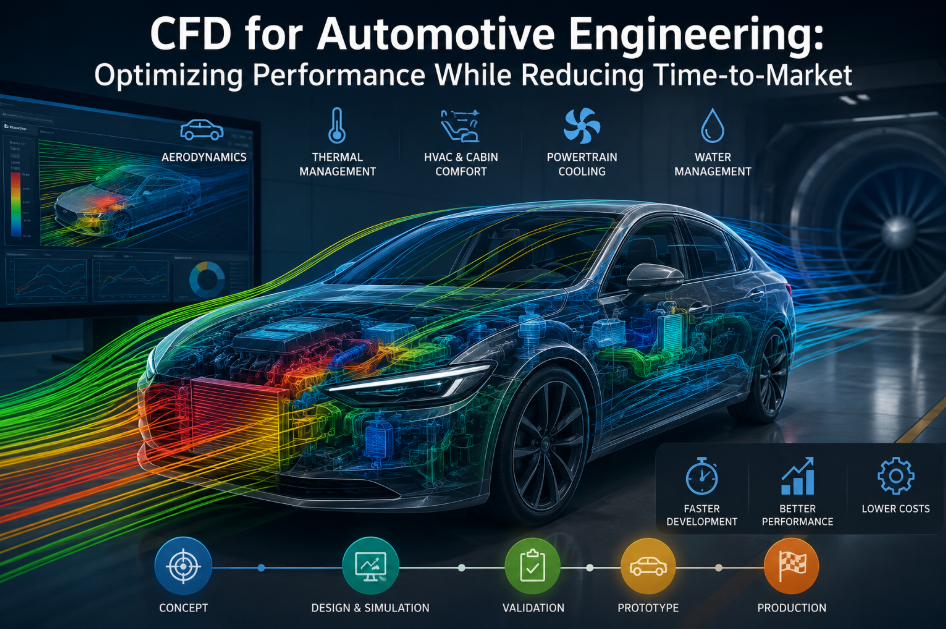
The automotive industry is undergoing its biggest transformation in decades. Electrification, autonomous driving, lightweight materials, sustainability regulations, and increasing customer expectations are forcing manufacturers to innovate faster than ever before. The pressure to reduce vehicle development cycles while maintaining performance, safety, and efficiency has made Computational Fluid Dynamics (CFD) an indispensable engineering tool.
Today, automotive manufacturers no longer rely solely on expensive wind tunnel testing or multiple physical prototypes. Instead, they use advanced CFD simulation software to predict airflow, heat transfer, aerodynamics, cooling performance, and fluid behavior during the earliest stages of product development.
By integrating CFD into the digital engineering workflow, OEMs and suppliers are significantly reducing development costs, accelerating design iterations, and bringing vehicles to market much faster.
Why Time-to-Market Matters in Automotive Engineering
Modern vehicle programs typically involve thousands of components developed simultaneously by global engineering teams. Delays in any subsystem—whether battery cooling, underhood airflow, HVAC performance, or aerodynamic optimization—can impact the entire launch schedule.
Reducing time-to-market enables automotive companies to:
- Launch new models ahead of competitors
- Reduce engineering change costs
- Improve vehicle efficiency
- Meet stringent emission and safety regulations
- Shorten prototype development cycles
- Increase overall product quality
This is where CFD has become a game-changing technology.
The Growing Role of CFD in Automotive Design
Computational Fluid Dynamics enables engineers to simulate fluid flow and thermal behavior digitally before manufacturing a single part.
Instead of waiting weeks for prototype testing, engineers can evaluate hundreds of design alternatives within days.
Typical automotive CFD applications include:
Exterior Aerodynamics
Vehicle drag directly impacts fuel economy and EV driving range.
CFD helps optimize:
- Vehicle body shape
- Mirrors
- Spoilers
- Underbody panels
- Diffusers
- Air curtains
- Active aerodynamic systems
Even a small reduction in drag coefficient (Cd) can significantly improve vehicle efficiency.
Battery Thermal Management for EVs
Electric vehicles have introduced entirely new thermal challenges.
CFD enables engineers to design:
- Battery cooling plates
- Liquid cooling systems
- Air-cooled battery packs
- Thermal runaway mitigation strategies
- Uniform cell temperature distribution
Proper battery cooling improves charging speed, battery life, safety, and driving range.
Powertrain Cooling
Whether internal combustion engines, hybrids, or electric powertrains, thermal management remains critical.
Engineers use CFD to optimize:
- Radiators
- Intercoolers
- Oil coolers
- Coolant flow
- Fan performance
- Air intake systems
Cabin Comfort and HVAC
Passenger comfort has become a major differentiator.
CFD simulations analyze:
- Cabin airflow
- Vent placement
- Defrost performance
- Air conditioning efficiency
- Passenger thermal comfort
- Air quality
Underhood Airflow
Managing temperatures around engines, electronics, batteries, and power electronics is increasingly complex.
CFD predicts:
- Heat dissipation
- Component temperatures
- Air recirculation
- Cooling effectiveness
Water Management
Automotive engineers simulate:
- Rainwater drainage
- Splash behavior
- Windshield water flow
- Wiper performance
These simulations improve durability and customer experience.
Digital Twins Are Accelerating Vehicle Development
Many automotive manufacturers now combine CFD with Digital Twin technologies.
A digital twin allows engineers to simulate real-world operating conditions throughout a vehicle’s lifecycle.
Benefits include:
- Predictive maintenance
- Continuous design optimization
- Connected vehicle analysis
- Manufacturing optimization
- Virtual validation
Digital twins reduce physical testing while improving engineering confidence.
Leading CFD Software Used in the Automotive Industry
Several advanced CFD platforms dominate automotive engineering.
Siemens Simcenter STAR-CCM+
Siemens’ Simcenter STAR-CCM+ is one of the most comprehensive CFD platforms available today.
Widely used by global automotive OEMs, it offers integrated multiphysics simulation capabilities for:
- Vehicle aerodynamics
- Battery thermal management
- Electric motor cooling
- Combustion simulation
- Multiphase flow
- Aeroacoustics
- Water management
- Rotating machinery
- Conjugate heat transfer
Its automated meshing, design exploration, and integration with the Siemens Xcelerator portfolio make it particularly valuable for digital engineering workflows.
Ansys Fluent
Ansys Fluent remains one of the most trusted CFD solutions across automotive, aerospace, and energy industries.
Key capabilities include:
- External aerodynamics
- Internal flow
- Combustion
- Battery cooling
- Turbulence modeling
- Heat transfer
- AI-assisted meshing
- GPU acceleration
Fluent supports highly accurate simulations for both passenger and commercial vehicle development.
SOLIDWORKS Flow Simulation (SOLIDWORKS CFD)
For product designers and mechanical engineers working within the SOLIDWORKS ecosystem, SOLIDWORKS Flow Simulation offers integrated CFD capabilities directly inside the CAD environment.
It is ideal for:
- Cooling analysis
- HVAC studies
- Electronics cooling
- Pressure drop analysis
- Fluid flow optimization
- Heat exchanger design
Its ease of use makes it particularly suitable for small and medium-sized engineering teams seeking rapid design validation.
COMSOL Multiphysics
COMSOL Multiphysics is a versatile simulation platform widely used for coupled multiphysics analyses in automotive engineering. Its integrated CFD module enables engineers to model complex fluid flow while simultaneously considering heat transfer, structural mechanics, electromagnetics, chemical reactions, and other physical phenomena within a single simulation environment.
COMSOL is particularly valuable for applications where multiple physical effects interact, such as:
- Electric vehicle battery thermal management
- Fuel cell and hydrogen system design
- Cooling of electric motors and power electronics
- Cabin HVAC and passenger comfort analysis
- Underhood thermal management
- Heat exchangers and coolant flow
- Microfluidic components for automotive sensors
- Exhaust after-treatment systems
- Water management and fluid transport
Autodesk CFD
Autodesk CFD is widely adopted during the conceptual design phase, enabling engineers to quickly evaluate airflow and thermal performance before moving to detailed analysis.
Cadence Fidelity CFD
Cadence Fidelity has gained significant traction in high-fidelity automotive simulations, particularly for:
- External aerodynamics
- Aeroacoustics
- Thermal management
- EV battery cooling
- High-performance computing (HPC)
XFlow – Dassault Systèmes SIMULIA
High-Fidelity Computational Fluid Dynamics (CFD) Software
AI is Transforming CFD Workflows
Artificial Intelligence is reshaping how engineers perform CFD simulations.
Modern CFD platforms now incorporate AI-driven capabilities such as:
- Automated mesh generation
- Design optimization
- Surrogate modeling
- Reduced-order models
- Intelligent post-processing
- Simulation result prediction
Engineers can now evaluate hundreds or even thousands of design alternatives in a fraction of the time previously required, enabling faster and more informed decision-making.
High-Performance Computing Enables Faster Simulation
Automotive CFD simulations often involve hundreds of millions of computational cells.
Today’s CFD software leverages:
- Multi-core CPUs
- GPU computing
- Cloud-based HPC
- Distributed computing
- Parallel processing
This dramatically reduces simulation times from days to hours, allowing engineering teams to accelerate development without compromising accuracy.
Benefits of Using CFD in Automotive Engineering
Organizations implementing CFD throughout the product development lifecycle achieve several competitive advantages:
- Reduced prototype costs
- Faster design iterations
- Improved vehicle aerodynamics
- Enhanced battery safety
- Better thermal management
- Lower development risks
- Reduced energy consumption
- Faster regulatory compliance
- Improved passenger comfort
- Shorter product development cycles
The Road Ahead
As software-defined vehicles, electric mobility, and autonomous technologies continue to evolve, CFD will play an even greater role in automotive innovation. Engineers are increasingly integrating CFD with AI, digital twins, optimization tools, and cloud computing to create highly efficient virtual development environments.
Rather than replacing physical testing, CFD complements it by enabling engineers to identify and resolve design issues early, significantly reducing costly late-stage modifications. Organizations that embrace advanced CFD technologies can accelerate innovation, improve product quality, and gain a competitive edge in a rapidly changing automotive landscape.
Conclusion
Reducing time-to-market is no longer just about speeding up manufacturing—it begins with smarter engineering. Advanced CFD solutions such as Siemens Simcenter STAR-CCM+, Ansys Fluent, SOLIDWORKS Flow Simulation,COMSOL, Autodesk CFD, and Cadence Fidelity CFD empower automotive companies to optimize designs virtually, minimize physical prototyping, and deliver safer, more efficient, and higher-performing vehicles.
As the automotive industry continues its shift toward electrification, connected mobility, and sustainable transportation, CFD will remain at the heart of digital product development, helping manufacturers innovate faster while reducing costs and engineering risks.