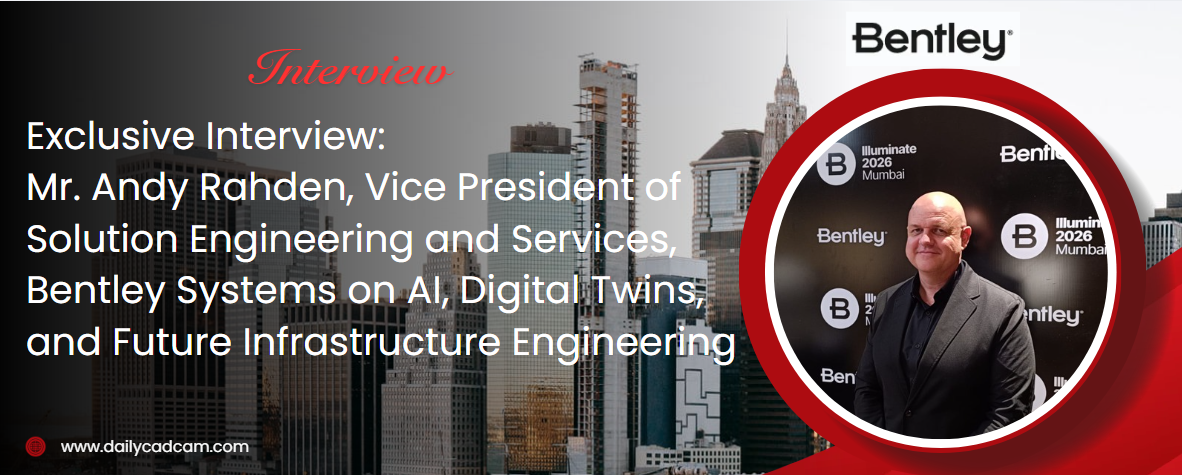
During Bentley Systems’ Illuminate Mumbai 2026, DailyCADCAM Editor Mr. Sachin Rajaram Nalawade sat down for an exclusive interview with Mr. Andy Rahden, Vice President of Solution Engineering and Services for Bentley. During their conversation, Rahden spoke about his professional journey, Bentley’s vision for infrastructure technology, AI-ready infrastructure, and digital twins. He also explored data optimization, Bentley Infrastructure Cloud, sustainability, and the future of infrastructure engineering.
Q. You have had an impressive career journey across the engineering software and technology industry, including leadership roles in CAD, engineering education, and digital transformation businesses. Could you share your professional journey and experience across organizations like SOLIDWORKS, Autodesk and now Bentley Systems, and explain your current role and responsibilities at Bentley Systems?
Andy Rahden: My journey began with a degree in mechanical engineering, which initially led me to the manufacturing side of the industry. My first professional role was with a water infrastructure design company under Baker Hughes. After that, I joined a SOLIDWORKS partner organization where I spent about five years. That experience served as my introduction to the 3D design and CAD revolution during the late 1990s and early 2000s.
I later joined Autodesk, where I spent nearly a decade in various key leadership positions. Drawing on those experiences, I went on to found an engineering education company dedicated to CAD and engineering software training for Autodesk, Bentley Systems, and several other platforms. We took that company public in 2018. Following a successful IPO and my subsequent exit in 2019, I served as CEO of another education technology company before eventually joining Bentley Systems about three years ago.
Today at Bentley Systems, I lead our Solution Engineering, Services, and Data Optimization teams. Our primary responsibility is to deeply understand the complex technical and business challenges facing infrastructure organizations and align Bentley’s advanced technologies to solve them. We help customers implement Bentley solutions effectively, optimize their engineering workflows, and prepare their organizations for future AI-driven infrastructure engineering.
Q. Today, artificial intelligence has become one of the most discussed technologies across industries. In manufacturing and mechanical engineering sectors, companies already have decades of structured CAD and PLM data that can be utilized for machine learning and AI applications. Infrastructure organizations, however, deal with extremely large, complex, and distributed project data environments. How can infrastructure companies prepare themselves for AI adoption, and what are the biggest challenges organizations face while becoming AI-ready?
There are many similarities between manufacturing and infrastructure industries. Manufacturing companies started experimenting with generative design and AI-driven engineering roughly 15 to 20 years ago. Today, the infrastructure sector is entering that exact same transformation phase.
The potential for AI in infrastructure engineering is huge, particularly in areas like structural analysis, bridge design optimization, automated drawing production, project planning, and design reuse. For example, AI can help generate multiple bridge design variations based on previous projects and structural criteria, helping engineers improve both efficiency and accuracy.
However, the biggest challenge today is data organization. If infrastructure companies cannot locate previous project files, structural analysis reports, drawings, or engineering references because their data is poorly managed, then AI becomes ineffective. I often compare this to walking into a messy closet. If everything is disorganized, you simply cannot find what you need.
Over the years, many organizations have become complacent about engineering data management. System administrators may have retired or moved on, while simultaneously, the volume and complexity of infrastructure project data have skyrocketed. Without a structured, unified, and clean data architecture, companies simply cannot harness the power of AI technologies.
That is exactly why Bentley Systems created dedicated Data Optimization teams. We help organizations clean, organize, structure, and optimize their engineering data environments so they can prepare for AI-driven workflows.
Q. There is a lot of discussion globally around AI, but many organizations are still trying to understand its real-world applications in infrastructure engineering. From Bentley Systems’ perspective, what are some of the practical and meaningful applications of AI that are already helping infrastructure companies improve productivity, efficiency, and project delivery?
At Bentley, we are not interested in talking about AI as an abstract concept. We are strategically focused on practical, deployable AI applications that solve real-world challenges facing engineers today.
We are already seeing practical AI use cases in structural analysis optimisation, automated drawing generation, intelligent design reuse, engineering search capabilities, and project planning workflows. For example, AI can analyse historical infrastructure data to help engineers create improved design variations for new projects.
Bentley’s federated search capabilities within ProjectWise are a prime example of this in action. Engineers can now search across massive infrastructure project files and retrieve meaningful engineering intelligence almost instantly. This capability is absolutely vital for organisations trying to reuse legacy project knowledge or effectively implement AI-driven workflows.
The biggest requirement for AI, however, is organized engineering data. If your data is disorganized, incomplete, or inaccessible, then AI systems cannot deliver meaningful results. That is exactly why Bentley is investing heavily in infrastructure-specific data optimisation and lifecycle intelligence.
You highlighted the importance of engineering data and mentioned ProjectWise as a key technology platform. Infrastructure projects involve multiple stakeholders, massive amounts of engineering information, and long project lifecycles. Could you explain how ProjectWise helps organizations manage infrastructure data more efficiently and why it is becoming critical for AI-ready infrastructure workflows?
ProjectWise plays a vital role because it is so much more than a file management platform. ProjectWise is a purpose-built, infrastructure-specific engineering data environment designed to manage complex infrastructure workflows, engineering files, collaboration, and lifecycle data.
Infrastructure projects, whether they are highway networks, bridges, railways, airports, or water utilities, involve massive amounts of information across multiple disciplines. ProjectWise allows organizations to manage all this information in a single, connected, and highly structured environment.
The platform supports multiple engineering file formats and enables deep search capabilities across an entire project portfolio. As organizations prepare for AI-driven engineering, ProjectWise becomes essential because AI systems require accessible, organized, and properly structured engineering information.
Bentley Systems also integrates ProjectWise with technologies such as iTwin, SYNCHRO, and AssetWise, allowing organizations to create connected infrastructure workflows from planning and design to construction, operations, and maintenance.
Q. Sustainable infrastructure development has become a major global priority today. Governments and infrastructure companies are increasingly focused on reducing carbon footprint, improving resource efficiency, and developing environmentally responsible infrastructure. How can AI and Bentley technologies help engineers and infrastructure companies create more sustainable infrastructure projects?
Sustainable infrastructure starts with better planning and a deeper understanding of both above-ground and subsurface conditions before construction begins. Bentley Systems significantly strengthened this capability by acquiring Seequent, which helps engineers better understand underground conditions before infrastructure development starts.
Many inefficiencies within infrastructure projects happen because construction begins before planning and design are fully completed. When teams work from incomplete designs, the inevitable result is costly rework, schedule delays, material waste, and a substantially larger carbon footprint.
By using infrastructure-specific Bentley technologies such as OpenRoads, OpenBridge, OpenBuildings, OpenRail, and MicroStation, engineers can create more detailed, accurate, and data-rich designs before construction starts. This proactive approach drastically improves operational efficiency and significantly reduces physical waste on the construction site.
AI can further support sustainability by analysing previous project performance, optimising material usage, improving structural efficiency, and helping organisations make smarter engineering decisions. But technology alone is not enough. Engineers must also adopt more disciplined and detailed approaches toward infrastructure planning and design.
Q. Digital twins are now becoming an important part of modern infrastructure projects, smart cities, transportation systems, airports, railways, and utilities. However, many people still do not fully understand what a digital twin truly means. Could you explain what digital twins are, how Bentley approaches digital twin technology, and how infrastructure organizations benefit from digital twin implementations?
A. A digital twin is a highly accurate digital representation of a physical infrastructure asset throughout its entire lifecycle. It seamlessly combines design information, construction data, operational intelligence, and real-world asset performance into a connected digital environment.
If you think about airports, bridges, rail systems, metro projects, highways, or water infrastructure, digital twins help engineers visualise and understand those assets during planning, construction, operations, and maintenance stages.
Bentley Systems has developed the iTwin platform specifically for infrastructure digital twins. iTwin empowers organizations to create highly detailed digital representations of infrastructure assets using engineering data, reality capture, drone scanning, asset analytics, and operational information.
Digital twins are not exclusively reserved for greenfield, new-build infrastructure projects. Existing assets can also be transformed into digital twins using technologies such as reality capture, drone scanning, and as-built modeling. This capability allows organizations to monitor asset conditions, improve maintenance planning, analyse operational performance, and support future infrastructure upgrades.
Q. Infrastructure projects today require not only efficient design and construction, but also long-term asset management, maintenance, and operational intelligence. Bentley Systems has been strongly promoting Bentley Infrastructure Cloud. Could you explain how Bentley Infrastructure Cloud integrates technologies such as ProjectWise, SYNCHRO, AssetWise, and iTwin to support the complete infrastructure lifecycle?
A. Bentley Infrastructure Cloud brings several Bentley technologies together, including ProjectWise, SYNCHRO, AssetWise, and iTwin, into a connected infrastructure lifecycle platform.
ProjectWise acts as the engineering data and collaboration backbone, and SYNCHRO provides 4D construction management and visualisation capabilities. AssetWise supports infrastructure operations and asset management, while iTwin powers visualisation, analytics, and digital twin experiences.
Together, these technologies help organisations manage the complete infrastructure asset lifecycle, from planning and design to construction, operations, maintenance, and modernisation.
The future of infrastructure engineering will depend heavily on connected digital environments where engineering data, AI capabilities, operational analytics, and digital twins work together seamlessly. Bentley Infrastructure Cloud is designed specifically to support that future.
Q, India is aggressively investing in highways, railways, metro systems, airports, smart cities, water infrastructure, and sustainable urban development as part of the “Viksit Bharat 2047” vision. What would be your message to engineering students, young professionals, and infrastructure organizations preparing for the future of digital infrastructure engineering?
A. My primary advice would be to invest time in learning infrastructure-specific engineering technologies. Generic CAD tools may help accomplish simple tasks, but infrastructure engineering requires specialized workflows and specialized technologies.
I strongly encourage engineering students and professionals to learn Bentley Systems’ technologies such as MicroStation, OpenRoads, OpenBridge, OpenBuildings, OpenRail, ProjectWise, iTwin, and Bentley Infrastructure Cloud.
To support this journey, Bentley Learn is an excellent platform that provides self-paced industry-standard training resources designed to build these high-demand skills. The future of global infrastructure engineering will undoubtedly revolve around AI, digital twins, data intelligence, and connected digital workflows. The organizations and professionals who prepare for that future today will be in the best position to lead the next generation of infrastructure development globally.
_______________________
The interaction with Mr. Andy Rahden provided valuable insights into how Bentley Systems is shaping the future of infrastructure engineering through AI-ready workflows, digital twins, infrastructure lifecycle management, and data-driven engineering practices. His deep understanding of engineering technologies, combined with his experience across CAD, digital transformation, and technical education industries, highlighted the growing importance of structured infrastructure data and infrastructure-specific solutions in the era of AI and digital infrastructure development. The discussion also reflected Bentley’s long-term commitment to enabling smarter, more sustainable, and digitally connected infrastructure projects worldwide.
DailyCADCAM sincerely thanks Mr. Andy Rahden, Vice President of Solution Engineering and Services at Bentley Systems, for taking time during Illuminate Mumbai 2026 to share his thoughts, experiences, and vision for the future of infrastructure engineering. We also thank the Bentley team for facilitating this insightful interaction and look forward to continuing discussions on emerging technologies transforming the global infrastructure industry.