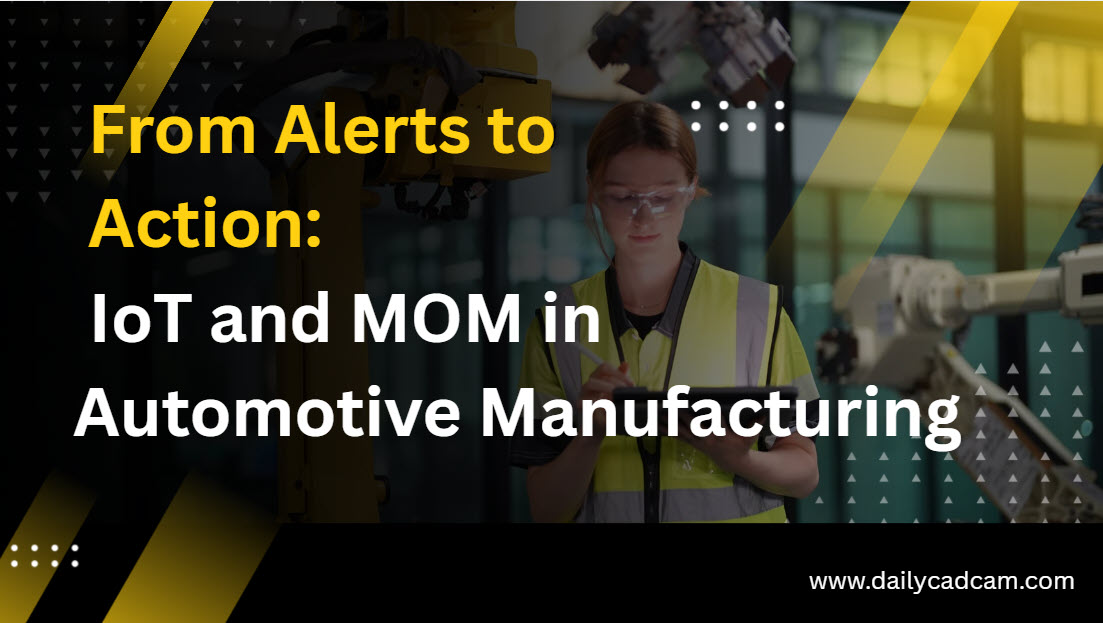
The automotive industry is undergoing a rapid digital transformation driven by electrification, mass customization, and increasing pressure for efficiency and quality. In this evolving landscape, the convergence of the Industrial Internet of Things (IoT) and Manufacturing Operations Management (MOM) is proving to be a game changer.
For manufacturing engineers, the real value lies not just in collecting data—but in acting on it.
Understanding the Foundations
IoT in Manufacturing connects machines, sensors, and devices to capture real-time shop floor data—machine health, cycle times, environmental conditions, and more.
MOM (Manufacturing Operations Management) manages and optimizes production operations, including MES, quality, scheduling, and performance tracking.
Individually powerful, together they enable a truly intelligent factory.
The Simplest Way to Understand It
IoT is the “Alert,” but MOM is the “Action.”
In many factories today, IoT systems are already in place. Machines are connected. Dashboards exist. Alerts are generated.
A light blinks. A screen turns red.
But then… nothing happens.
Someone needs to:
- Inform a supervisor
- Call a technician
- Diagnose the issue
- Search for documentation
This delay is exactly where productivity and profit are lost.
From Alerts to Action: The Real Transformation
When IoT is integrated with MOM, the response becomes automated and intelligent.
Instead of just highlighting a problem:
- The system identifies the issue
- Triggers a workflow
- Notifies the right team
- Provides actionable instructions
For example:
If a machine shows abnormal vibration, the system doesn’t just raise an alert—it automatically generates a maintenance task, assigns it to the technician, and provides recommended actions before a breakdown occurs.
It’s like upgrading from a smoke alarm that only beeps to a sprinkler system that actually puts out the fire.
Real-World Automotive Examples
BMW – Smart Factory with MOM Integration
BMW has implemented IoT-enabled production systems combined with MOM platforms to create highly connected factories. Sensors across assembly lines monitor equipment and process conditions in real time, while MOM systems orchestrate production workflows, quality checks, and maintenance actions.
Impact:
- Faster response to production deviations
- Improved quality consistency
- Reduced downtime through predictive maintenance
Tesla – Data-Driven Manufacturing
Tesla’s manufacturing strategy relies heavily on connected machines and real-time analytics. IoT data is continuously analyzed and fed into operational systems to optimize production and detect issues early.
While Tesla uses proprietary systems, the principle mirrors IoT + MOM integration:
- Real-time alerts trigger immediate corrective actions
- Continuous optimization of production processes
- Rapid scaling of manufacturing operations
Siemens Opcenter (MOM Platform)
Siemens Opcenter is a leading MOM solution widely used in automotive manufacturing.
When integrated with IoT platforms (like MindSphere or shop floor sensors), Opcenter enables:
- Real-time production visibility
- Automated quality checks and traceability
- Predictive maintenance workflows
- Closed-loop manufacturing execution
Example Use Case:
A machine deviation detected via IoT automatically triggers a workflow in Opcenter, assigns a corrective task, and logs the issue for traceability—ensuring compliance and faster resolution.
Visit for more details on Opcenter – https://www.siemens.com/en-us/products/opcenter
Dassault Systèmes DELMIA Apriso
DELMIA Apriso is another powerful MOM platform used by global automotive OEMs and suppliers.
With IoT integration, DELMIA Apriso enables:
- Global production visibility across plants
- Real-time synchronization between shop floor and enterprise systems
- Automated responses to machine and process events
Automotive Impact:
- Standardized operations across multiple plants
- Faster issue resolution through automated workflows
- Improved compliance and traceability
Why This Matters for Automotive Manufacturing
In automotive production, where downtime, defects, and delays directly impact cost and delivery timelines, this integration delivers:
- ✔️ Reduced unplanned downtime
- ✔️ Faster issue resolution
- ✔️ Improved product quality
- ✔️ Higher production efficiency
- ✔️ Better asset utilization
The Digital Spine Approach
The real goal is not just digitization—it’s connected execution.
The Going Digital® Bottom Line:
Don’t just invest in IoT to “see” more problems. Use a Digital Spine to fix them faster.
If your data:
- Doesn’t trigger action
- Doesn’t automate workflows
- Doesn’t improve response time
Then it’s not delivering value—it’s just an expensive visibility tool.
IoT and MOM are not just complementary—they are interdependent.
IoT tells you what is happening.
MOM ensures something is done about it.
For automotive manufacturers, this combination is the key to moving from reactive operations to proactive, intelligent manufacturing.
Because in the end, data without action is just noise—and action driven by data is where real value begins.
Thank you,