The Architecture, Engineering, and Construction (AEC) industry is undergoing a major transformation driven by digitalization, artificial intelligence, BIM, cloud collaboration, sustainability, and data-driven project delivery. As India accelerates its infrastructure growth under the vision of Viksit Bharat, technology platforms are playing an increasingly critical role in enabling smarter, faster, and more sustainable development.
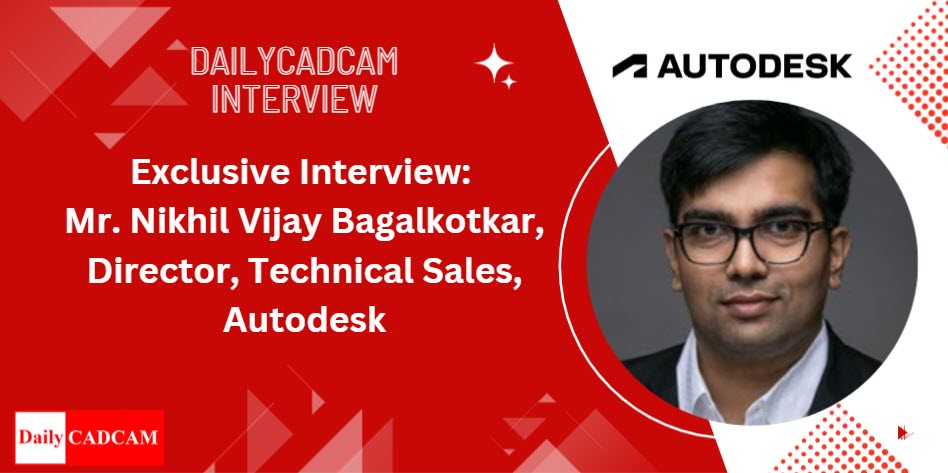
In this exclusive interview with DailyCADCAM, Mr. Nikhil Vijay Bagalkotkar, Director – Technical Sales, Autodesk, shares insights into Autodesk’s vision for the future of the AEC industry across India and the SAARC region. He discusses the growing adoption of BIM, digital twins, AI-driven workflows, cloud-based collaboration, infrastructure modernization, water management solutions, Autodesk Forma, Revit, academic partnerships, and the company’s continued focus on empowering both large enterprises and smaller consultancies through digital innovation.
DailyCADCAM: With Autodesk’s vision that a better world can be both designed and made, what role do you see technology, sustainability, and innovation playing in shaping this future? What does ‘designing a better world’ mean to you?
Mr. Nikhil: Across architecture, engineering, construction, and manufacturing, we’re seeing a decisive convergence of technology, sustainability, and innovation. AI, generative design, and real-time simulation is no longer just about efficiency; it’s enabling designers to test thousands of low-carbon, low-waste options before the first prototype is built. Sustainability targets are reshaping business models, pushing firms to think in terms of circular economies and regenerative systems. Innovation, therefore, isn’t a single breakthrough but an ecosystem shift: data-rich workflows, connected supply chains, and digital twins that let us measure and reduce environmental impact continuously. These forces together are redefining what “good design” means, moving from form and function to long-term resilience and social responsibility.
At Autodesk, we translate this convergence into practical tools and partnerships. Our cloud-based platforms break down silos so architects and engineers can collaborate on a shared digital model, reducing rework and material waste. Generative design and AI help customers explore lighter, stronger, and more sustainable alternatives in minutes. We’re embedding lifecycle analysis directly into our software so that energy use, carbon impact, and material efficiency are visible from day one of a project. In India and globally, we’re investing in training and certification programs to build the skills that make these innovations real—whether that’s a construction firm adopting digital twins for predictive maintenance or a start-up designing products for circular reuse. For us, ‘designing a better world’ is about empowering every creator to make sustainability a default outcome, not an afterthought.
As the Director for AEC in India and SAARC, what is your vision for driving digital transformation in the AEC industry across this region?
I see digital transformation as the next big leap for the AEC industry in India and the wider SAARC region, and integration and collaboration are at the heart of it. Safety, sustainability, cost, and timelines can often seem to compete with one another, but the right digital platforms show they can work together. Using Building Information Modeling (BIM) and Autodesk Construction Cloud, we can bring every participant—designers, engineers, contractors, and owners—onto a single connected workflow that runs through the entire project lifecycle. This shared approach leads to faster decisions, fewer surprises, and better outcomes.
The key is removing the traditional barriers between stakeholders. When government bodies, contractors, consultants, and regulators work on a common digital platform, projects become more efficient and transparent. We’ve already seen this in action with the Delhi Metro, where integrated BIM workflows helped speed up construction and cut down on rework. My goal is to make this level of digital collaboration the norm, so that building resilient, sustainable infrastructure becomes simpler and more predictable across the region.
How is Autodesk contributing to India’s vision on Viksit Bharat through its technologies and solutions?
Autodesk is committed to being both a technology partner and an enabler for the Viksit Bharat vision, which calls for transforming India into a self-reliant, digitally empowered nation by 2047. Our solutions extend beyond global best practices to address India-specific needs, including localized BIM toolkits. The BIM Package for Viksit Bharat, which includes features such as the Revit India Country Kit and Civil 3D India Country Kit, enables professionals to comply with local regulations, codes, and workflows without sacrificing speed or quality.
Furthermore, our regional cloud data storage initiative offers robust security and compliance for government and infrastructure projects, allowing teams to collaborate efficiently and transparently. Public sector projects, including national highways, railways, and healthcare campuses, have used Autodesk’s robust tools to compress timelines, ensure cross-discipline coordination, and deliver sustainable outcomes. Our ongoing collaboration with leading academic and government institutes ensures that digital upskilling and workforce readiness are integral to this transformation, guaranteeing a future-ready talent pool for India’s next phase of growth.
What is the current level of digitalization across infrastructure projects in India, and which sectors show higher digital maturity?
Digitalization in India’s infrastructure sector has moved rapidly from being a future aspiration to a present-day imperative. Sectors such as transportation infrastructure including metros, airports, expressways and urban redevelopment projects are leading in digital adoption. These industries have increasingly embraced BIM and cloud-based workflows as standard practice, recognizing the tangible benefits in project delivery and risk reduction.
In these more advanced sectors, digital blueprints and digital twins are now common. They go beyond visualization to provide deep data integration for real-time scenario analysis, cost tracking, safety compliance, and sustainability reporting. For instance, transportation megaprojects such as the Delhi Metro Rail Corporation have adopted Autodesk Construction Cloud to centralize information across the lifecycle, thereby minimizing errors, reducing costly rework, and enabling remote stakeholder engagement. Similarly, the municipal and water management sectors are rapidly catching up, integrating digital design, simulation, and asset management for more resilient outcomes.
Autodesk is known for its strong presence among large consultants. How is Autodesk supporting smaller consultants, Architects and users in India?
Digital transformation is steadily leveling the playing field for small and medium enterprises, boutique consultants, and even independent creators in India’s AEC sector. Increasingly, these smaller players are winning significant projects, thanks to affordable cloud-based design tools, accessible upskilling channels, and community-driven learning. Industry data from the Autodesk State of Design & Make (SDM) report indicates that more than half of digitally mature firms in India credit technology adoption for accelerating project delivery, enhancing customer satisfaction, and driving new business growth. However, skill shortages and resource constraints remain key barriers for many small organizations, making support and enablement from technology partners crucial.
Autodesk actively democratizes access by making its technology, support, and educational content available to all segments, not just industry giants. Free educational licenses and deeply localized learning programs including partnerships with NSDC, IIT Bombay, VIT, and Anna University ensure that tomorrow’s project leaders and practitioners gain hands-on experience before entering the workforce. In addition, Autodesk’s robust portfolio of cloud solutions, such as Fusion 360 and Construction Cloud, offer SMEs the same real-time collaboration, digital twin, and automation capabilities as large enterprises but in a pay-as-you-go and scalable manner.
A strong example is Pinnacle Infotech, which began as a small consultancy and leveraged Autodesk technology and continuous upskilling to become a global leader in BIM solutions. Through such collaborations, hundreds of smaller consultancies and regional architects are now delivering international-standard work, winning large-scale projects, and growing their business footprint in a competitive market.
How does the AEC market in India compare to other SAARC countries in terms of technology adoption and maturity?
The construction and engineering industry across Asia Pacific is undergoing a rapid digital transformation, with India emerging as a clear leader in this journey. According to the 2025 State of Digital Adoption in the Construction Industry report, Indian businesses are deploying an average of 8.6 digital technologies- a figure notably higher than other markets in the region and allocating 35% of their total expenditure to new technology investments. This demonstrates a strong commitment to leveraging digital tools to enhance efficiency, competitiveness, and revenue growth.
Key technologies such as Building Information Modelling (BIM), AI and Machine Learning, and geospatial technologies are driving significant improvements in project delivery and operational performance. For example, leading firms like Larsen & Toubro have harnessed drone and satellite-based data collection powered by AI to improve surveying precision and project site insights, providing a competitive advantage and enhancing decision-making processes.
Despite this rapid adoption, challenges remain—most notably, the digital skills gap, particularly in AI and ML, which 36% of Indian businesses identify as a critical hurdle. Recognizing this, over 80% of Indian firms are actively upskilling their workforce and forming partnerships with educational institutions to close these gaps. This strategic focus on skills development is vital to sustaining momentum and unlocking the full value of digital investments.
How are emerging technologies such as AI, BIM, and cloud-based collaboration transforming project delivery in the AEC industry? Additionally, Revit continues to lead the way in BIM—could you share what sets Revit apart from other BIM solutions and why it remains the top choice for professionals?
Emerging technologies like AI, BIM, and cloud-based collaboration are redefining how projects are delivered across the AEC industry. Artificial intelligence accelerates repetitive design tasks, provides predictive insights, and supports advanced simulation, helping teams optimize cost, safety, and sustainability right from the planning stage. Building Information Modeling (BIM) acts as the single source of truth, centralizing project data so updates are real time, traceable, and accessible to every stakeholder. When combined with cloud-based platforms, this integration enables seamless collaboration, reduces errors, and shortens delivery timelines.
Revit continues to lead in BIM because of its unmatched interoperability and strong localization. Features such as the India Country Kit allow professionals to meet local codes and workflows while maintaining global standards. Its seamless integration with other Autodesk products and third-party tools makes multi-disciplinary coordination straightforward. For example, Tata Consulting Engineers used Revit to generate concurrent documentation across multiple disciplines, cutting the design documentation cycle from a month to just five days. Additionally, Revit’s advanced BIM workflows enabled precise rebar modeling, enhanced safety coordination, and significant time savings across complex project teams at terminal 2 of Bengaluru Airport. These capabilities keep Revit the preferred platform for professionals who need both global best practices and local flexibility.
Can you give some real-world examples where Autodesk’s digital technologies helped overcome infrastructure challenges?
Autodesk’s digital technologies are helping infrastructure projects overcome complex challenges around scale, coordination, and sustainability.
In India, the Delhi Metro Rail Corporation’s Phase IV expansion used Autodesk BIM 360 to align design, engineering, and construction teams. This integration reduced rework, streamlined scheduling, and accelerated project delivery. The Pinnacle Infotech IGBC Platinum–certified campus in Madurai applied digital twin technology and sustainable design practices to conserve resources and optimize site utilization. Large medical campuses across the country are also using unified cloud-based environments to coordinate multiple disciplines, ensuring faster handovers, greater transparency, and stronger compliance with national standards.
Globally, Autodesk supported the restoration of the Notre Dame Cathedral in Paris, where our digital reconstruction tools enabled precise, data-driven planning that both safeguarded the heritage structure and expedited the rebuilding timeline. These examples demonstrate how Autodesk’s platform connects people, data, and processes to deliver projects that are faster, more resilient, and more sustainable.
Digital twins and artificial intelligence are emerging as transformative technologies in the infrastructure sector. As a systems and software specialist, how does Autodesk envision their role in the future, and what solutions does Autodesk currently offer to support Digital Twin initiatives?
Digital twins are rapidly changing how infrastructure is designed, built, and operated. By creating a living digital replica of a physical asset, one that updates continuously with data from design, construction, and operations, they turn static plans into dynamic systems. This means owners and operators can simulate different scenarios, predict maintenance needs, and actively manage performance across the asset’s entire lifecycle. As cities grow and infrastructure ages, digital twins will be critical for improving resilience, cutting costs, and meeting sustainability goals.
Autodesk is investing heavily to make this vision practical. Our Tandem platform is designed specifically for creating and managing digital twins of buildings. It enables teams to capture, structure, and federate data in a centralized format, which is vital for seamless operational handovers and ongoing facility optimization. In water and horizontal infrastructure, Innovyze Info360 extends digital twin capabilities further, integrating live data from sensors, climate sources, and IoT devices for smarter operational decision-making.
These platforms enable predictive maintenance, support advanced analytics, and provide actionable insights to reduce downtime, lower costs, and achieve sustainability commitments. This continuous data integration and intelligence ensure that each asset remains valuable and resilient long after handover.
In the context of water infrastructure—such as stormwater and wastewater systems, water supply, and drainage—how are Autodesk solutions supporting the sector? Could you share any examples that highlight this impact?
Autodesk offers a comprehensive suite of tools to meet the complex demands of water infrastructure covering stormwater, wastewater, water supply, and drainage systems. Our solutions combine BIM with advanced hydrological modeling to simulate rainfall impacts, predict flood risks, design efficient drainage networks, and ensure regulatory compliance. Real-time monitoring and optimization features help agencies and engineers plan, build, and manage systems that are both resilient and sustainable.
A strong example is in urban flood management, where firms such as Climate Adaptive Systems have used Autodesk software to rapidly model multiple scenarios. This approach improves planning accuracy, speeds up decision-making, and reduces the cost and time of design iterations. By localizing our toolkits and knowledge resources, we make these technologies practical and accessible for India’s evolving water infrastructure needs
Autodesk Forma is gaining attention as a next-generation platform for the AEC sector. Could you explain how Forma is being used in the industry today, and what kind of response you are seeing from professionals and organizations adopting it?
Autodesk Forma is emerging as a powerful platform for early-stage planning and design in the AEC sector. Today, firms are using it to conduct rapid site analysis, evaluate multiple massing and layout options, and assess environmental factors such as daylight, wind, and energy performance—before a single line is drawn in detailed design. Its AI-driven simulations and cloud-based collaboration let teams test scenarios in real time and engage stakeholders with data-backed visuals, helping them make informed choices earlier in the project lifecycle.
The industry response has been strong. Both large infrastructure players and agile design studios in India are adopting Forma to shorten feasibility studies, secure faster regulatory approvals, and cut down on late-stage design changes. Because it connects seamlessly with Revit, teams can move from concept to detailed design without losing data or intent, which reduces errors and saves time. Professionals tell us that Forma not only improves efficiency but also gives them a competitive edge when bidding for complex urban and commercial projects where speed, sustainability, and precision are critical
What partnerships does Autodesk AEC Solutions have with academic institutions to support engineering education and skill development?
Autodesk is deeply committed to advancing engineering education and building a future-ready workforce. We collaborate with leading institutions—including IIT Bombay, IIT Palakkad, VIT, and Anna University—to provide free access to Autodesk software, hands-on labs, and curriculum integration. These partnerships have resulted in Centers of Excellence, regional training bootcamps, and the creation of more than 400 hours of Hindi-language content for the government’s iGOT Karmayogi platform.
Through alliances with the National Skill Development Corporation (NSDC) and Novatr, we have already upskilled over 40,000 learners with industry-recognized certifications in AEC and digital design. Together, these initiatives ensure that engineering graduates enter the workforce equipped with the tools, practical experience, and digital mindset needed to drive immediate and impactful adoption of modern AEC technologies, supporting India’s infrastructure and development goals.
Could you share more about your career journey—what inspired your transition from the hardware/electronics sector into a leadership role in the AEC industry, and how has that experience shaped your approach to driving innovation? As a leader, what do you find most rewarding about working with AEC professionals in India and the SAARC region?
I began with a computer science foundation and then built a business lens through my MBA. My early roles at IBM and EMC gave me exposure to enterprise infrastructure, storage, large-account management, and customer transformation. At Citrix, that evolved into cloud, virtualization, workspace transformation, and solution-led selling. That phase taught me that technology creates value only when it is tied to business outcomes and when customers are willing to rethink how they work.
Moving into AEC with Autodesk was a natural next step because the impact is much larger and more visible. AEC shapes how cities, infrastructure, buildings, and communities are created. In India and the SAARC region, the scale of development makes technology adoption especially important. We do not just need to build more; we need to build better, faster, more sustainably, and with greater predictability.
My approach to innovation is to look beyond tools. For me, innovation is about changing workflows, decision-making, and business outcomes. Whether it is BIM, cloud collaboration, automation, digital twins, or AI, the real question is: how does this help an architect, engineer, contractor, or owner make better decisions and deliver better projects?
What I find most rewarding is working with AEC professionals who are solving real-world problems every day. These are people building the infrastructure that societies depend on. Helping them challenge the status quo and lead with technology is what makes this journey meaningful.
Looking ahead, where do you see the AEC industry in India and the SAARC region over the next decade, and how do you envision your organization contributing to this growth? Also, what advice would you share with young professionals who are beginning their careers in the AEC field?
Over the next decade, the AEC industry in India and the broader SAARC region will be defined by rapid urbanization, massive infrastructure investment, and an accelerating shift to digital-first delivery. We will see greater adoption of advanced construction technologies—AI-driven design, industrialized construction, digital twins, and data-centric operations—making projects faster, more sustainable, and more resilient. Green infrastructure, high-speed transport networks, and climate-ready urban development will move from pilot projects to mainstream practice as both public and private sectors demand higher productivity and lower carbon footprints.
Autodesk intends to be a key enabler of this growth. We are expanding our cloud platforms, strengthening local data services, and investing in AI, automation, and next-generation BIM to help governments, developers, and engineering firms deliver complex projects with greater speed and transparency. At the same time, we remain committed to upskilling talent through partnerships with universities, skill councils, and industry bodies so the workforce can fully leverage these digital tools.
For young professionals entering the AEC field, my advice is simple: embrace continuous learning and digital fluency. Mastering collaborative platforms, data analytics, and sustainable design will not only keep you relevant but place you at the center of the industry’s transformation. The next decade offers an unparalleled opportunity to shape the built environment of a rapidly developing region—those who combine creativity with technological expertise will be the leaders of that future.
DailyCADCAM thanks Mr. Nikhil Vijay Bagalkotkar, Director – Technical Sales, Autodesk, for sharing his valuable insights on the future of the AEC industry, digital transformation, BIM, AI, cloud collaboration, and sustainable infrastructure development. We appreciate his time and perspectives on how technology is reshaping the design, engineering, and construction landscape across India and the SAARC region.
We also thank Autodesk for its continued contribution toward advancing digital innovation, industry-academia collaboration, and future-ready engineering practices that are helping shape the next generation of infrastructure development.