Guest Post by: Theophilus Dsouza, (BEACON India) Best Engineering Aids and Consultancies Pvt. Ltd.
Superelasticity is a unique mechanical behaviour exhibited by certain advanced engineering materials such as Shape Memory Alloys (SMAs), High Entropy Alloys (HEAs), and some Amorphous alloys. It enables a material to undergo exceptionally large, fully recoverable elastic deformations when subjected to external loading.
Conventional metallic materials such as structural steel, brass, aluminium alloys etc typically exhibit relatively small elastic strains, generally ranging from 0 to 0.8%. In these materials, elastic deformation occurs through the stretching of atomic bonds under an applied load, as illustrated in Figure 1. Once the load is removed, the atomic bonds return to their original configuration, allowing the material to recover its initial shape.
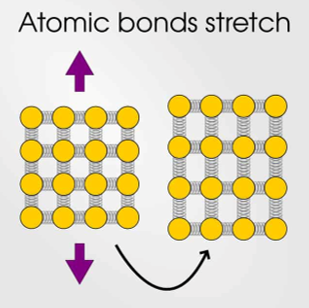
| Figure 1: Elastic Deformation in Regular Metallic Alloys |
Shape Memory Alloys possess a fundamentally different mechanism of elastic deformation. Unlike conventional metals, they can sustain elastic strains of approximately 8–10%, making them nearly an order of magnitude more deformable while still returning to their original shape after unloading.
This remarkable behaviour is achieved through a stress-induced phase transformation rather than simple atomic bond stretching. During loading, the crystal lattice undergoes a coordinated rearrangement or lattice reorientation (also called Crystal Shifting), resulting in a transformation from the Austenite phase to the Martensite phase as shown in Figure 2.
Although several Mechanisms can produce Superelasticity in different class of materials, this article focuses specifically on the crystal structure transformation responsible for Superelasticity in Shape Memory Alloys.
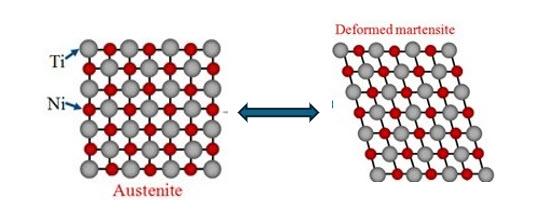
| Figure 2 : Phase Transformation during Elastic Deformation |
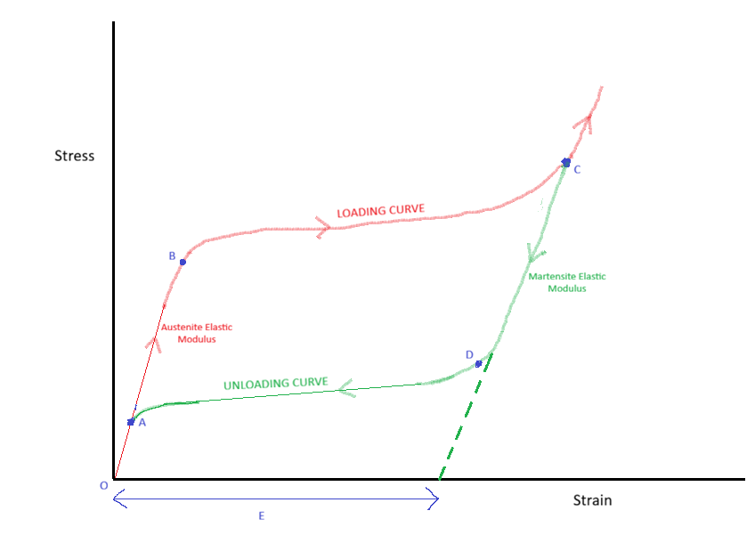
Now let’s have a look at the Stress vs Strain curve of typical Shape Memory Alloy in the Elastic Regime as shown in Figure 3. Shape Memory Alloys like Nitinol show this behaviour, wherein in its unloaded state it has an Austenite Crystal Structure. Upon Loading it undergoes a stress induced Phase Transformation from Austenite to Martensite along O→A→B→C (red curve) as seen in figure 3. below.
| Figure 3: Stress vs Strain curve depicting Superelasticity in Shape Memory Alloys |
The green curve represents the unloading path, which is followed on release of the Load, along C→D→A wherein the material transforms back to Austenite, from Martensite. One of the most remarkable features of this behaviour is that the strains accumulated during the phase transformation are almost entirely recoverable (Elastic). The transformation plateau allows the material to undergo very large strains with only a small increase in stress.
The points in the stress-strain curve represent the following:
B: Start of Transformation from Austenite to Martensite during Loading
C: End of Transformation from Austenite to Martensite during Loading
D: Start of Transformation from Martensite to Austenite during unloading
A: End of Transformation from Martensite to Austenite during unloading
E: Transformation Strain
The Martensitic Phase structure will undergo plastic deformation upon loading further. It is important to note that the stress values at which this transformation takes place depend on the reference temperature at which the Test is conducted, hence the values are temperature sensitive.
How is this Superelastic Material Behaviour modelled in Abaqus?
Abaqus uses a material model based on the work of Auricchio and Taylor to simulate Superelasticity. The Super Elasticity option can be found under the Mechanical tab of the Edit Material window. The data table as seen in Figure 4. needs to be filled with the True Stress values, according to the data points obtained from the stress vs strain curve explained in Figure 3.
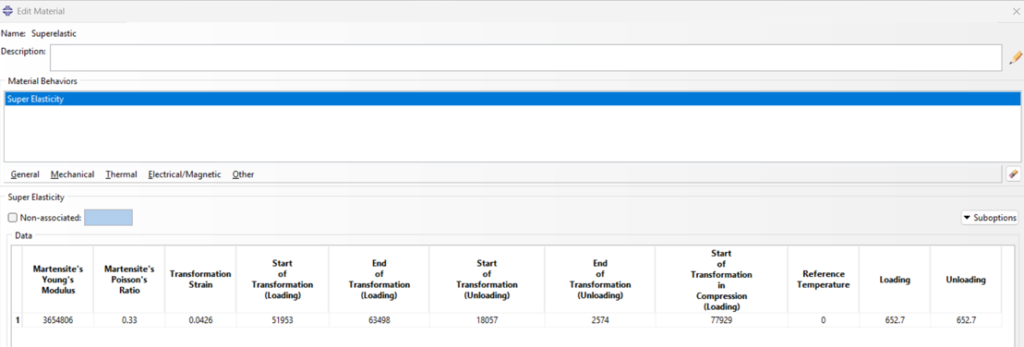
| Figure 4: Super Elasticity Material Model in Abaqus CAE |
The Slope along C→D Straight line represents the Elastic Modulus of the Martensite phase. The slope along O→A→B straight line represents the Elastic Modulus of the Austenite Phase. The Elastic Modulus and Poisson Ratio of the Austenite phase needs to be defined using Linear Elasticity itself as seen in Figure 5.
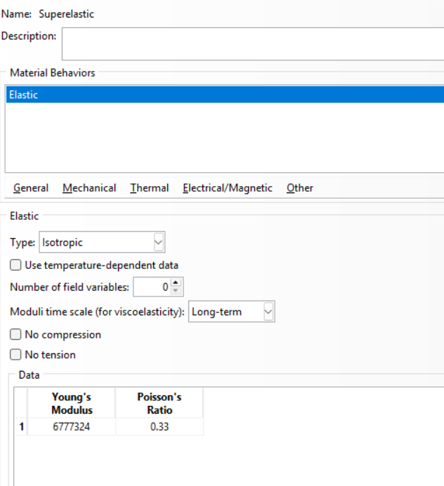
| Figure 5: Elastic Modulus and Poisson Ratio of the Austenite Phase |
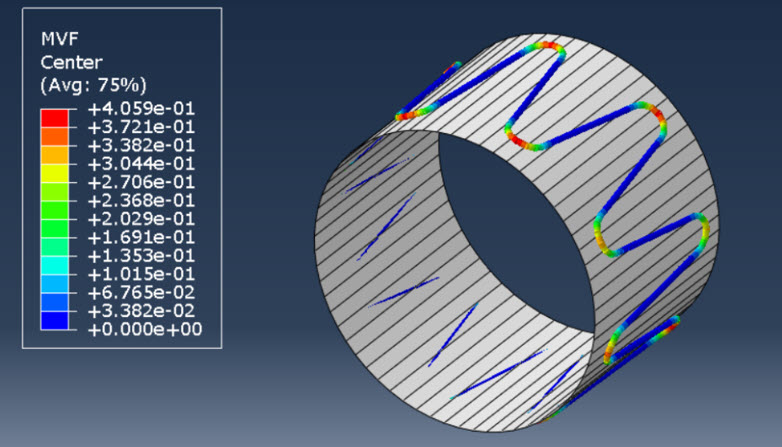
We can even plot contours of the fraction of Martensite i.e. Martensite Volume Fraction (MVF) to check for transformation as seen in Figure 6. which consists of a Nitinol cardiovascular stent in an expanded state, during its manufacturing process. This variable is requested from the Field Output Requests under Volume Fraction option and is available only when the Superelasticity Material Model is used.
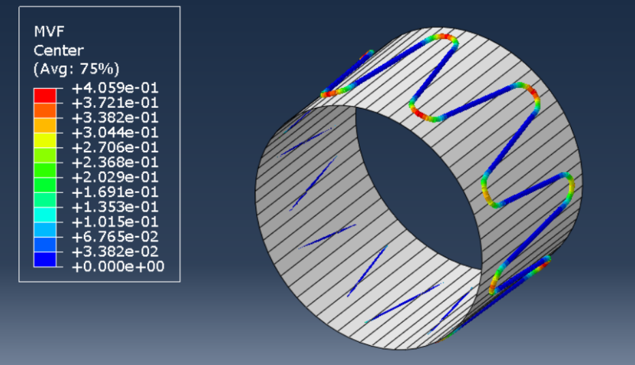
| Figure 6: Martensite Volume Fraction Contour Plot |
Engineering Applications
The exceptional recoverable strain and fatigue resistance exhibited by Superelastic Shape Memory Alloys have enabled their adoption across a wide range of engineering and medical applications.
In the biomedical industry, Superelasticity is extensively utilized in the manufacture of cardiovascular stents, orthodontic archwires, bone staples, guidewires, and minimally invasive surgical instruments. The ability of these materials to undergo large deformations and recover their original shape allows medical devices to be compressed during insertion and subsequently expand or return to their functional configuration inside the human body.
In the aerospace industry, Shape Memory Alloys are increasingly being incorporated into morphing wing technologies, where they are used in flexible wing skins, adaptive control surfaces, and deployable structures.
Within the electronics and telecommunications industry, Superelastic materials are employed in flexible antennas, communication hardware, connectors, and other components that must withstand repeated mechanical loading
In the consumer goods industry, Shape Memory Alloys are commonly used in the manufacture of eyewear frames, where their superior flexibility and shape recovery provide enhanced durability and resistance to accidental bending.
————————————————————————————————————-
Guest Post by: Theophilus Dsouza, (BEACON India) Best Engineering Aids and Consultancies Pvt. Ltd.
————————————————————————————————————–