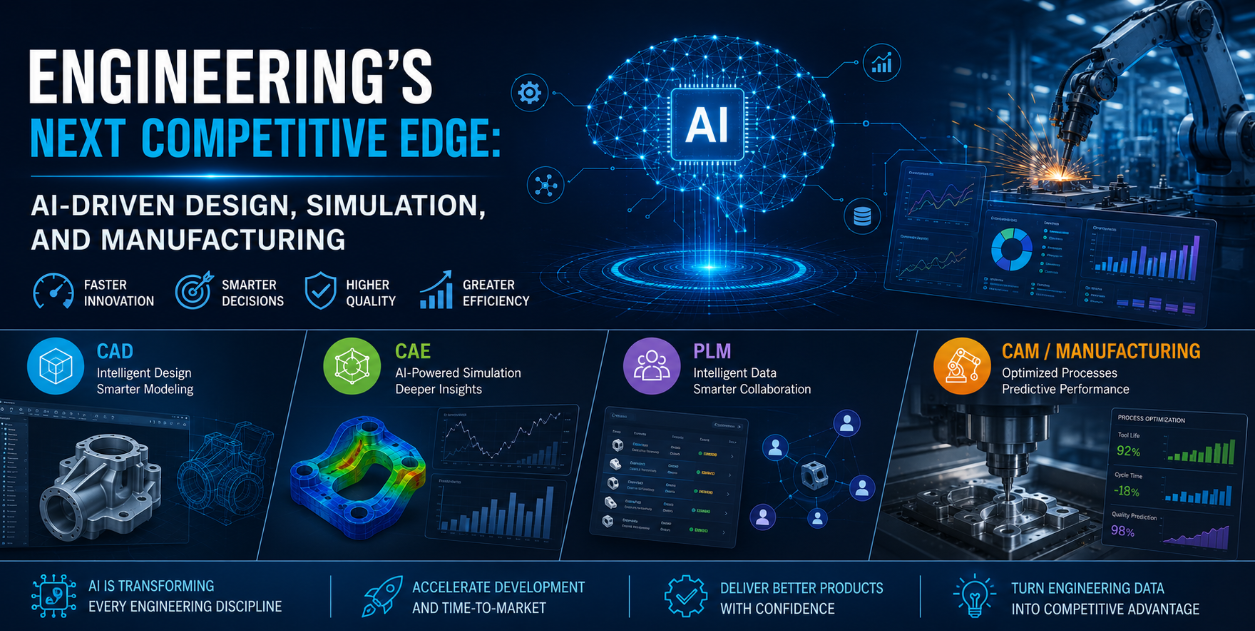
Artificial Intelligence (AI) has rapidly evolved from a futuristic concept into a practical engineering tool. Today, AI is transforming how products are designed, simulated, manufactured, and managed throughout their lifecycle. Leading CAD, CAE, PLM, CAM, and Manufacturing software vendors—including Autodesk, Dassault Systèmes, Siemens, PTC, Hexagon, Bentley Systems, Sandvik, and Synopsys —are integrating AI into their platforms to automate repetitive tasks, improve design quality, and accelerate engineering workflows.
Yet many engineering organizations continue to view AI as an emerging technology rather than an immediate business necessity. Their hesitation is understandable—concerns around cost, data security, workforce readiness, and process disruption are common. However, delaying AI adoption carries a hidden cost that is often overlooked: technical debt.
In software development, technical debt refers to the future costs incurred by postponing improvements today. The same principle now applies to engineering organizations. Every year a company delays AI adoption, it increases the gap between its engineering capabilities and those of competitors embracing intelligent design and manufacturing.
Understanding Technical Debt in Engineering
Traditionally, technical debt referred to outdated software, inefficient code, or aging IT infrastructure. Today, engineering technical debt extends much further.
It includes:
- Manual engineering processes
- Legacy CAD workflows
- Siloed PLM data
- Repetitive documentation
- Inefficient design reviews
- Non-automated simulation workflows
- Knowledge trapped within experienced engineers
When AI can automate or optimize these processes but organizations continue relying solely on manual methods, they accumulate operational inefficiencies that become increasingly difficult to overcome.
AI Is Already Embedded in Engineering Software
One common misconception is that adopting AI requires investing in entirely new software platforms. In reality, many engineering applications already include AI-powered capabilities.
Modern CAD and engineering software now offers features such as:
- Intelligent sketch recognition
- Automated feature creation
- Design recommendations
- Generative design
- Automated drawing generation
- AI-assisted simulation setup
- Predictive maintenance analytics
- Natural language search within PLM
- Automated BOM validation
- Intelligent document classification
The challenge is no longer whether AI is available—it is whether organizations are leveraging these capabilities effectively.
Manual Engineering Workflows Are Becoming a Competitive Disadvantage
Engineering teams spend a significant portion of their time on repetitive, low-value tasks.
Examples include:
- Renaming files
- Organizing assemblies
- Creating standard drawings
- Updating revisions
- Searching for existing models
- Generating reports
- Validating CAD standards
- Preparing simulation inputs
AI can significantly reduce the time spent on these activities, allowing engineers to focus on innovation, optimization, and problem-solving.
Companies that continue relying entirely on manual workflows risk slower product development cycles and increased engineering costs.
CAD Design Is Becoming Smarter
AI is reshaping the role of CAD software from a digital drafting tool to an intelligent design assistant.
Emerging capabilities include:
Intelligent Feature Recognition
AI can recognize design intent from imported geometry and simplify model editing.
Automated Design Suggestions
Modern systems recommend geometry improvements based on engineering best practices.
Generative Design
Instead of manually designing multiple concepts, engineers define constraints while AI generates optimized alternatives based on weight, strength, manufacturability, and cost.
Automated Drawings
AI increasingly assists with creating manufacturing drawings, annotations, dimensions, and documentation.
Rather than replacing engineers, these tools enable them to evaluate more design options in less time.
CAE Is Entering the Era of Intelligent Simulation
Simulation has traditionally required significant expertise and computational resources.
AI is helping simplify CAE through:
- Automatic mesh optimization
- Smart solver selection
- Material recommendations
- Failure prediction
- Simulation result interpretation
- Design optimization
Instead of running hundreds of iterations manually, engineers can focus on evaluating the most promising solutions identified by AI-assisted workflows.
PLM Is Becoming a Knowledge Platform
Many organizations possess decades of engineering knowledge stored inside PLM systems.
Unfortunately, much of this information remains difficult to access.
AI-powered PLM systems can:
- Search engineering documents using natural language
- Recommend similar past projects
- Identify reusable components
- Detect duplicate parts
- Predict project risks
- Improve change management
Rather than acting solely as document repositories, modern PLM platforms are evolving into intelligent engineering knowledge systems.
Manufacturing Is Becoming Predictive
AI extends well beyond design.
Manufacturing organizations increasingly use AI for:
- Machine monitoring
- Predictive maintenance
- CNC optimization
- Tool wear prediction
- Quality inspection
- Visual defect detection
- Production scheduling
- Supply chain forecasting
Companies delaying adoption risk falling behind competitors that achieve higher productivity, improved quality, and lower operational costs.
The Skills Gap Is Growing
One overlooked consequence of delaying AI adoption is workforce readiness.
Young engineers graduating today are increasingly exposed to AI-assisted design tools during their education. They expect intelligent software, automation, and digital collaboration as part of their daily workflow.
Organizations relying solely on legacy engineering processes may find it harder to attract and retain top talent.
At the same time, experienced engineers nearing retirement often possess valuable design knowledge that remains undocumented. AI-powered knowledge management can help capture and preserve this expertise before it is lost.
AI Is Enhancing Engineering Collaboration
Engineering projects today involve globally distributed teams working across multiple disciplines.
AI is improving collaboration by:
- Automatically classifying engineering documents
- Translating technical documentation
- Summarizing design reviews
- Detecting workflow bottlenecks
- Recommending reviewers
- Identifying conflicting design changes
This leads to faster decisions and fewer communication errors across complex engineering projects.
Cybersecurity and Governance Still Matter
While AI adoption offers significant advantages, engineering organizations must proceed responsibly.
Key considerations include:
- Protecting intellectual property
- Securing proprietary CAD models
- Governing AI-generated content
- Validating engineering outputs
- Ensuring regulatory compliance
- Training employees on responsible AI usage
AI should augment engineering expertise—not replace engineering judgment.
Where Should Companies Begin?
Organizations do not need a complete digital transformation overnight.
A practical roadmap includes:
- Identify repetitive engineering tasks
- Explore AI capabilities already available in existing software
- Launch small pilot projects
- Train engineering teams
- Measure productivity improvements
- Expand successful implementations gradually
Incremental adoption often delivers measurable returns while minimizing disruption.
Looking Ahead
Over the next five years, AI will become deeply integrated into every stage of product development—from concept generation and simulation to manufacturing, quality assurance, and lifecycle management.
Engineering firms that proactively embrace these capabilities will be better positioned to:
- Accelerate product development
- Improve design quality
- Reduce engineering costs
- Enhance collaboration
- Capture organizational knowledge
- Respond faster to changing customer demands
Those that postpone adoption may find themselves burdened by increasing technical debt, making future transformation more expensive and more difficult.
AI is no longer an experimental technology reserved for research labs or software companies. It has become a strategic capability embedded within the engineering tools that designers, analysts, manufacturers, and PLM professionals use every day.
For engineering organizations, the question is no longer whether AI will transform CAD, CAE, PLM, and manufacturing—but how quickly they are prepared to evolve alongside it.
The firms that begin building AI-enabled engineering workflows today will gain a lasting competitive advantage through faster innovation, smarter decision-making, and more resilient product development processes. Those that wait risk accumulating technical debt that extends beyond software—it will affect productivity, competitiveness, talent acquisition, and long-term business growth.