Home Blog Page 676

BETA CAE Systems Releases ANSA, EPILYSIS, META Suite and KOMVOS v21.0.3

0

LUCERNE, Switzerland, Mar 29, 2021 – BETA CAE Systems announces the first bug-fix release of ANSA/EPILYSIS/META and KOMVOS v21.0.x series, version 21.0.3. Apart from fixes in the detected issues, this version also hosts noteworthy enhancements and implementations.


betasuite


Known issues resolved in ANSA

General

Unexpected file size increase was encountered upon execution of File > Save as or File > Save visible, in combination with the change set functionality. Through this fix, a reparation routine will now return the initial file size, when opening affected ANSA databases.

ANSA_TRANSL.py: Running a pre- or post-output function with three arguments would erroneously raise an exception and unexpected termination would occur on Windows machines, when the script function session.Quit() was used.

Data Management

Input model definition of a PLMXML, previously exported by ANSA, would lead to erroneous hierarchy, in case of empty groups or in case of multiple top level items.

Connections & Assembly

ANSA would unexpectedly terminate when selecting a Model Container with hundreds thousands of elements as connectivity of a GEB or Connector, while “highlight” was activated.

Unexpected termination would also occur upon connections realization, when Node-to-Node FE Representation type (RBE2, CBAR, etc.) was used on Linked Faces.

Shell Mesh

The Macros functionality has been enhanced, when the option Reconstruct is active. Joining, now, two unmeshed Macro areas updates the segmentation of the perimeters of the new Macro area, whereas joining one unmeshed and one meshed Macro area can now successfully be performed.

Safety

The Dummy Marionette tool for Radioss has been enhanced in various aspects, such as:

Imposed displacements come in the correct direction, whereas a relaxation time parameter has been added. ANSA.defaults values of the tool are saved in [tonne], [mm], [sec] units and, when reading from ANSA.defaults file, values are converted to the tool’s active units.

The tool allows from now on the selection of deformable nodes for the application of the loads – functionality available also for LS-DYNA and Pam-Crash, apart from Radioss.

Scripting

Various fatal error cases in TOPO-related functions have been combatted, including:

Unexpected termination could occur, when other entities (instead of CONS) were provided as input arguments to the base.ConsToCurves() function.

Unexpected termination could occur, when a script including the base.CurvesCreateFillet() function was run in -b mode.

The return of the base.PickPointOnSurface() function would lack accuracy and ANSA would unexpectedly terminate when the function was applied to a Face instead of a list of Faces.

For more details about the new software features, enhancements and corrections please, refer to the Release Notes document.

Known issues resolved in EPILYSIS

ELEMENTs

Differences in Eigenmodes would falsely be produced, due to the CQUAD8 bending curvature evaluation.

Output

Data Recovery results, like Forces and Stresses, would be inconsistent in case of CTRIA6 with deleted edge nodes.

Furthermore, if elements of a fluid solid mesh consist of grids with the same coordinates, a fatal error is issued and the elements are listed in the .f06 file.

For more details about the new software features, enhancements and corrections please, refer to the Release Notes document.

Known issues resolved in META

Abaqus

Thanks to the implementation of Abaqus_RESULTS_SEARCH_PATH <directory path> that can now be added in the META_post.defaults file, when geometry is loaded from the *.inp file, the automatic file detection will search in the specified directory.

NVH Calculators

In case of NASTRAN FRF Components, which contained Acceleration and Displacement results, with the latter being only Pressure, the calculated responses would be zero.

Decks

Various cases regarding reading of files were spotted and, consequently, fixed:

Failures were reported, when reading results from Abaqus .odb files.

Paraview .vtu files with second order elements could not be loaded properly.

Ansys Phase results could be different when read alone or together with Magnitude.

History Variables of LS-DYNA were not read correctly from .d3plot files compressed with Femzip, in certain cases of big .d3plot files. Additionally, time history result files (binouts) created from *CASE were not read at all, whereas PID thickness was incorrect, when reading geometry from d3plot file.

Displacement results were not read correctly as scalar results through NASTRAN HDF format.

TAITherm Results in EnSight format were not read at all.

Annotations

Unexpected termination could occur when trying to create an Annotation on Window inside a 2D plot window, without any active plots.

Managing Curve Data

Non-Linear results from NASTRAN punch files were not loaded.

Reading time history results using Follow Nodes was not recorded correctly in session.

Project File & METADB

Unexpected termination could occur upon saving a project file, after having deleted some PIDs from the model

For more details about the new software features, enhancements and corrections please, refer to the Release Notes document.

New Documentation in META

Toolbars

Crash and Safety:

  1. Human Body Models Post
  2. EU-NCAP Far Side

For more details about the new software features, enhancements and corrections please, refer to the Release Notes document.

Compatibility and Supported Platforms

ANSA files saved by all the first and second point releases of a major version are compatible to each other. New major versions can read files saved by previous ones but not vice versa.

META Project files saved from version 21.0.3 are compatible and can be opened by META version 16.0.0 or later. To be readable by META versions earlier than v16.0.0, they have to be saved selecting the option “Version 16.0.0” or “Version <16.0.0”.

Support for Mac OS has been discontinued.

Support for 32-bit platform has been discontinued for all operating systems.

Download

Where to download from

  1. Customers who are served directly by BETA CAE Systems, or its subsidiaries, may download the new software, examples and documentation from their account on our server. They can access their account through the “user login” link at our web site.
  2. Contact us if you miss your account details. The Downloads menu items give you access to the public downloads.
  3. Customers who are served by a local business agent should contact the local support channel for software distribution details.

What to download

All files required for the installation of this version reside in the folders named “BETA_CAE_Systems_v21.0.3” and are dated as of March 19, 2021. These files should replace any pre-releases or other files downloaded prior to that date.

The distribution of this version of our pre- and post-processing suite is packaged in one, single, unified installation file, that invokes the respective installer and guides the procedure for the installation of the required components.

For the installation of the software on each platform type, download from the respective folders, the .sh file for Linux or the .msi file for Windows.

In addition to the above, optionally, the META Viewer is available to be downloaded for each supported platform.

The tutorials and the example files reside in the folder named “TUTORIALS”. This folder includes the complete package of the tutorials and example files, and a package with only the updated ones.

The Abaqus libraries required for the post-processing of Abaqus .odb files are included in the installation package and can be optionally unpacked.

Earlier software releases are also available in the sub-directory called “Previous_Versions” or in a folder named after the product and version number.

About BETA CAE Systems

BETA CAE Systems is a private engineering software company committed to the development of state of the art CAE software systems that meet the requirements of all simulation disciplines. The company’s products, the ANSA pre-processor/ EPILYSIS solver and META post-processor suite, and SPDRM, the simulation-process-data-and-resources manager, hold a worldwide leading position across a range of industries, including the automotive, railway vehicles, aerospace, motorsports, chemical processes engineering, energy, electronics, heavy machinery, power tools, and biomechanics.

Committed to its mission to produce best-in-class CAE software systems, BETA CAE Systems offers products that consistently exceed expectations and provides exemplary technical support to its customers. The company’s continuously growth attest to the high level of customer satisfaction and user confidence. For more information, visit http://www.beta-cae.com.

Invitation
Siemens sd17

Maplesoft Offers Maple Flow Mathematics Tool for Engineering Projects

0

WATERLOO, ON, Canada, Mar 29, 2021 – Maplesoft announced Maple Flow, a new mathematics tool that allows engineers to more easily brainstorm, develop, and document their mathematics and analyses. Maple Flow provides a virtual, whiteboard-style environment that automatically keeps calculations live as users refine, reposition, and develop their calculations. In addition to the new Maple Flow, Maplesoft has also announced a new release of the powerful and comprehensive math software Maple. Both products offer access to the world’s leading math engine, with Maple Flow providing an interface and workflow specifically tailored to design engineers doing calculations and quick scratchpad math, while Maple is a more general purpose tool that supports the advanced mathematical analysis and algorithm development work done by research engineers.


MapleFlowMaple Flow, a free-form tool offers virtual whiteboard-style environment with live calculations


By providing a flexible, whiteboard-style environment, Maple Flow allows design engineers to easily sketch out and formalize technical ideas, revising and reordering content with simple drag-and-drop behavior. Users can add math, text, and images to a live, interactive document, and Maple Flow keeps all of the mathematics automatically updated. The Maple Flow environment handles the design calculations that lie at the heart of virtually all engineering projects, such as circuit analysis, beam loading, highway pavement design, and combustion.

“Too often, engineers avoid mathematics tools in the early stages of their projects because they need more freedom to brainstorm and make revisions,” says Samir Khan, Product Manager at Maplesoft. “These engineers often start work using whiteboards or paper, and eventually have to recreate their work in a math tool. With Maple Flow, design engineers can begin work in an environment that offers the same flexibility as their whiteboards, together with all the power and documentation abilities they would expect in a mathematics and analysis tool from Maplesoft.”

In addition to Maple Flow, Maplesoft has also released a new version of Maple, the advanced analysis and algorithm development tool for research engineers.  Maple is used around the world for a wide variety of advanced projects, such as electrical power systems, signal processing, and structural and civil engineering. The latest release, Maple 2021, offers a range of enhancements across the entire product, from small productivity changes to new areas of mathematics.  Improvements include a stronger math engine that can tackle even more problems, a streamlined workflow, and expanded tools for signal processing, working with thermophysical data, and physics.

For more information about Maple Flow, visit  https://www.maplesoft.com/products/MapleFlow.

For more information about new features in Maple 2021, visit http://www.maplesoft.com/products/maple/new_features

About Maplesoft

Maplesoft is the leading provider of high-performance software tools for engineering, science, and mathematics. Maplesoft Engineering Solutions provide advanced tools and services for system simulation, calculation management, and systems engineering, helping organizations maximize the power of their engineering knowledge so they can complete their projects quickly and successfully. The Maplesoft product suite includes Maple, for technical computing and calculation management, MapleSim, the advanced system-level modeling and simulation tool, and MapleMBSE, which supports a model based systems engineering approach to requirements management. Maplesoft products and services are used in machine design, robotics, aerospace, automotive, industrial automation, and many other fields where engineers face complex challenges. Key applications include the creation of digital twins, dynamic analysis of mechanisms, battery systems modeling, heat transfer modeling, and bus fleet electrification. Customers include Boeing, FLSmidth, Ford, Google, Intel, NASA, and Samsung. For more information, visit https://www.maplesoft.com.

Maplesoft is a subsidiary of Cybernet Systems Group.

Hexagon MI Introduces m&h LS-R-4.8 Wireless Laser Scanner for CNC Machine Tools

0

SURREY, UK, Mar 26, 2021 – Hexagon’s Manufacturing Intelligence division has launched a wireless multi-sensor laser scanner with metrology levels of precision, designed specifically to work inside CNC machine tools.


mh LSR48World’s first wireless laser scanner for measuring parts within CNC machines eliminates part inspection and alignment bottlenecks
 

The m&h LS-R-4.8 can capture around 40,000 measurement points a second – compared to the status quo of taking individual points with traditional touch probes – and securely transmits the data to the receiver, via radio, which enables operators to change the sensor automatically without manual intervention.

Measuring on the machine tool, whether for workpiece inspection, temperature, or tool control, is a valuable source of information in the machining process. With this data, workpieces can be controlled before, or even in between, machining. In this way the quality of products can be assured, and measurement results used to flexibly improve production – for example through automatic part alignment. These small improvements accumulate to improve production efficiency.

The wireless scanner will remove bottlenecks by taking inline measurement for in-process enhancements away from CMM machines. In modern production, manufacturing often must stop until the results come in. This new wireless laser scanner provides quick measurement on the machine tool, and the results are quickly sent to relevant areas of the production, such as quality engineers or production managers.

Capturing 40,000 measurement points a second provides information about the complete part, rather than just selected individual points. This enables users to evaluate production quality, enhance production processes by identifying problems early, better align the parts for steps later in the workflow, and an insight into the complete part quality. Manuel Müller, product marketing manager comments: “Wireless connectivity means these measurements are now all possible without moving the part away from the machine or installing external mobile measuring devices – both of which would be time consuming.”

The improved time-saving and higher throughput gained from using the scanner is particularly important where multiple machines are used for sequential production steps. Parts must be precisely positioned in order to start milling accurately each time. Manuel Müller explains: “The laser increases the speed of throughput by capturing the complete surface of the whole part instantly, rather than slowly measuring many individual points. Measuring parts with manual devices between each step takes considerably longer than using an integrated laser scanner.”

The wireless scanner deploys laser triangulation to deliver high levels of speed and accuracy. The laser beam is projected on to the component, and its reflection passes through a lens where it is detected by an imager. The position measurement points are then determined by that information.

Dedicated modular software presents the data in an easy-to-understand format, making it simple for machine operators or quality teams to quickly identify quality issues and correctly align a part for reworking while it is still fixed to the machine tool. The wealth of data laser scanning brings to the machine tool also offers machine OEMs and their operators powerful new capabilities:

  1. Creating colour maps that superimpose the clamped part onto the source CAD model to identify deviations
  2. Measuring freeform surfaces with up to five axes, which guarantees that almost every part of the component can be measured
  3. Scanning a part while it is on the machine tool, to exporting an STL file to CAD, create a point cloud for reverse engineering, for example with Hexagon’s REcreate software.
  4. Generation of correction values using a “Best-Fit” software module, that can be loaded to the machine control for automatic part adjustment.

The new package includes the wireless scanner, modular software, and RC-R-100 multi-sensor receiver. The scanner is stored directly in the tool magazine inside the CNC machine and is inserted to the spindle automatically without any manual intervention.

Working principally with machine tool companies, enabling them to deliver added value to their customers, Hexagon is providing a solution which can be used on multiple machines from different machine tool OEMs. The laser is just one of a series of Hexagon measuring devices which turn a machine tool from any supplier into a full multi-sensor device. For example, separate probes can capture temperature and wall thickness, and now full surface data is captured with the laser.

Everything runs with just one receiver, and Manuel Müller explains that the wireless technology switches between them seamlessly: “We’re working with OEMs who will fit several sensors to their machines, which can simply be switched automatically for particular applications, depending on the program the user is running.”

About Hexagon

Hexagon is a global leader in sensor, software and autonomous solutions. We are putting data to work to boost efficiency, productivity, and quality across industrial, manufacturing, infrastructure, safety, and mobility applications.Our technologies are shaping urban and production ecosystems to become increasingly connected and autonomous – ensuring a scalable, sustainable future.

Hexagon’s Manufacturing Intelligence division provides solutions that utilise data from design and engineering, production and metrology to make manufacturing smarter.

Hexagon (Nasdaq Stockholm: HEXA B) has approximately 21,000 employees in 50 countries and net sales of approximately 3.8bn EUR. Learn more at hexagon.com and follow us @HexagonAB.

Nemetschek Publishes 2020 CSR Report

0

MUNICH, Germany, Mar 26, 2021- The Nemetschek Group has published its CSR Report 2020. Titled “Sustainable Building”, the report shows the Group’s approach to sustainability and the measures taken in the areas of Employees & Society, Environment & Climate and Integrity & Compliance.


nddjrfmtsaqnxhq2529a


“Managing our company well and taking responsibility for employees, society and the environment are vitally important to us. As a family business, we are paying attention to solutions that are sustainable in the long term,” says Dr. Axel Kaufmann, CFOO and spokesman for the executive board of the Nemetschek Group.

With its innovative solutions, the Nemetschek Group increases efficiency and productivity along the entire value chain of the construction industry. All stakeholders along the construction lifecycle can plan better and prevent reconstruction and errors. They can cooperate better, thereby providing a more accurate approach, saving raw materials and energy, and minimizing carbon emissions. By using prefabricated components, the stakeholders can build more efficiently, reduce waste or recycle it directly at the production site. More sustainable building materials, such as wood, can be better deployed and the final building can also be managed more efficiently and sustainably with digital solutions.

In the sustainability report six customer examples demonstrate how resources and raw materials can be saved with the use of Nemetschek solutions, for example in the planning of a school in the USA, the construction of a new city district in Finland or the management of government buildings in Belgium.

Moreover, the report shows why the Nemetschek Group is an attractive employer in a competitive job market. First data is also published on the topic of diversity & inclusion. For example, 53 different nationalities work in the Nemetschek Group.

About Nemetschek Group

The Nemetschek Group is a pioneer for digital transformation in the AEC industry. With its intelligent software solutions, it covers the entire lifecycle of building and infrastructure projects and guides its customers into the future of digitalization. As one of the leading corporate groups worldwide, the Nemetschek Group increases quality in the building process and improves the digital workflow of all those involved in the building process. This makes it possible to design, build and manage buildings with greater efficiency, sustainability and environmental compatibility in terms of resources. The focus is on the use of open standards (Open BIM). The portfolio also includes digital solutions for visualization, 3D modeling and animation. The innovative products of the 15 brands of the Nemetschek Group in the four customer-oriented segments are used by approximately six million users worldwide. Founded by Prof. Georg Nemetschek in 1963, the Nemetschek Group today employs more than 3,000 experts.

Publicly listed since 1999 and quoted on the MDAX and TecDAX, the company achieved revenue amounting to EUR 596.9 million and an EBITDA of EUR 172.3 million in 2020.

GUC Adopts Ansys HFSS 3D Layout’s Simulation Workflow to Accelerate Advanced-IC Design

0

PITTSBURGH, PA, USA, Mar 26, 2021 – Global Unichip Corporation (GUC) is adopting a groundbreaking simulation workflow developed by Ansys (NASDAQ: ANSS) to accelerate Advanced-IC design. The workflow enables enhanced innovation across CoWoS, InFO and interposer designs, including GUC’s newly announced, silicon-proven GUC multi-die interLink (GLink) interface, which is essential for developing leading-edge AI, HPC and data center networking applications.


To maintain market leadership, GUC engineers must create, simulate and optimize Advanced-ICs with unprecedented speed, achieving first-pass design success and optimal device performance. However, major roadblocks stall the simulation process, especially in complex areas such as CoWoS, InFO design manipulation and device meshing.

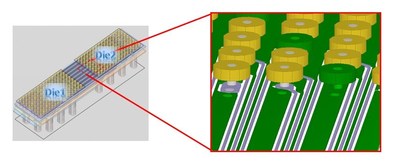
Ansys HFSS 3D Layout’s workflow empowers GUC engineers to simulate faster and solve challenging geometries by incorporating several innovative tools, including ECADXplorer — a powerful new GDS editing platform that simplifies design manipulation to drive rapid simulation. Integrating cutting-edge meshing technologies coupled with Ansys’ industry-leading 3D HFSS solver, the workflow reduces simulation set-up time from hours to minutes. This helps GUC Advanced-IC designers efficiently extract S-parameter models of their devices with the highest fidelity. Additionally, it spurs the development of game-changing technologies such as GLink, which provides 6-10 times less power consumption than an alternative solution and occupies two times less silicon area.

“Advanced-IC package designs are highly sophisticated due to the ever-growing demand for increased functionality and lower power consumption within a smaller footprint. The strong momentum of GLink adoption by our AI, HPC and networking customers supports our commitment to building a wide IP portfolio and deepening GUC’s advanced packaging design expertise,” said Igor Elkanovich, chief technology officer at GUC. “HFSS 3D Layout helps our engineering team decrease Advanced-IC design complexity, integrate heterogeneous chips and improve multi-chip performance to ensure customers receive new AI, HPC and Data Center Networking products much sooner.”

“Through this enhanced workflow, Ansys increases the productivity for GUC Advanced-IC designers by significantly simplifying the design process,” said Shane Emswiler, senior vice president at Ansys. “Leveraging HFSS 3D Layout, GUC engineers are swiftly creating fully parametric models, performing design studies of electronic packaging and exploring more design options than ever to evaluate tradeoffs prior to production — delivering considerable reductions in development time and expense.”

About GUC

Global Unichip Corporation (GUC) is the advanced ASIC leader, who provides the semiconductor industry with leading IC implementation and SoC manufacturing services, using advanced process and packaging technology. Based in Hsin-chu Taiwan, GUC has developed a global reputation with a presence in China, Europe, Japan, Korea and North America. GUC is publicly traded on the Taiwan Stock Exchange under the symbol 3443. For more information, visit https://www.guc-asic.com.

About Ansys

If you’ve ever seen a rocket launch, flown on an airplane, driven a car, used a computer, touched a mobile device, crossed a bridge or put on wearable technology, chances are you’ve used a product where Ansys software played a critical role in its creation. Ansys is the global leader in engineering simulation. Through our strategy of Pervasive Engineering Simulation, we help the world’s most innovative companies deliver radically better products to their customers. By offering the best and broadest portfolio of engineering simulation software, we help them solve the most complex design challenges and create products limited only by imagination. Founded in 1970, Ansys is headquartered south of Pittsburgh, Pennsylvania, U.S.A. Visit www.ansys.com for more information.

Aras Simulation Management Enables System Exploration, Verification Across the Lifecycle

0
ANDOVER, MA, USA, Mar 26, 2021 – Aras, the only resilient platform provider for digital industrial applications, announced the latest release of Aras Simulation Management, the most scalable, flexible and open solution for enabling simulation across the lifecycle. The application delivers capabilities for managing process and data for the full range of simulation types from a wide variety of vendors. Analysis data and results become part of the digital thread connecting simulation to the business with closed-loop traceability to requirements.


ExKrP_gWYAAkcVW


Today, ever-increasing product complexity is driving the need for more simulations and more types of simulation – 3D, systems, math models, electronics, embedded software – in more areas with tools from many different vendors. In most enterprises, simulation is managed separately in silos that are often optimized for tools from a single vendor and only accessible to small groups of simulation specialists. The disconnected nature of simulation limits the use and value of analysis, leads to error-prone inefficiencies, and prevents digital thread traceability.

“It is critical for organizations to have a simulation strategy in place that ensures input data and simulation findings are fully connected to the right product configuration, completing the digital thread,” said Peter Bilello, President & CEO of CIMdata. “With the release of the Aras Simulation Management application, Aras now provides users with the ability to connect simulation to the digital thread of product data, enabling simulation to become an integrated, traceable, and repeatable step in the development, manufacture, and support of complex products.”

“Aras Simulation Management is not a stand-alone modeling capability,” said John Sperling, SVP Product Management at Aras. “It is part of the overall suite of applications on the Aras platform, and along with Aras Requirements Engineering, Aras Systems Architecture, and Aras Product Engineering is a key enabler of Systems Thinking and Digital Transformation strategies for our customers.”

For the first time, organizations can manage all different types of simulation connected with engineering, manufacturing and maintenance processes across the enterprise. With a resilient platform as its foundation, Aras Simulation Management delivers best-in-class scalability to handle geometrically increasing simulation data sets along with far greater flexibility for process transformation.

Aras Simulation Management enables simulation experts to focus on modeling, analysis and methodologies while eliminating redundant administrative tasks. Simulation inputs such as accurate product configuration variants, mixed-fidelity models and parameter values are automatically part of simulation studies, while analysis results are exposed in mainstream processes as part of the digital thread. Large scale simulation management is essential when there are hundreds or thousands of cases to be evaluated over a large number of product variants. Teams throughout the lifecycle can then easily compare findings from one design variation to the next and run repeatable simulation processes in order to make timely decisions using results connected to the right version of the product.

Using Aras Simulation Management enables global companies to achieve better simulation coverage to meet the needs of today’s engineering requirements, mitigate the impact of multi-discipline product complexity, and quickly evolve business strategies that involve simulation at scale now and into the future.

About Aras

Aras provides a resilient platform for digital industrial applications. Its open, low code technology enables the rapid delivery of flexible, upgradeable solutions for the engineering, manufacturing, and maintenance of complex products. Aras’ platform and product lifecycle management applications connect users in all disciplines and functions to critical product data and processes across the lifecycle and throughout the extended supply chain. Airbus, Audi, DENSO, GE, GM, Honda, Kawasaki, Microsoft, Mitsubishi, and Nissan are using the platform to manage complex change and traceability. Visit www.aras.com to learn more and follow us on Twitter and LinkedIn.

Maplesoft Releases Maple 2021 for Mathematics

0

WATERLOO, ON, Canada, Mar 26, 2021 – Maplesoft announced a major new release of its flagship product, Maple, the powerful and easy to use mathematical software. Maple is used by mathematicians, educators, students, engineers, and scientists to analyze, explore, visualize, and solve math problems. The new release, Maple 2021, offers a range of enhancements across the entire product, from small productivity changes to new areas of mathematics.


Maple2021-PR


Maple 2021 includes a large number of enhancements particularly designed to support math education. Some of these features include:

  1. Three interactive Clickable Calculus Study Guides that help students learn Calculus, Precalculus, and Multivariate Calculus
  2. A new package providing  tools for teaching and learning differential equations, including helpful visualizations and step-by-step solvers
  3. Content development tools enabling instructors to create educational content inside Maple, and then deploy it to their students through Maple Learn, an online environment designed specifically for teaching and learning math from high school to second year university

In addition, Maple 2021 delivers a more powerful math engine, a streamlined workflow for interactive problem solving, and enhanced content and application development tools. Highlights include:

  1. Greater problem solving abilities, with new algorithms and solving techniques for differential equations, integration, abstract algebra, graph theory, physics, quantum chemistry, and other areas of math, science, and engineering
  2. Enhanced performance of frequently used fundamental routines, resulting in faster computations
  3. Streamlined workflow when creating and working with documents that involve both calculations and text

“Our customers rely on Maple for so many different reasons, from interactive problem solving, to visualizing advanced mathematical concepts, creating curriculum materials, developing new algorithms to tackle tough research problems, and more,” says Karishma Punwani, Director of Academic Product Management at Maplesoft. “With Maple 2021, customers get access to a host of improvements across all aspects of the product to enhance their diverse uses of Maple.”

Maple is part of the Maple Math Suite, a collection of products from Maplesoft that provides access to the world’s most powerful mathematics engine through a variety of specialized, easy-to-use interfaces that make it extremely easy to explore, visualize, and solve mathematical problems in different situations. Other products include the recently introduced Maple Learn, the online environment for teaching, learning, and doing math from high school to the second year of university, and the free Maple Calculator app, which allows students to graph and solve problems on their phone.

For more information about new features in Maple 2021, visit http://www.maplesoft.com/products/maple/new_features

About Maplesoft

Maplesoft has provided mathematics-based software solutions to educators and researchers in science, technology, engineering, and mathematics (STEM) fields for over 30 years.  Maplesoft’s flagship product, Maple, combines the world’s most powerful mathematics engine with an interface that makes it extremely easy to analyze, explore, visualize, and solve mathematical problems. Maplesoft products and services are used by more than 8000 educational institutions, research labs, and companies, in over 90 countries. In 2018, Maplesoft spun off its online education product line into a separate corporation, DigitalEd.

Maplesoft is a subsidiary of Cybernet Systems Group.

MathWorks Releases MATLAB, Simulink R2021a

0

NATICK, MA, USA, Mar 26, 2021 – MathWorks introduced Release 2021a of the MATLAB and Simulink product families. Release 2021a (R2021a) offers hundreds of new and updated features and functions in MATLAB and Simulink, along with three new products and 12 major updates. New capabilities in MATLAB include dynamic controls in live scripts as well as a new task for adding plots to live scripts without writing any code. Simulink updates enable users to import C code as reusable Simulink libraries and to speed up simulations. R2021a also introduces new products in the areas of satellite communications, radar, and DDS applications. More details are available in the R2021a Release Highlights (2:10).

New products introduced in R2021a include:

Satellite Communications Toolbox

As the number of low earth orbit (LEO) satellites increases to serve the high-speed mobility market, Satellite Communications Toolbox is designed to help equipment makers and operators model, simulate, analyze and verify satellite communications systems and links. The new toolbox provides a flexible environment in MATLAB for developing standards-based satellite communications signals, and configurability and extensibility for multi-domain simulation and verification of satellite communication, navigation and remote sensing systems.

Radar Toolbox

Radar Toolbox includes algorithms and tools for the design, simulation, analysis and testing of multifunction radar systems. As a result, radar system designers and integrators can assess system design trade-offs before radars are built or procured. Starting with R2021a, radar specific capabilities and examples previously found in Phased Array System Toolbox will be found in the new Radar Toolbox.

DDS Blockset

The new Simulink add-on, DDS Blockset, gives system and algorithm engineers developing software for DDS-based embedded systems a full Model-Based Design experience featuring modeling, simulation, verification and code generation. As a result, engineers find errors much sooner while performing faster design and coding iterations.

In addition to the new products, R2021a includes major updates to Polyspace, Stateflow and other products in the areas of Autonomous Systems, Computational Finance, Control Systems, Image Processing & Computer Vision, RF and Mixed-Signal, and Test & Measurement. R2021a is available immediately worldwide. For information on all new products, enhancements, and bug fixes to the MATLAB and Simulink product families, visit the R2021a Highlights page.

About MathWorks

MathWorks is the leading developer of mathematical computing software. MATLAB, the language of engineers and scientists, is a programming environment for algorithm development, data analysis, visualization, and numeric computation. Simulink is a block diagram environment for simulation and Model-Based Design of multidomain and embedded engineering systems. Engineers and scientists worldwide rely on these product families to accelerate the pace of discovery, innovation, and development in automotive, aerospace, electronics, financial services, biotech-pharmaceutical, and other industries. MATLAB and Simulink are also fundamental teaching and research tools in the world’s universities and learning institutions. Founded in 1984, MathWorks employs more than 5000 people in 16 countries, with headquarters in Natick, Massachusetts, USA. For additional information, visit mathworks.com.

Siemens Veloce Virtual Network App Certified for IxVerify 3.0

0

PLANO, TX, USA, Mar 25, 2021 – Siemens Digital Industries Software announced that its Veloce Network (VN) App is now certified for use with the Keysight IxVerify 3.0 software pre-silicon test solution. Siemens’ Veloce hardware-assisted verification solution has provided integration with the virtual solutions from Keysight for years, and now this support has been extended to many advanced features of Keysight IxVerify3.0. With this certification, customers can now seamlessly leverage Keysight’s world-class pre-silicon test technology within a highly advanced emulation-based verification flow.


Server in datacenter. Cloud computing data storage 3d renderingVeloce VN App integration with IxVerify enables mutual Ethernet networking customers to accelerate their lab-based validation infrastructure using a high-performance pre-silicon environment on Veloce emulation hardware.


The integration takes advantage of the high-performance co-model channel bandwidth of Veloce Strato emulation hardware together with the virtual IxVerify-VN App solution for deterministic, full-system verification. The Veloce VN App integration with IxVerify enables mutual Ethernet networking customers to accelerate their lab-based validation infrastructure using a high-performance pre-silicon environment on Veloce emulation hardware.

“Our virtual network traffic generation set-up brings the advantages of IxVerify together with the Veloce emulator via sound engineering at the integration level,” said Udupi Harisharan, engineering manager at Cisco. “The IxVerify GUI helps clients control and monitor traffic in the Veloce VN App, and also enables porting the same test scripts used at pre-silicon to the lab to test post-silicon.”

“Pre-silicon verification with IxVerify and the Veloce VN App has continued to evolve and create increasing value for mutual customers such as Cisco,” said Razvan Arhip, IxVerify solution manager at Keysight. “Expanding support for advanced traffic generation and measurements now provides powerful new capabilities to test chip features and complete early performance testing.”

“The networking market has driven significant innovation in the virtualization of hardware emulation,” said Jean-Marie Brunet, senior director of product management and marketing for the emulation division at Siemens Digital Industries Software. “The validation of Veloce for IxVerify 3.0 is based on a long-term collaboration at the technical integration level to satisfy mutual customers like Cisco.”

About Siemens Digital Industries Software

Siemens Digital Industries Software is driving transformation to enable a digital enterprise where engineering, manufacturing and electronics design meet tomorrow. The Xcelerator portfolio helps companies of all sizes create and leverage digital twins that provide organizations with new insights, opportunities and levels of automation to drive innovation. For more information on Siemens Digital Industries Software products and services, visit www.sw.siemens.com or follow us on LinkedInTwitterFacebook and Instagram. Siemens Digital Industries Software – Where today meets tomorrow.

Aras Systems Architecture Connects MBSE to Full Lifecycle Digital Thread

0
ANDOVER, MA, USA, Mar 25, 2021 – Aras, the only resilient platform provider for digital industrial applications, announced the release of Systems Architecture, a new application that coordinates systems model definition with tool independent data from all engineering disciplines including mechanical, software, electronics, simulation, and more. For the first time, a uniform view of all related systems models and their design intent is directly connected with the other aspects of the engineering process to form the digital thread improving collaboration and reducing risk.


ExPzSVOXIAQ_a68


Organizations can now provide a uniform view of the overall systems model and its design intent across the entire enterprise. The Aras approach enables holistic analysis of systems-of-systems designs to optimize performance and identify undesirable emergent properties between sub-system boundaries. By having the systems architecture become a central connective tissue in the product’s Digital Thread, design and business risks are more easily mitigated.

Systems engineers can select their modeling methodology and MBSE tool of choice. Aras Systems Architecture harmonizes incompatible system modeling methodologies, languages and tools – breaking down data silos – to enable creative freedom in Model-Based Systems Engineering (MBSE). By doing so, Aras accommodates emerging trends in systems modeling such as SysML 2.0 along with future breakthroughs in MBSE methodologies and tools.

Aras delivers the most scalable, flexible and open solution for managing systems models. Aras Systems Architecture captures the descriptive parts of the systems model – often referred to as the Functional and Logical breakdown of a product – and connects them with other aspects of the design such as Requirements definition and Physical representations of the product, together called the RFLP (Requirements/Functional/Logical/Physical).

With the ever-increasing complexity of today’s smart connected products, organizations can now address interdisciplinary collaboration across the supply chain. Enterprises are now able to shift their focus beyond just mechanically-oriented physical structures and conventional Bill of Materials representations. Aras provides a system architecture-centric view of products with traceability to all related details, regardless of the tool used to create the model. Globally distributed teams are able to track functional and logical breakdowns of a product, as well as relationships to requirements, physical parts and other product data through a customizable systems model schema that is semantically rich.

“Aras Systems Architecture together with Aras Requirements Engineering, Aras Simulation Management, and Aras Product Engineering provide a key enabler for systems thinking and digital transformation strategies at our customers. These interconnected applications on the Aras platform enable Model-Based Systems Engineering to truly become the driver of next generation design.” said John Sperling, SVP Product Management at Aras.

About Aras

Aras provides a resilient platform for digital industrial applications. Its open, low code technology enables the rapid delivery of flexible, upgradeable solutions for the engineering, manufacturing, and maintenance of complex products. Aras’ platform and product lifecycle management applications connect users in all disciplines and functions to critical product data and processes across the lifecycle and throughout the extended supply chain. Airbus, Audi, DENSO, GE, GM, Honda, Kawasaki, Microsoft, Mitsubishi, and Nissan are using the platform to manage complex change and traceability. Visit www.aras.com to learn more and follow us on Twitter and LinkedIn.