Home Blog Page 775

MathWorks Releases MATLAB, Simulink R2020a, Expands AI Capabilities for Deep Learning

0

NATICK, MA, USA, May 8, 2020 – MathWorks introduced Release 2020a with expanded AI capabilities for deep learning. Engineers can now train neural networks in the updated Deep Network Designer app, manage multiple deep learning experiments in a new Experiment Manager app, and choose from more network options to generate deep learning code. R2020a introduces new capabilities specifically for automotive and wireless engineers in addition to hundreds of new and updated features for all users of MATLAB and Simulink. More details are available in the Release 2020a video.

AI and Deep Learning

“MathWorks provides a comprehensive platform for building AI-driven systems,” said David Rich, MATLAB marketing director. “We’ve taken three decades of product, consulting and support experiences and applied it to an AI workflow that empowers engineers and scientists to clean data, build models and deploy them in production IT or embedded systems.”

The new release introduces an enhanced Deep Learning Toolbox that helps users:

  1. Manage multiple deep learning experiments, keep track of training parameters, and analyze and compare results and code with the new Experiment Manager app.
  2. Interactively train a network for image classification, generate MATLAB code for training, and access pretrained models with Deep Network Designer app.

Additionally, GPU Coder now offers a more expansive set of networks to implement AI systems on cloud and edge devices, including Darknet-19, Darknet-53, Inception-ResNet-v2, NASNet-Large, and NASNet-Mobile.

New Products, Major Updates, and Enhanced Product Features

R2020a includes three new products:

  1. Motor Control Blockset contains a library of motor control algorithms optimized for generating compact code as well as out-of-the-box support for multiple motor control hardware kits.
  2. Simulink Compiler lets engineers generate standalone applications, web apps, and software components from Simulink models, enabling simulations to run without installing Simulink.
  3. MATLAB Web App Server offers controlled access from a browser to MATLAB web apps deployed across a user’s organization.

The new release also includes major updates:

  1. Automotive engineers can more easily create driving scenarios using imported road data from high-definition geographic maps and optimize shift schedules for performance, fuel economy, and emissions analysis.
  2. For wireless engineers, MATLAB support for 5G and WiFi-6 technologies has expanded with additional support for waveform generation and cell detection.
  3. Users can generate C++ classes from MATLAB classes, and the new release introduces message-based communication for service functions and reusable subsystems.

R2020a includes hundreds of other enhancements in the MATLAB and Simulink product families including:

  1. MATLAB now provides improved support for non-ASCII character sets with default UTF-8 encoding, new graphics customization capabilities and new chart types for visualizing data, and Live Editor Tasks for interactively retiming or synchronizing timetables and stacking or unstacking table variables.
  2. Simulink users can now write C code directly into their models to integrate external algorithms, use a new C Function block to easily add pre- or postprocessing of preconfigured C functions, and specify different code for simulation and code generation.

Availability

R2020a is available immediately worldwide. For information on all new products, enhancements, and bug fixes to the MATLAB and Simulink product families, visit the R2020a Highlights page.

About MathWorks

MathWorks is the leading developer of mathematical computing software. MATLAB, the language of engineers and scientists, is a programming environment for algorithm development, data analysis, visualization, and numeric computation. Simulink is a block diagram environment for simulation and Model-Based Design of multidomain and embedded engineering systems. Engineers and scientists worldwide rely on these product families to accelerate the pace of discovery, innovation, and development in automotive, aerospace, electronics, financial services, biotech-pharmaceutical, and other industries. MATLAB and Simulink are also fundamental teaching and research tools in the world’s universities and learning institutions. Founded in 1984, MathWorks employs more than 5000 people in 16 countries, with headquarters in Natick, Massachusetts, USA. For additional information, visit mathworks.com.

Invitation
Siemens sd17

Altair Acquires WRAP Software, Strengthen its Wireless Communications Portfolio

0

TROY, MI, USA, May 8, 2020 – Altair, (Nasdaq: ALTR) a global technology company providing solutions in product development, high-performance computing (HPC), and data analytics, today announced the acquisition of the WRAP software business from Swedish company WRAP International AB. WRAP is a world-leading software technology for spectrum management and radio network planning for civil and defense organizations.

With 30 years of development, originally in Saab, the WRAP software covers a wide range of applications with focus on controlling radio spectrum assets for maximum utilization, including radio planning, interference, and coverage calculations, complementing Altair’s existing FekonewFASANT, and WinProp software for wireless propagation modeling and network planning. The impressive users of WRAP include among many others major defense organizations, telecom authorities, broadcast operators, and public safety organizations.

“WRAP software will be a strategic complement to Altair’s portfolio as we fortify our solutions for areas like wireless communications including 5G, connectivity, and IoT,” said James Scapa, Altair’s chief executive officer and founder. “We continue to focus on providing the world’s best software portfolio to help our customers meet their goals.”

As the world becomes ever-more connected, the required infrastructure is critical. This technology will bolt on to Altair’s existing portfolio in high-frequency electromagnetics.

“The WRAP team is thrilled to become part of the Altair ecosystem,” said Olov Carlsson, technical director of WRAP. “Since our inception, we have become trusted experts in spectrum management and radio network planning for civil and defense organizations, and we know that our wide-range of customers working to provide mission-critical safety communication channels will benefit from this Altair ecosystem.”

About Altair (Nasdaq: ALTR)

Altair is a global technology company that provides software and cloud solutions in the areas of product development, high performance computing (HPC) and data analytics. Altair enables organizations across broad industry segments to compete more effectively in a connected world while creating a more sustainable future. To learn more, please visit www.altair.com.

ModuleWorks Updates Ultra-Precision Machining with New Features

0

AACHEN, Germany, May 7, 2020 – To keep pace with the fast changing requirements of the optics market, ModuleWorks has added several new features to its ultra-precision machining core. These new features advance the overall strategy of combining conventional CAM machining patterns like roughing, drilling and chamfering with the needs of ultra-precision machining.

The input data for ultra-precision machining are different to those in standard CAD/CAM systems. Optical features are often defined by formulas, polynomials and point clouds. ModuleWorks accepts a mixture of these different data types as input for toolpath generation and now also accepts so-called secondary drive surfaces that provide optional control of the tool orientation motion. This new feature smooths out vibrations and orientation changes for improved multi-axis turning and milling of complex workpieces.

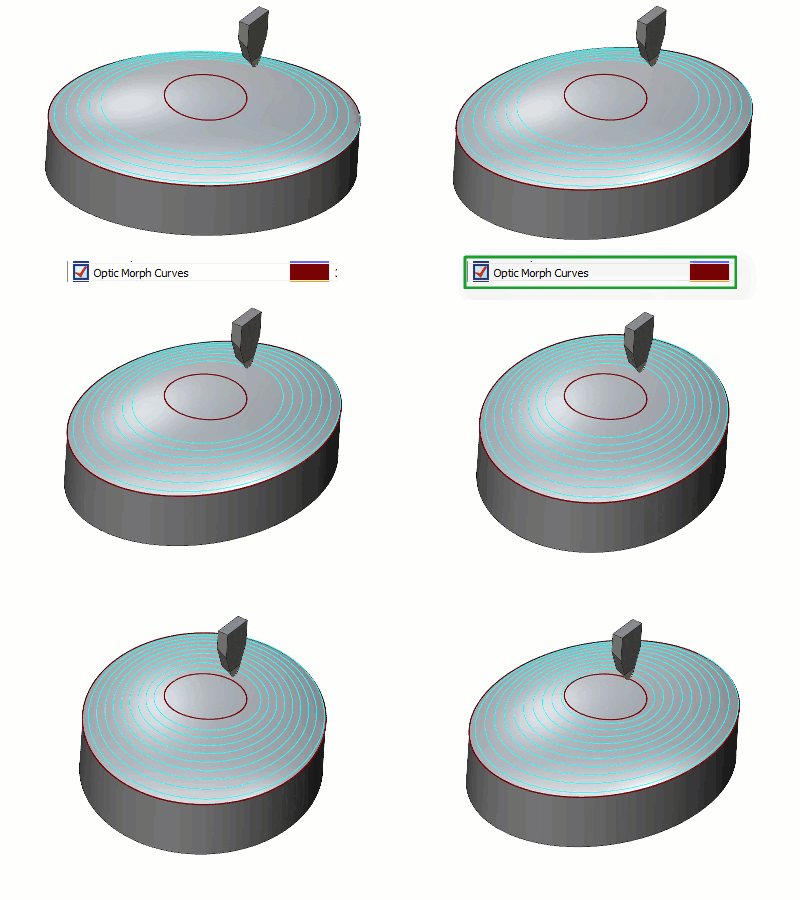
A spiral morph pattern has been developed for manufacturing non-rotational symmetrical molds for lenses. The morph pattern delivers enhanced precision by generating a continuous toolpath without abrupt changes in the tool direction.

Furthermore, new application-driven projection methods ensure optimal pattern distribution onto surfaces for manufacturing parts within required form and positional tolerances. In addition, new projection methods enable inside and outside diamond turning.

New Ultra-Precision Machining Features

Spiral Morph Pattern

This new toolpath pattern enhances the precision of non-rotational symmetrical parts. This feature is in high demand for manufacturing molds for elliptical lenses where a continuous toolpath from the outer elliptical contour to the circular center of the parts is needed. The spiral morph pattern creates a spiral toolpath which morphs the elliptic outer contour into a circular one in the center. Users benefit from a continuous toolpath without abrupt change in the tool direction, which enhances precision.

The algorithm interpolates between the outer and inner input curves, which can both be arbitrarily formed. You can also control other parameters such as the cutting direction and the distance between adjacent toolpaths (step-over).


Spiral Morph


Point Data Import

New projection methods are now available for projecting toolpath patterns onto the surface of a part.

Standard methods use Z-axis projection to project a pattern from top to bottom onto a surface, but z-axis projection does not deliver appropriate toolpaths for all types of part. ModuleWorks has developed application-driven solutions that complement the Z-axis projection with two new methods. Each method is appropriate for specific part shapes. The three projection types are:

  1. Z-Axis Projection: the standard projection method. The toolpath pattern is generated in the xy-plane and projected along the z-axis onto the surface.
  2. Point Projection: The toolpath pattern is generated on a plane which is parallel to the xy-plane at a specified height and then projected towards (or away) from a point on the z-axis at a given height. Its preferred application is, for example, for strongly curved lens surfaces which are not completely covered by Z-axis projection. Point projection can also be combined with the spiral morph pattern to manufacture asymmetric molds such as D-segments.
  3. Line Projection: A helix toolpath pattern (axis on the z-axis) is generated and radially projected towards (or away) from the z-axis. It is predominantly used for tube-shaped parts. It generates a revolving pattern which can cover either the inner or outer surface. A typical application area is turning vertical walls on an asymmetric die using inside and outside diamond turning.


Point Data Import


Point and Line Projection

New projection methods are now available for projecting toolpath patterns onto the surface of a part.

Standard methods use Z-axis projection to project a pattern from top to bottom onto a surface, but z-axis projection does not deliver appropriate toolpaths for all types of part. ModuleWorks has developed application-driven solutions that complement the Z-axis projection with two new methods. Each method is appropriate for specific part shapes. The three projection types are:

  1. Z-Axis Projection: the standard projection method. The toolpath pattern is generated in the xy-plane and projected along the z-axis onto the surface.
  2. Point Projection: The toolpath pattern is generated on a plane which is parallel to the xy-plane at a specified height and then projected towards (or away) from a point on the z-axis at a given height. Its preferred application is, for example, for strongly curved lens surfaces which are not completely covered by Z-axis projection. Point projection can also be combined with the spiral morph pattern to manufacture asymmetric molds such as D-segments.
  3. Line Projection: A helix toolpath pattern (axis on the z-axis) is generated and radially projected towards (or away) from the z-axis. It is predominantly used for tube-shaped parts. It generates a revolving pattern which can cover either the inner or outer surface. A typical application area is turning vertical walls on an asymmetric die using inside and outside diamond turning.


322

About ModuleWorks

ModuleWorks is the leading software component provider for the CAD/CAM industry. With over 170 employees and 800 man years of software development, ModuleWorks’ expertise in toolpath creation and simulation is recognized throughout the industry and its software components are already optimizing the performance and quality of over 500,000 installed seats of CAD/CAM software around the world.

From standard products to exclusive development projects, we work in close cooperation with you to bring your own vision of Industry 4.0 to life. Our comprehensive product portfolio and cutting-edge software components enable you to optimize your CAD/CAM solutions and connect to CNC/MTB systems to increase your competitiveness and help you Get There Faster. For more information, visit https://www.moduleworks.com.

Nachi- Fujikoshi Joins Romax Bearing Catalog Portfolio

0

NOTTINGHAM, UK, May 7, 2020 – Romax Technology, the leading provider of Computer Aided Engineering (CAE) software and services for electro-mechanical drivetrain design and simulation, today announced that it has collaborated with Nachi-Fujikoshi Corp to expand the bearing catalog portfolio available within its Romax Nexus software platform.


B1032E-5


Through this partnership, drivetrain engineers across multiple industries can pick and choose Nachi’s catalog bearings to model drivetrains quickly in their concept and detailed design stages. This is particularly beneficial in specific markets such as off-highway applications, where the low production volume means design engineers are constantly pressured to use catalog bearings rather than special bearings to reduce costs. In automotive applications, production volume often justifies special bearing cost. However, design engineers are pressured to reduce the amount of part-numbers, in order to minimize costs of internal administration, by choosing catalog bearings rather than creating new special bearings.

“We are excited to partner with Nachi to expand our bearing catalog offering” said Andy Poon, CEO of Romax. “Our global customers have already saved millions of dollars by switching from special bearings to catalog bearings, and we have plans to continue to expand our bearing catalog partnership program in the future.”

“We believe that the best way to reach and help more global customers is through the Romax bearing catalog partnership program, and we are already getting some positive feedback from our customers” said Mr. Kawagishi, Chief Engineer of Nachi.

About Nachi-Fujikoshi 

Nachi-Fujikoshi is a global corporation known for its bearings, industrial robots, cutting tools, machine tools, hydraulic equipment and special steels, etc. Nachi-Fujikoshi was founded in 1928 and began manufacturing bearings in 1938. Nachi-Fujikoshi contributes to the expansion in the world of manufacturing by capitalizing on their abilities.

As a comprehensive machinery manufacturer, Nachi-Fujikoshi has the multifaceted operations and technologies to provide various solutions to customers in fields such as automotive, industrial machinery, energy, and infrastructure. For more information, visit http://www.nachi.com.

About Romax Technology

Headquartered in Nottingham, UK, Romax Technology has approximately 240 employees globally serving more than 250 customers in the automotive, aerospace, wind power, marine, bearing and rail industries. After its acquisition by Hexagon AB, the company will operate as the part of Hexagon’s Manufacturing Intelligence division. For more information, visit https://romaxtech.com.

CCE Offers Free Cloud CAD Viewer to Assist Remote Working in COVID Crisis

0

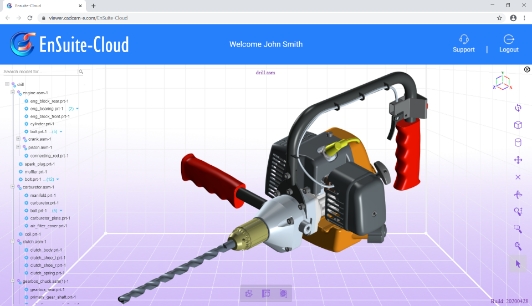
FARMINGTON HILLS, MI, USA, May 7, 2020 – CCE, a leading provider of advanced CAD interoperability technology, has launched a free cloud CAD viewer product, EnSuite-Cloud, to assist remote working during the current COVID crisis.


EnSuite-View


EnSuite-Cloud is a free CAD viewer that works directly on any browser. Users can view files from all major CAD formats, including CATIA V5, CATIA V6 (3DXML), SOLIDWORKS, NX, Creo, Autodesk Inventor, Solid Edge, JT and glTF among others.

EnSuite-Cloud uses an advanced web rendering engine to power its viewer that is significantly faster, and offers much greater performance optimizations than other rendering engines, especially when dealing with large 3D CAD models, both parts and assemblies.

“The current crisis has forced companies to get innovative with remote work methodologies, while being careful with resources under these trying times. EnSuite-Cloud truly democratizes CAD by empowering everyone with free access to high quality 3D CAD viewing technology regardless of their location. Investing in expensive CAD viewing technology, or worse still using a CAD license, is a resource drain most companies can’t afford today. EnSuite-Cloud is free and accessible directly on any browser. Users don’t have to worry about installing new software upgrades. Periodic updates will be delivered automatically without causing any disruption to the user. We are hoping it helps companies continue with their engineering innovation under these challenging times,” said Vinay Wagle, CCE’s V.P. of Sales & Marketing.

Users can not only view multi-CAD files in their browser, but also be able to measure, evaluate bounding box and create section views of the model among other things.

EnSuite-Cloud is built using CCE’s proprietary CAD interoperability technology that is currently being licensed by several top CAD Independent Software Vendors (ISVs). As a result, it is completely CAD independent. Users do not need licenses of the CAD systems to view files of those systems. It is also platform independent and can be viewed on any of the supported browsers.

For additional information, please visit the EnSuite-Cloud page on our website or click here to start viewing CAD files for free.

About CCE:

Incorporated in Michigan, CCE has more than 25 years of CAD/CAM/CAE software development experience, as well as an extensive background in related services. Since 1989, CCE’s focus in CAD technology & application development has spearheaded its mission to deliver customers value through innovative, disciplined, and communications-focused technology products and services. CCE has offices located in Farmington Hills, Michigan and Fort Lee, New Jersey. For more information on CCE’s products and services, visit www.cadcam-e.com.

Accelonix to Sell Nano Dimension’s 3D Printed Electronics Products in France

0

SOUTH FLORIDA, FL, USA, May 6, 2020 – Nano Dimension Ltd. (Nasdaq, TASE: NNDM), a leading Additively Manufactured Electronics (AME)/PE (Printed Electronics) provider, announced the partnership with Accelonix as the Company’s new agent for the French market.

Accelonix, headquartered in France, has been introducing, selling and supporting products in the French electronics market since 1984. Internationally, the Accelonix group has installed more than 2000 test systems in the maintenance/repair sector. It’s most notable success to date is in the market of in-circuit test systems. As pioneers in “flying probe” fixtureless test, the Accelonix group is recognized as leaders in educating industry and promoting this valuable test technique. The Accelonix group is responsible for over 150 installations throughout France, Benelux and Spain.

“One of our major strong points is our historical commitment to promoting and supporting innovative products. Additive Manufacturing of Electronics will be the next evolution of electronics fabrication as it makes designs beyond all existing IPC rules possible and manufacturable,” said Jonathan Hall, Managing Director of Accelonix. “We are happy to partner with Nano Dimension, the market leader in printed electronics/AME technology.”

“It is great to partner with the market leader in France. Accelonix has an excellent reputation in the electronics industry and long-term relationships with a large customer base.  We are fortunate to join forces with them,” said Valentin Storz, General Manager of Nano Dimension Europe.

About Accelonix

Accelonix is a group of companies operating across Western Europe serving the electronics industry by offering specialized sales and support. They provide a key interface between customers and suppliers offering market-leading products and services. To guarantee excellent support and to maximize the return on investment, Accelonix works closely with a portfolio of industry-leading suppliers, selected for their suitability to the European market in terms of their technology, flexibility, and scope of expertise. For more information, please visit  www.accelonix.com.

About Nano Dimension

Nano Dimension (Nasdaq, TASE: NNDM) is a provider of intelligent machines for the fabrication of Additively Manufactured Electronics (AME). High fidelity active electronic and electromechanical subassemblies are integral enablers of autonomous intelligent drones, cars, satellites, smartphones, and in vivo medical devices. They necessitate iterative development, IP safety, fast time-to-market and device performance gains, thereby mandating AME for in-house, rapid prototyping and production. Nano Dimension machines serve cross-industry needs by depositing proprietary consumable conductive and dielectric materials simultaneously, while concurrently integrating in-situ capacitors, antennas, coils, transformers and electromechanical components, to function at unprecedented performance. Nano Dimension bridges the gap between PCB and semiconductor integrated circuits. A revolution at the click of a button: From CAD to a functional high-performance AME device in hours, solely at the cost of the consumable materials. For more information, please visit www.nano-di.com.

Nemetschek Acquires US-based ADAPT Corporation for Structural Engineering

0

MUNICH, Germany and FOOTHILL RANCH, CA, USA, May 6, 2020 – Software provider Nemetschek Group (ISINDE0006452907) and its California-based subsidiary RISA, market leader for steel structural analysis and design, announced the acquisition of ADAPT Corporation, headquartered in California, USA. ADAPT is the leader for concrete structural design in the US. With this move, the Nemetschek Group becomes the largest provider for all-material building design in this market. Customers will significantly benefit from having an all-material building design solution under one roof.


321


“This acquisition is an important milestone, not only for RISA and ADAPT, but also for the building design industry”, says Viktor Várkonyi, Chief Division Officer, Planning & Design Division and member of the Executive Board of the Nemetschek Group. “Combining the market leader for steel and concrete structural design will change the market and create a strong analysis solution that will increase our market positioning in the US. Additionally, it is an important strategic cornerstone for our Planning & Design division in the Nemetschek Group.”

With the easy-to-use structural analysis software solutions from ADAPT, customers can design concrete buildings more efficiently, minimize errors and significantly improve quality and accuracy. ADAPT has been in the market for over 30 years and serves customers in 85 countries. Integrating both solutions under the roof of RISA will create one solution for the building market – regardless of material – and give the customers the flexibility to work with the solution that fits best.

“We are very happy to become part of the Nemetschek Group. For us this is an excellent match in terms of strategy and structure,” explains Dr. Florian Aalami, President and CEO of ADAPT. “There is a strong brand recognition and customer loyalty for both RISA and ADAPT. Customers will be excited to have the two market leaders together,” he adds.

“The acquisition is a great fit for both companies,” says Amber Freund, CEO of RISA. “We are thrilled to have the experienced team from ADAPT on board. Our customers will significantly benefit from this combined power, as we are now able to offer a comprehensive concrete and steel design solution including post-tensioning. The completion of this acquisition makes the Nemetschek Group the leading provider of all-material structural analysis and design solutions in the US.”

Designers use post tensioned concrete design to reinforce concrete by prestressing it. Many of today’s high-performance concrete structures, including many landmark bridges and buildings, employ some type of prestressing. With the acquisition, the Nemetschek Group not only extends its solution offering strategically but also reinforces its market presence in North America.

About RISA

RISA Tech, Inc. has been developing cutting-edge structural design and optimization software since 1987. With a well-trained team of engineers and software developers, we are working to meet the needs of our growing client base by implementing new design features and expanding the suite of software tools that we offer.Providing exceptional customer service is a priority to us and is something we continue to strive for in our day-to-day operations. We provide fast, dependable technical support to our users and want them to know that we are proactively working for them. We have a wide variety of design engineering experience within the office, which gives us a great perspective for future development goals. This is also essential in providing quality technical support, as we have experienced many of the same engineering design challenges ourselves. Our focus is squarely on our clients.

About ADAPT

ADAPT has been delivering leading structural engineering software, consulting services, and professional training programs to structural design professionals worldwide. From our headquarters in California and through our network of Associates and Authorized Distributors, ADAPT serves more than 5,000 customers in over 85 countries. Our customers have successfully relied on ADAPT software and services to more productively and accurately design hundreds of bridges and millions of square feet of buildings, resulting in fewer errors, improved quality and accuracy, and better projects overall. We provide a wide range of reliable and easy-to-use structural analysis software solutions for the design of building and bridge structures. Our commitment to excellence, passion for the design of concrete structures, and full-service partnership approach to our customers, has earned us a global and loyal customer base.

About the Nemetschek Group

The Nemetschek Group is a pioneer for digital transformation in the AEC industry. As the sole corporate group worldwide, Nemetschek covers the entire life cycle of building and infrastructure projects with its software solutions and guides its customers into the future of digitalization. With intelligent and innovative software solutions, the Nemetschek Group increases quality in the building process and improves the digital workflow of all those involved in the building process. This revolves around the use of open standards (Open BIM). The innovative solutions of the 16 brands in the four customer-oriented divisions are used by around six million users worldwide. Founded by Prof. Georg Nemetschek in 1963, the Nemetschek Group today employs more than 2,800 experts.

Publicly listed since 1999 and quoted on the MDAX and TecDAX, the company achieved a preliminary revenue amounting to EUR 556.9 million and an EBITDA of EUR 165.7 million in 2019. For more information, visit https://www.nemetschek.com.

Hexagon MI Launches NCSIMUL 2021 for CNC Simulation

0

SURREY, UK, May 6, 2020 – An array of new and enhanced functionality keeps the latest digital twin software from Hexagon at the very forefront of Industry 4.0 Smart Factory technology, by increasing CNC program quality through automatic and predictive analysis.


NCSIMUL-2021


NCSIMUL virtually builds the real-life machining environment to avoid errors, decrease set-up times and switch CNC programs between machines.

The 2021 release features a new comparison mode which detects excessive material, during a fast and hidden simulation. It shows a solid comparison between the CAD/CAM models or previous cut stock, and the NCSIMUL simulated model.

Technical Director Philippe Legoupi says this new item of functionality is the only way to detect unwanted rest stock on a large part. It shows a list of the excess material that’s left, and can also be displayed in a 3D window linked to the list. Amongst its numerous benefits: finding small, missing drill holes on large aerospace components; and finding missing holes which need to be connected on mould bodies and hydraulic parts.

Integrated to NCDoc, Dimensioning is a new function which creates control instructions for operators during the CNC process. “It defines a dimension check-list with user-defined tolerances; automatically defines the minimum measurement needed for each cut; generates a comprehensive view for the programmer and operator on the 3D simulation; and works with the NCDoc documentation template.” This saves time and money, particularly when using the Wizard to create the correct number of measurements, even when using a probe tool on the machine.

A new set of options quickly evaluate tools that can benefit from air-cutting optimization, with the ‘out of material working time’ in the sequence list. This works with the NCDoc documentation template, and customizes stock nearness values for each sequence, and the optimization is automatically stored for future strategies.

Enhancements to editing Setup reduce simulation time by merging fixtures, parts and rough stock elements from one, or multiple, CAD files read in NCSIMUL. “It creates simple geometric rough stock – either cylinder or cubes – an automatic part envelope; and all setup elements can move up or down.”

Improvements to mill-turn tooling management for ESPRIT CAM and TopSolid CAM interface: With a new ‘Configuration interface file’ associated to each digital twin, it is now possible to define the mapping of tool assembly positioning – station number, turret and orientation –between the CAM system and NCSIMUL. This means the interfaces can crate NCSIMUL projects, ready to run the simulation.

A simplified 2D display for turning parts improves the analysis of dynamic rough stock. Philippe Legoupi explains: “It quickly displays the tool and toolpath next to the cut model and reference part profiles.”

The document centre is now available online, and includes additional descriptions of the released versions, including more details under the ‘case studies,’ and ‘focus on’ tabs.

Finally, for cutting tool wear simulation as defined in the tool magazine, a button now runs the simulation for tools either ‘fresh out of the box,’ or ‘worn down.’ User-defined values apply for each cutting tool, and the system can check if a worn tool will generate alarms or collisions with unwanted rest stock material. This defines the sharpening rules, and decreases tool consumption.

Concluding, Philippe Legoupi says: “The enhanced functionality in NCSIMUL 2021 further increases shop-floor productivity and reduces manufacturing costs.”

About Hexagon’s Manufacturing Intelligence Division

Hexagon is a global leader in sensor, software and autonomous solutions. We are putting data to work to boost efficiency, productivity, and quality across industrial, manufacturing, infrastructure, safety, and mobility applications.

Our technologies are shaping urban and production ecosystems to become increasingly connected and autonomous – ensuring a scalable, sustainable future.

Hexagon’s Manufacturing Intelligence division provides solutions that utilise data from design and engineering, production and metrology to make manufacturing smarter.

Hexagon (Nasdaq Stockholm: HEXA B) has approximately 20,000 employees in 50 countries and net sales of approximately 3.8bn EUR. Learn more at hexagon.com and follow us @HexagonAB.

CIMdata to Host Free Webinar on ‘PLM Benefits, Metrics & ROI’

0

ANN ARBOR, MI, USA, May 6, 2020 – CIMdata, Inc., the leading global PLM strategic management consulting and research firm, announces an upcoming free educational webinar, “PLM Benefits, Metrics & ROI.” The webinar will take place on Thursday, 28 May 2020, at 11:00 a.m. (EDT) and will last for one hour.

This webinar will present ways to develop viable, realistic metrics and predict the cost of undertaking an initial product lifecycle management (PLM) investment or upgrade. Regardless of where they are on the digitalization journey, attendees will find this webinar to be timely and informative. It will provide useful guidance on justifying PLM (and other similar tools) that can have a significant, positive impact on an organization.

This webinar will help attendees:

  1. Understand how to define metrics for PLM and related digitalization initiatives.
  2. Understand what to do if a baseline cannot be established for the needed metrics.
  3. Understand how metrics can support PLM adoption.
  4. Understand where other companies stand and how they use PLM metrics.

According to John MacKrell, CIMdata’s Chairman, and the host for this webinar, “Organizations that CIMdata works with often ask two questions during their PLM journey—First, what is it going to cost to put in place? Second, how will it create benefits now and in the future of the organization.”

Mr. MacKrell has over 40 years of experience in the application of computer-based solutions to engineering and manufacturing, with more than 20 years of those years at CIMdata. He has held senior positions in product management, marketing, research and development, and consulting.

This webinar will be useful to people from many parts of an organization, as PLM is cross-functional and feeds ERP, manufacturing, service, and other downstream processes. Specifically, senior and middle managers, PLM team members, PLM users, IT, purchasing, and anyone impacted by how an organization justifies, promotes, and communicates PLM as a valuable solution in an organization will find the information pertinent and valuable.

During the webinar, attendees will have the opportunity to ask questions about the topics discussed.

  1. To find out more, visit: https://www.cimdata.com/en/education/educational-webinars/webinar-plm-benefits-metrics-and-roi.
  2. To register for this webinar, please visit https://register.gotowebinar.com/register/2863092400029130499.

Carlson Releases FiX1 Fixed Installation Scanner for Volumetric Scanning, Stockpile Measurement

0

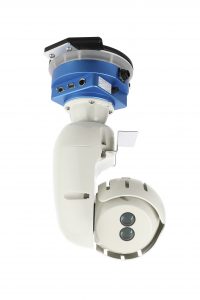
MAYSVILLE, KY, USA, May 5, 2020 – Carlson Software has released the FiX1 Fixed Installation Scanner for volumetric scanning and stockpile measurement. Designed as a permanent installation, the FiX1 is used to automate the delivery of volumetric data without the need for personnel and additional measurement tools on-site.


Carlson FiX1 – Fixed Installation Scanner


The Carlson FiX1 provides a simple, automated method for obtaining volumetric data of stockpiles in many different installation scenarios. The instrument can be mounted upside down or right-side up dependent on the stockpile placement. After installation, no knowledge of surveying, data processing, or point cloud manipulation is required by users. It can be scheduled to scan, process, and deliver a result without user intervention.

The instrument is accessed through the FiX1 Web UI. Once a volumetric scan is activated, the FiX1 Web UI will generate a point cloud, extract the region of interest, and automatically calculate the volume of material in that area.

“What I think users will really like about the FiX1 is that it can provide a complete history of scans,” says Brad Husack, Carlson support and special projects engineer. “Volumes are stored and users can download results at any time”.

Additionally, the Web UI provides a graphical representation of historical changes. Scan density and coverage can be user-defined through the setting of laser and angle resolutions in the Web UI.

The FiX1 features a rugged IP67 design for operation even in extreme environments. It can be remotely connected through either cellular data, Wi-Fi, or ethernet connection.

For more information about the Carlson FiX1, visit carlsonsw.com/fix1 or contact your local Carlson sales representative by visiting carlsonsw.com/where-to-purchase/dealers.

About Carlson Software Inc.

Carlson Software Inc. specializes in CAD design software, field data collection, laser measurement, and machine control products for the civil engineering, surveying, GIS, construction, and mining industries worldwide, providing one-source technology solutions for the entire project cycle. Carlson Software is headquartered in Maysville, Ky., U.S.A., with branch offices in Boston, MA, Almere, The Netherlands; Brisbane, Australia; Ottawa, Canada; and York, England. For more information, visit http://www.carlsonsw.com.