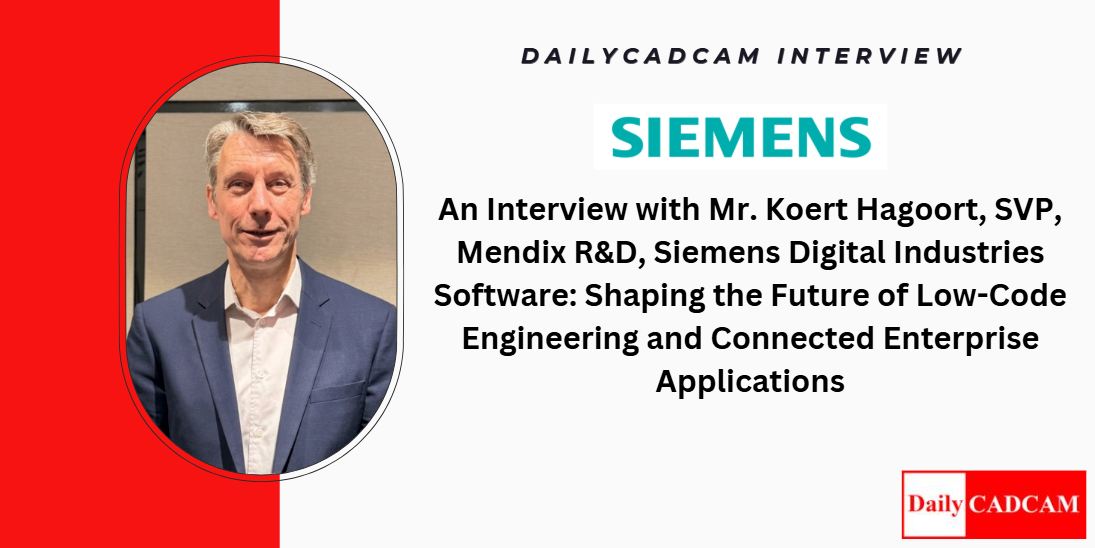
At Realize LIVE APAC 2026 in Bengaluru, DailyCADCAM Editor and Founder Mr. Sachin Nalawade spoke with Mr. Koert Hagoort, SVP, Mendix R&D at Siemens Digital Industries Software, about the evolution of low-code development, the growing role of AI, and how Mendix can help manufacturers and engineering organizations build customized applications and connect systems across the enterprise.
In this conversation, Mr. Koert explains where Mendix fits into the Siemens portfolio, why low-code remains relevant in the age of AI coding assistants, how MCP is changing system integration, and how manufacturers such as Jabil are using Mendix to address enterprise and manufacturing challenges.
Q: Mr. Koert, could you tell our readers about your professional journey and how you came to Mendix?
Koert Hagoort: I started my career at a Dutch software startup working in facility and building management, which was quite different from the areas Siemens focuses on today. I was one of the early employees and worked on building the software product.
I stayed with that company for about 20 years. It was a very good experience, and eventually the company was acquired by a French organization.
Just before that acquisition, I came into contact with Mendix. At that time, the low-code wave was gaining momentum, and I decided to join Mendix. I joined relatively early, when it was still a small company, about two years before Siemens acquired Mendix.
During those early years, we focused on building the Mendix platform and expanding internationally, particularly in the United States and APAC. After Siemens acquired Mendix, the opportunities became much broader because we could collaborate with Siemens products and organizations across the countries where Siemens operates.
Over the years, I have moved through different roles within R&D, but my focus has always remained on product development and software engineering.
Q: For readers who may not be familiar with Mendix, what exactly is it, and how does it contribute to product development?
Koert Hagoort: Mendix originally started as a low-code development platform for building applications in general. The technology itself is not limited to manufacturing or engineering.
However, when we combine Mendix with Siemens products, we describe the role as “adapt and extend.”
You can use Mendix to customize and extend systems such as PLM or MES, or to connect engineering and production systems.
A good example is our collaboration with Opcenter. Opcenter provides the core manufacturing execution system, while Mendix can be used to create the user-facing applications. For example, a person working on a production line may have a screen in front of them that was developed using Mendix, while that application connects to the MES system that actually manages the production process.
This gives customers a faster and potentially more cost-effective way to tailor applications to their specific requirements rather than modifying a standard product through extensive custom development and expensive services.
Mendix is also increasingly positioned within Siemens’ broader industrial software ecosystem. Today, Mendix is used to connect systems, workflows and users across areas such as engineering, manufacturing and the wider product lifecycle.
Q: How is this different from simply using APIs for customization?
Koert Hagoort: The back-end systems will typically have APIs, but you still need a way to present the information to the people using those systems.
That could be a shop-floor worker or an engineer working at a desktop.
Mendix can call the APIs of different systems and bring the information together into one application. We sometimes describe this as a “single pane of glass.”
Instead of users having to move between several systems, you can create an application that brings together the information they need to perform their particular job.
Q: We are seeing AI coding assistants and copilots becoming increasingly capable. Developers need less coding knowledge than before. Is AI a threat to low-code development?
Koert Hagoort: AI is definitely changing the way we work, but we believe low-code remains relevant.
You can use AI coding tools to generate code very quickly, and you can also use AI capabilities within Mendix to accelerate application development.
But there is another important aspect of low-code: communication between people.
If I give you 2,000 lines of code generated by an AI coding assistant and ask you to understand how the application works, that isn’t necessarily the easiest way to communicate the design.
With low-code, you work with visual models. The model could represent a workflow or a data model. That makes it much easier for people to understand what an application does, how it works and why it was designed in a particular way.
Another benefit is that Mendix provides components for many common development requirements. Those components are already available rather than requiring developers to solve the same problems repeatedly.
The other challenge is taking AI-generated solutions from individual productivity to enterprise scale.
An individual developer can use an AI tool and build something very quickly on a laptop. But when an application becomes part of an enterprise workflow, you need governance, collaboration, security, integration and maintainability.
That is where a platform remains important.
Mendix’s current Studio Pro strategy combines visual modeling, AI-assisted development, open architecture and enterprise governance to help organizations move AI-assisted development into production environments.
Q: Does Mendix support products from other vendors and other engineering software platforms?
Koert Hagoort: Yes.
Within the Siemens portfolio, we integrate with different products, but Mendix itself is open and standards-based.
If a system provides an API—such as a REST API or OData API—or supports other integration mechanisms, it can be integrated with Mendix.
And now we are seeing MCP, or Model Context Protocol, becoming an important new integration mechanism.
Products that expose an MCP server can potentially communicate through this standardized approach. This is particularly interesting as AI agents become more important because agents also need ways to communicate with systems and with other agents.
The fact that it is standards-based is important. It means the integration does not necessarily have to be limited to one particular vendor ecosystem.
Q: Can you share a customer example where Mendix has delivered significant value?
Koert Hagoort: One example is Jabil.
Jabil initially used Mendix to standardize production-support systems across its global manufacturing operations.
They have factories in different regions, including Mexico, Asia and the United States. They wanted standardization and governance, but at the same time, individual plants have their own specific requirements.
Mendix allows them to build solutions that can be adapted to local requirements while maintaining governance of the overall application portfolio.
They have also used Mendix to digitalize manufacturing processes that were previously paper-based.
Another area they are now addressing is legacy modernization.
They have applications built using older technologies that are no longer supported. They are using AI-assisted capabilities to analyze the legacy applications, understand their data and functionality, and accelerate the development of replacement solutions. Jabil has been able to move significantly faster than the original schedule they had planned for a traditional migration approach.
Q: What kind of skills does a company need if it wants to adopt Mendix? Does it need to hire specialized software engineers?
Koert Hagoort: You don’t necessarily need to be a software engineer to work with Mendix, although having software engineering experience certainly helps.
A model we recommend is creating a Center of Excellence.
The company can have a small group of people with strong Mendix expertise. That team can then support other people and teams across different locations.
People don’t necessarily need a traditional software engineering background. What is important is that they are comfortable working with technology and willing to learn.
You can start with relatively simple applications and gradually move toward more complex solutions as your experience increases.
This is one of the benefits of low-code and AI-assisted development: it can make application development accessible to a much broader group of people.
Someone could come from mechanical engineering, software engineering or another technical background and learn to develop applications with the appropriate training and motivation.
Mendix’s current development environment is designed to support different developer profiles, from business-oriented developers through experienced technical developers.
Q: We see many service providers having their booths at Realize LIVE APAC developing applications for customers. How does the Mendix partner ecosystem work?
Koert Hagoort: Both models exist.
Some partners build solutions using Mendix and sell those solutions to customers.
Others are more traditional service providers who extend the development capacity of a customer’s internal team.
Our preferred model is for a customer to develop some internal Mendix capability. They may have their own people who understand the platform, while partners can provide additional capacity when larger projects or programs are undertaken.
Partners can also be valuable when the problem is particularly complex.
For example, if an application needs to integrate SAP, production systems and other critical manufacturing systems, the architecture needs to be carefully designed so that it can scale and remain maintainable.
That is where experienced Mendix partners can provide significant value.
Q: Is Mendix mainly for large OEMs, or can SMEs also use it?
Koert Hagoort: Mendix has always been offered as a SaaS-based subscription solution.
If you start with a small number of users, the cost can also be relatively low. As the deployment grows to thousands of users, the cost naturally increases.
We also have specific pricing for India.
Our recommendation is to “start, structure and scale.”
Start small. Select one, two or three relatively small problems and solve them.
Then measure the business outcome. It could be cost reduction, quality improvement or another tangible business benefit.
Once you have demonstrated success, you can take the next step.
This reduces the initial risk and investment. Once the organization gains confidence that it can achieve measurable results, it can expand the use of the technology.
Q: What Mendix training and certification programs does Siemens provide for people who want to develop these skills?
Koert Hagoort: We have Mendix learning paths and certification programs.
There are multiple certification levels, beginning with Mendix Rapid Developer, which provides an introduction to the platform.
The subsequent levels focus increasingly on practical application development and best practices, progressing from intermediate to advanced and expert capabilities.
The goal is not simply to teach someone how to use the technology, but to help developers learn how to build applications properly and gain practical experience.
Q: Software and technology are changing very quickly, particularly with cloud and AI. How does Mendix keep applications current?
Koert Hagoort: We have the Mendix development environment, Studio Pro, and the Mendix Runtime, which runs the applications.
We have increased our release cadence so that while major versions are released periodically, we also provide frequent updates.
AI is now also helping with application upgrades.
Our AI assistant, Maia, is integrated into the Mendix development environment. Maia provides assistance across application development, including guidance, generation and automation.
We have also introduced an Update Assistant to help developers with application upgrades.
The idea is that a developer shouldn’t get stuck on an older version because upgrading is too complicated or expensive. AI can automate parts of the upgrade process, create a plan and help developers work through the required changes.
This is important because technology continues to evolve, and applications need to evolve with it.
Q: When is the right time for a company already using CAD, PLM and other enterprise systems to consider Mendix?
Koert Hagoort: I would start with the fundamentals.
You need your core systems in place—your design environment, PLM and some form of ERP or business system.
Once those fundamental systems are established, Mendix can be used for the areas that those systems don’t cover or where your organization needs something different.
Instead of developing extensive custom code, you can use Mendix to build the required applications and connect the systems.
The advantage is that you’re not simply generating code and then creating another maintenance burden. The application remains within a platform that supports integration, maintenance and evolution.
For engineering and manufacturing organizations, this is particularly relevant when they need to connect processes across design, production and business systems.
Q: How is Mendix deployed? Does it require specific hardware or can it run in the cloud?
Koert Hagoort: Mendix Studio Pro is the desktop development environment used by the individual developer.
The applications themselves can be deployed in different environments.
They can run on virtual machines, on-premises environments or cloud infrastructure. Organizations can also use private cloud environments such as Azure, Google Cloud or AWS.
Mendix also offers its own cloud environment, where the application environment is managed by us.
This gives customers flexibility depending on their IT, security, cloud and deployment requirements.
Mendix’s current documentation also describes deployment flexibility across public cloud, third-party cloud and self-hosted environments.
Q: Can Mendix be used beyond mechanical and electronics industries—for example, infrastructure and construction?
Koert Hagoort: Yes.
Mendix is not specific to one industry.
The platform itself is designed for application development, while the applications built on it can address specific industry requirements.
So it can be used in infrastructure, construction and other industries as well.
Q: What is your message to DailyCADCAM readers working in CAD, CAM, engineering and manufacturing?
Koert Hagoort: My first recommendation is to start experimenting with these technologies yourself.
There are many AI and development tools available, including tools that can be tried at little or no cost.
It is important to understand how these technologies work and what they can actually do.
Technology is developing extremely quickly. Some people say they will wait until everything is mature before they start learning about it. I don’t think that is the best strategy.
Every new innovation builds on what came before it.
So get involved, understand the technology and experiment with it. Once you understand what these tools can do individually, you will also be better positioned to identify where they can create value within your company, department or engineering team.
You can then become one of the people who helps your organization decide where these technologies can deliver better outcomes.
Closing Note
The conversation with Mr. Koert Hagoort highlights how the role of software development is evolving alongside AI, cloud computing and connected engineering systems.
For CAD/CAM/CAE and manufacturing organizations, the key takeaway is that low-code is not necessarily being replaced by AI—it is evolving with it. AI can accelerate development, while a governed low-code platform can provide the visual models, reusable components, integration capabilities and enterprise framework needed to turn individual productivity gains into scalable business applications.
For manufacturers already investing in CAD, PLM, MES and ERP, Mendix represents an approach to addressing the gaps between core enterprise systems and the specialized workflows that make each organization unique. Its relevance is also expanding as AI agents and standards such as MCP create new possibilities for connecting applications and systems.
For engineering professionals, Koert’s advice is particularly relevant: start experimenting now rather than waiting for the technology to mature completely. Understanding AI and low-code capabilities today can help engineers, developers and technology leaders identify opportunities to improve workflows and contribute to the next generation of connected engineering and manufacturing environments.
DailyCADCAM thanks Mr. Koert Hagoort for sharing his insights and perspectives with our readers.