Toolhive: Connecting CAM Programming and the Shop Floor Through Digital Tool Data Management.
As manufacturers look to improve productivity, reduce setup times, and make better use of their CNC machining resources, effective tooling data management is becoming increasingly important. Many machine shops still rely on spreadsheets, handwritten notes, and disconnected systems to manage cutting tools, assemblies, and production information.
Toolhive, a cloud-based tool data management solution from Sandvik Machining Solutions, aims to address these challenges by connecting tool libraries, CAM programming, and shop-floor operations in one digital environment.
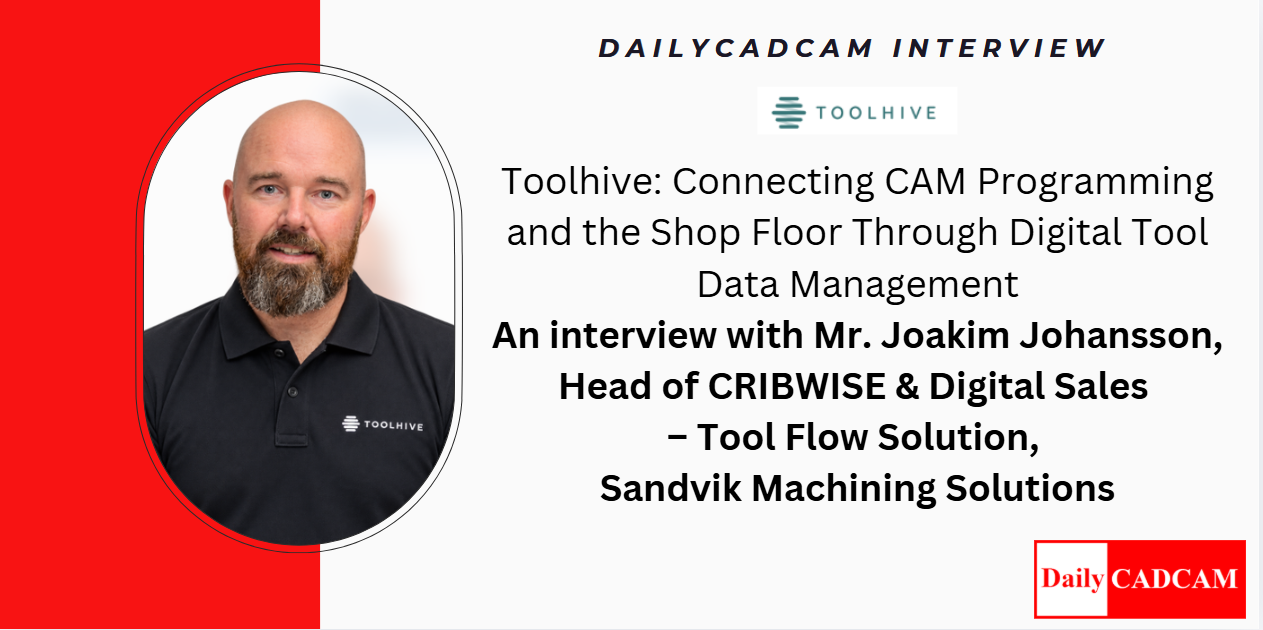
In this interview with DailyCADCAM Editor Sachin Nalawade, Mr. Joakim Johansson discusses his journey with Sandvik, the challenges facing manufacturing companies in India and Europe, and how Toolhive can help businesses improve tooling workflows. He also shares insights into CAM integration, artificial intelligence, the relationship between Toolhive and CRIBWISE, and Sandvik’s plans for the Indian market.
DailyCADCAM: Could you tell us about your professional journey and how you became involved in digital tool management?
Joakim Johansson: I started my career with Seco Tools in 2005, working with shop-floor logistics and a solution called Seco Point. My initial responsibilities included configuring and building vending machines and tool cabinets according to customer requirements.
Over the next six to seven years, I progressed into a global role managing tool-flow logistics for Seco. During this period, we recognized an opportunity within Sandvik to bring together the experience and ideas developed across its cutting-tool businesses.
Sandvik owns several major cutting-tool brands, including Sandvik Coromant, Seco, Walter, and Dormer Pramet. We began exploring how tool management processes could be combined and made more efficient across the organization.
That initiative eventually led to CRIBWISE. We developed the solution from scratch and subsequently established the organization around it. I was asked to lead the business and build the CRIBWISE organization.
Today, CRIBWISE has approximately 2,000 active licences across 1,400 customers.
More recently, I took responsibility for digital sales within Tool Flow Solution, covering both Toolhive and CRIBWISE. My journey has therefore evolved from shop-floor logistics and tool management into digital solutions and sales over more than two decades with Sandvik.
DailyCADCAM: What manufacturing trends are you seeing in Europe compared with India?
Joakim Johansson: I see broadly similar trends in both markets, although companies are at different stages of their digital transformation.
For me, digitalization does not necessarily mean implementing a large, sophisticated system or pursuing every concept associated with Industry 4.0. It is about finding practical ways to improve how a machine shop operates.
Many workshops still depend on pen and paper, Excel spreadsheets, and handwritten notes. The first step is to move these processes into a digital environment.
Large international corporations sometimes aim to digitalize everything simultaneously. However, small and medium-sized workshops often benefit more from taking manageable steps that address their immediate operational challenges.
A company does not need to transform its entire production environment overnight. It can begin by organizing its tooling data, making information accessible to the right people, and connecting existing processes.
I believe manufacturers in India and across Asia are increasingly ready to take these steps. The opportunity is to help them adopt practical digital solutions that deliver value without introducing unnecessary complexity.
DailyCADCAM: For manufacturers discovering Toolhive for the first time, what value does it offer, particularly to small and medium-sized machine shops?
Joakim Johansson: The first question manufacturers should ask is what they need from a tool management system.
In a smaller workshop, there may not be a dedicated person responsible for managing tool inventory and tooling information. Therefore, the software must be simple enough for everyone to use without extensive training.
Toolhive is a cloud-based tool data management platform designed to make tooling information accessible where the work happens. Users can access the information they need through a connected device, helping machinists and production teams find the right tools more quickly.
Another important aspect is connecting the office with the shop floor.
CAM programmers need accurate information about the tools available to the workshop. They should be able to build tooling assemblies based on actual components and transfer those assemblies into supported CAM systems without repeatedly entering the same information.
This helps reduce data duplication and makes it easier to prepare jobs before they reach the machine.
Toolhive also supports work-order management, helping manufacturers organize what needs to be produced, how it should be produced, where it should be produced, and where production capacity is available.
Ultimately, the value of a tool management system depends on how effectively people use it. The solution must be intuitive, accessible, and supported by a team that understands the urgency of manufacturing operations.
DailyCADCAM: How does Toolhive integrate with CAM software? Is it a standalone solution or a plug-in?
Joakim Johansson: Toolhive is a standalone software-as-a-service solution. It manages tooling information independently while connecting with supported CAM systems through integrations and plug-ins.
For CAM programmers, one of the most useful capabilities is the ability to create digital tool assemblies and transfer them into their CAM environment.
Toolhive currently supports integrations with Mastercam, GibbsCAM, Cimatron, and ESPRIT EDGE. We have also been working on integrations with additional platforms, including SolidCAM, hyperMILL, and Autodesk Fusion 360.
The availability and commercial terms of individual plug-ins can vary depending on the CAM provider.
The objective is to make tooling information available throughout the workflow, from the creation and management of a digital tool assembly to its use in CAM programming and production.
Instead of treating a tool as simply a geometric shape for simulation, manufacturers can manage the complete assembly and its associated data.
DailyCADCAM: Toolhive offers access to a library of more than 500,000 tooling items. How is this data maintained and verified?
Joakim Johansson: We work with tool suppliers whose products are included in our web catalogue. At the time of this interview, the catalogue included 16 suppliers and more than 500,000 unique items.
We have teams in Germany and Malaysia responsible for maintaining the data.
An important consideration is ensuring that the information is suitable for use in CAM software. We verify the data so that tooling items can be used in the supported CAM environments.
When users create a tool assembly, Toolhive helps identify which CAM systems the assembly is ready for. If a required parameter is missing, the system indicates that the assembly is not yet ready for the relevant CAM application.
This is important because a tooling assembly consists of more than the cutting tool itself. It can include an insert, holder, adapter, shank, and other components.
Having the correct information for the complete assembly helps CAM programmers create more reliable digital representations of the tooling used in production.
DailyCADCAM: Many manufacturers still manage tooling information through Excel spreadsheets. When should they consider dedicated tool management software?
Joakim Johansson: The biggest hurdle is often getting started.
Excel is familiar, flexible, and easy to adapt. For a small workshop with a straightforward tooling setup, it may be perfectly adequate.
However, challenges arise as the operation grows. Multiple people begin using the same information, tool data gets duplicated across different files, and teams spend time checking which version is current. Adding new tools can also require repeated manual data entry.
Eventually, maintaining the spreadsheets becomes a task in itself.
Manufacturers should consider dedicated tool management software when multiple people depend on the same tool data, information is scattered across Excel and CAM systems, or maintaining the data consumes too much time.
The objective is not to replace Excel simply because a dedicated solution exists. It is to choose a system that matches the complexity of the operation.
Once manufacturers move to a centralized digital tool library, they can manage tooling data in one place, build and reuse assemblies, and connect the information to supported CAM systems.
What I often hear from customers after they make the transition is that they wish they had started much earlier.
DailyCADCAM: What infrastructure is required to deploy Toolhive? Do manufacturers need dedicated servers or additional hardware?
Joakim Johansson: No dedicated servers or specialized hardware are required.
Toolhive is delivered as software as a service. Users need an internet connection, a supported web browser, and a connected device to access the platform.
A computer with a reasonably sized screen is generally preferable for working with detailed tooling information, although access from a phone is also possible.
Because it is cloud-based, manufacturers do not need to set up their own servers for the application.
Data security is also an important consideration. As discussed during the interview, Toolhive uses encryption for data in transit and at rest and conducts regular security audits. Customers retain ownership of their tooling data, which is not shared with third parties.
DailyCADCAM: Is artificial intelligence being introduced into Toolhive? What role could AI play in future versions?
Joakim Johansson: We have many ideas and plans for AI, although our current implementation is limited primarily to a chatbot.
Users can ask questions about how to perform tasks in Toolhive, and the chatbot provides suggestions based on our knowledge base.
Beyond that, we have not yet implemented broader AI capabilities, but it is an area we are exploring.
One potential application is feature recognition.
Imagine uploading a 3D model containing a hole or another machinable feature. An AI-powered system could potentially identify the feature and help determine how it might be manufactured using the tooling available in the workshop.
The system could then use the digital tool library to identify suitable tools already available to the manufacturer.
The decision may also depend on production volume. If a company needs to manufacture only ten components, using existing tools may be sufficient. For an order of 10,000 components, however, optimizing the machining process could deliver substantially greater benefits.
Even a saving of ten seconds per component can become significant at higher production volumes.
These are the kinds of applications where AI could help manufacturers make better use of tooling information and improve machining decisions. They represent potential future capabilities rather than features already available in Toolhive.
DailyCADCAM: What kind of training and implementation support do customers need?
Joakim Johansson: Our philosophy is to keep the software simple to use and avoid unnecessary implementation complexity.
We do not want customers to require extensive training before they can start working with Toolhive.
We also provide Toolhive Academy, where customers can access tutorials and learning resources to understand the software and its workflows.
The aim is to help manufacturers get started without lengthy onboarding or complicated implementation projects.
This is particularly important for small and medium-sized workshops, where production teams may not have dedicated IT resources or the time to undertake a major software implementation.

DailyCADCAM: How does Toolhive work with CRIBWISE and other Sandvik solutions?
Joakim Johansson: Toolhive and CRIBWISE both belong to Sandvik’s Tool Flow Solution business.
The two platforms can be connected through an API key. When the same tool is represented in both systems, users can view stock information, including whether the tool is available, running low, or out of stock.
CRIBWISE provides capabilities for tool inventory management, replenishment, reporting, and the tracking of items through check-in and check-out processes.
We are working to enhance the integration so that more information can flow between the systems and the same tooling data can be used more effectively across both platforms.
The broader objective is to reduce duplication and improve continuity between digital tool data management and physical tooling inventory.
DailyCADCAM: Can you share an example of the productivity improvements customers have achieved with Toolhive?
Joakim Johansson: During our visit to a customer in India, we observed an opportunity to generate significant savings through reduced setup times.
The customer identified savings of approximately US$14,000 per month, based on the time operators saved when preparing machines for new jobs and locating the required tools more quickly.
The time saving per setup was relatively small—around 27 seconds—but the customer performed approximately six setups per hour.
When these savings are multiplied across operating hours and the full month, the financial impact becomes substantial.
This illustrates an important point about manufacturing productivity: improvements do not always require major investments or dramatic changes to the production process. Small, repeatable time savings can generate meaningful results when applied consistently across a high-volume operation.
The customer was also scheduled to present its experience at the event, providing an opportunity to discuss the results in greater detail.
DailyCADCAM: Is Toolhive designed primarily for small and medium-sized workshops, or can large enterprises also benefit?
Joakim Johansson: Initially, we expected Toolhive to be particularly suitable for small and medium-sized workshops. However, experience has shown that larger enterprises can benefit as well.
The fundamental challenges are similar regardless of company size. Manufacturers need reliable tooling information, effective communication between programming and production, and a way to manage tool assemblies efficiently.
The difference is often the scale of the operation and the number of tool assemblies being managed.
Toolhive’s subscription-based model is designed to make the solution accessible without requiring a large upfront investment in a perpetual software licence or dedicated server infrastructure.
A larger organization may require a higher-capacity subscription because it manages more tool assemblies, but the underlying objective remains the same: make tooling information easier to maintain, share, and use.
DailyCADCAM: What are Sandvik’s plans for Toolhive in India? How will you build the sales and support network?
Joakim Johansson: India is an important growth opportunity for us, and we have already started building our presence in the market.
We have signed a number of resellers, including ViaSell, which is among our early partners in India.
Our Tool Flow Solution division also has a local team of eight people in India, covering areas such as sales, inside sales, application support, development, and related functions.
Our strategy is to grow primarily through the reseller network.
We believe Toolhive is well suited to this approach because it is scalable, comparatively straightforward to implement, and available through a subscription model that customers can adopt without a substantial initial investment.
These characteristics make it easier for resellers to introduce the solution to manufacturers and support them as they move from manual tooling management to digital workflows.
We see significant potential for growth in India as more machine shops recognize the benefits of digital tool data management.
DailyCADCAM: What message would you like to share with CAM programmers and manufacturing companies in India?
Joakim Johansson: My message is to encourage greater collaboration across the manufacturing workflow.
CAM programmers should not work in isolation. They need to share their knowledge with production teams and ensure that the information developed during programming is useful on the shop floor.
We should aim for a more integrated workflow in which programming, tooling, setup, and production teams work with consistent information.
I have seen CAM programmers create the geometry of a tool primarily to simulate machining operations and avoid collisions. However, a digital tool assembly represents much more than its shape.
It includes the insert, holder, adapter, shank, and other relevant components. All these elements need to be represented correctly to achieve a reliable and effective machining process.
My recommendation is to build a digital tool library and connect it to the CAM environment. This helps ensure that the tooling information created during programming can also support the people preparing and running the machines.
Better collaboration and reliable tooling data can help manufacturers improve efficiency and build a more connected production environment.
DailyCADCAM: Thank you for sharing your insights with our readers.
Mr. Joakim Johansson: Thank you. It has been a pleasure speaking with you.
About Toolhive
Toolhive is a cloud-based tool data management software built for small and medium-sized machine shops. It helps manufacturers centralize tooling data, manage digital tool assemblies, connect with supported CAM systems, and coordinate information between the office and the shop floor.
Learn more at www.toolhivesolutions.com.
Thank you,
Sachin Nalawade, Founder & Editor, DailyCADCAM